ASHBRIDGES BAY from MUD ROADS & PLANK SIDEWALKS Part 6

ASHBRIDGES BAY

from MUD ROADS AND PLANK SIDEWALKS: LESLIEVILLE 1880

By Sam Herbert (1876-1966)

Ashbridge's_Marsh_as_shown_in_this_1873_painting_by_Lucius_O'Brien
Ashbridge’s Marsh, Lucius O’Brien, 1873

Ashbridges Bay teemed with fish and wild life. My favourite fishing spot was from the pilings outside the large ice house that was located at Leslie Street and Eastern Avenue, where the paint works is now located. It was a splendid place for sunfish, perch, bass, and catfish.

Two or three days a week after school, enough fish could be caught for a couple of good meals. This all helped out.

Sunset on Ashbridge's Bay. - [1909?]
Sunset on Ashbridges, about 1909. Bay, City of Toronto Archives, Fonds 1244, Item 248.
Across the Bay on the north shore was Bill Lang’s Boathouse. There was quite a lot of marsh in between.

big-shuttleworth-map.jpg

It seemed to be open season all the time for fishing, and almost every home contained a shotgun, some of them, the old muzzle-loading variety with shot, powder pouch, and ramrod as necessary equipment.

1877 Henri Julien
Illustration by Henri Julien, 1877

In the Fall, ducks came down in thousands to the Bay, and were shot for the market as well as home use. Many a duck hunter making quite a tidy sum from the sale of them, as well as providing for their own table. Duck hunting was not all fun, pushing out the boat, arranging guns and decoys, rowing out to the “Blind” in perhaps a cold rain, or sleet on dark morning. Then arrange the decoys, and make oneself as comfortable as possible while waiting for daylight, and the quack quack of the incoming ducks over your decoys. Many a cold and more serious illness could be traced to the annual or semi-annual duck hunt.

Icemen
Cutting Ice, Ashbridge’s Bay with Ice House in background

In winter, skating and iceboating on the Bay were the regular pastimes. The icemen reaped their harvest at that time as well. Ice, eighteen inches to two feet thick would be cut in large squares, hauled out and taken to the icehouse where it would be packed in sawdust until the following summer. Small evergreen trees were placed where the ice had been cut, and were the danger signs, so that skaters and ice boats would keep clear.

Ice boats and ice cutting Toronto Bay 1916 NAC
Ice boats and ice cutting Toronto Bay, 1916, Library and Archives Canada

Some breath-taking speeds were attained with ice boats.

They had cushions and were quite comfortable, but fur caps were a necessity. People did not go around in their bare heads in those days even in summer.

The Bay and adjoining ponds provided most of the skating needs, and on Toronto Bay, Ashbridges Bay, and the numerous ponds adjoining the Don River “Shinny on your own side” was the game, only we did not have the machine-made sticks as used to-day for hockey, but one would go to the nearest bush and select the proper sized stick with a curve in it, bring it home and trip it up to their individual tastes.

1883
Michael Hannaford, Scarborough Heights, 1883. Ashbridges Bay on the left with the City of Toronto in the distance.

In the marsh around the Bay, muskrat trapping was a recognized industry, and muskrat lined coats were very common, especially those with the large beaver collar, and when I say beaver, I mean beaver.

Beaver family scene

In the winter, when the rushes and reeds were dry, marsh fires were very common, and often the sky was darkened with the heavy black smoke, but very rarely any real damage occurred.

Don Valley Fishing
Fishing Don River

The Don River at that time was a winding crooked stream with many ponds near it. The water was clean and clear. Then it was decided to straighten the Don. It was surveyed, and soon the huge steam pile driver got to work sending down long posts side by side deep in the ground. These posts still form the shores of the Don although time has broken many of them away. I have caught many good strings of perch, sunfish and catfish while sitting on the posts of the newly straightened Don River.

At one time a ferry boat plied the Don River from the Gerrard Street bridge to the island. Captain James Quinn was in charge of the ferry “Arlington” which sailed between Toronto Island and up the Don River to the Gerrard Street Bridge. The Arlington was a fair-sized boat that would accommodate at the most about a hundred passengers.

This 1904 rendering of KATHLEEN by Charles I. Gibbons
“Kathleen”, Steam Ferry and sister ship to “The Arlington”, 1904, by Charles I. Gibbons

It was a nice trip, but the patronage did not warrant its continuance.

The Don was a wonderful place for small boats and canoes.

Don River, looking s.e. towards Don Jail, ca. 1870, artist unknown, TPL
Don River, looking south-east towards the Don Jail, ca. 1870, artist unknown, Toronto Public Library


ANOTHER FIRST HAND STORY OF ASHBRIDGE’S BAY

PICTURESQUE ASHBRIDGE’S BAY MAKES WAY FOR INDUSTRY

Vast Changes Being Made in East End of Toronto

LOOKING BACK FIFTY YEARS

Haunt of Pike Fishermen, Pleasureseekers and Birds Passes to Man

(By J. McPherson Ross)

Globe, Tuesday, January 8, 1918

Looking n.w. to Toronto skyline in left background by John Willson 1899
Looking n.w. to Toronto skyline in left background. Painting by John Willson, 1899

Ashbridge Bay, as it appears on the map of Toronto, was a beautiful sheet of water when I first saw it in the summer of 1863, and was clean and good enough to drink, abounding in fish, and was the haunt of numerous wild fowl all summer.  In the stormy, rainy fall, it was alive with wild ducks of all kinds that came to rest on their southern flight and to feed on plentiful masses of wild rice that grew in numerous patches. The marsh covered the shallow waters of the eastern part of the bay at the commencement of the sand bar by the foot of Woodbine avenue, as this roadway is now called. When the racetrack of that name was first built the marsh growth ended where the deep water started, and began again intermittently a little west of Leslie street. It was quite a fine sheet of water, and at the time of speaking the lake had made a cut at about the size of the present entrance.
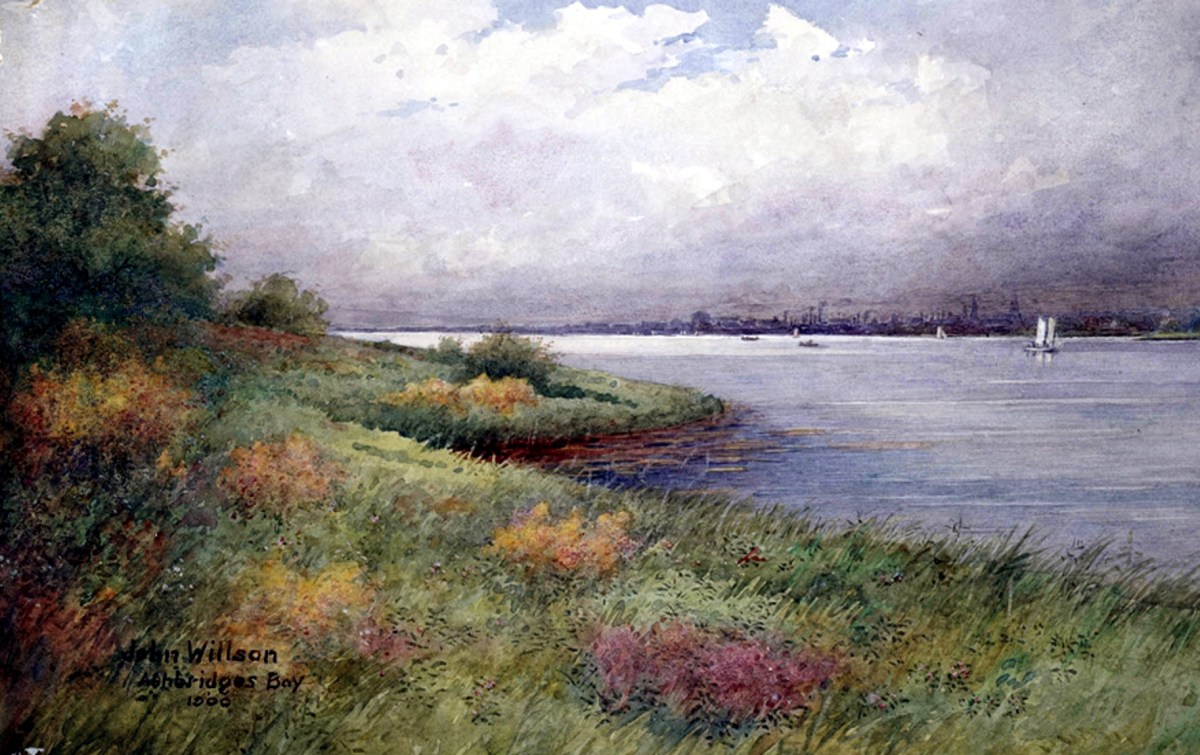
Ashbridges Bay John Willson 1900
Ashbridges Bay, John Willson, 1900

On days when the east winds were throwing up big breakers on the Island quite strong seas came sending over the bay, sufficient sometimes to wash out by the roots large poplars that grew on the street now called Leslie.  In those times several creeks added their quota of waters to the bay.  The overflow of Small’s Pond and a small creek at about Kenilworth avenue ended in the marsh, another one came through Ashbridge’s farm. One coming through Hastings’ and crossed the Kingston road and emptied into the gut, as it was then known. This gut was quite a sheet of water and formed a little harbor made use of by the fishermen who lived near it, and who ran their boats up the channel to the back of their lots which ended on the water.

Many a large sailboat might be seen those days at any time near the sidewalk on the Kingston road, later called Queen street. Quit a colony of fishermen lived near by, among whom we remember the names of Doherty, Laings, Marsh, Goodwin, Crothers and others who, if not fishermen, were duck-hunters or trappers. Or they also enjoyed the boating, fishing, and bathing privileges which were here in all their primeval abundance and purity of nature become becoming soiled and destroyed by the sewage and filth of the encroaching city.

1868.Gehle.Sketch.EofTorontobtwnDonandScarboron0020711ksm-1
1868

Creeks to the Lake.

Another creek started near the Danforth road and rand near the sandpit down through several market gardens, crossing the Kingston road at the foot of Pape’s lane, by a big willow tree that grew there on the south side, and ended its journey in the marsh that came almost to the road.  This marsh was filled with willows, alders and other growths that made quite a thicket, and was the roosting places of many wood-ducks and other denizens of this safe, marshy, woodland retreat, such as the bittern, woodcock, snipe, plover, sandpipers, and crow blackbirds or grackle. In fact, here and elsewhere wild life was teeming, and the naturalists of those days might revel in the enjoyment of their favorite study.  The marsh continued south and was unbroken till it ended at the Island, then went westward, with the exception of a patch of clear water of several acres’ extent, known as Brown’s Pond, which skirted the shore edge of such properties as Heward’s, Gorrie’s, Blong’s, Clark’s and ended with Smith’s, which also ended on the Don River.

Charles Sheard

I omitted mentioning a creek that also started near the sandpit and ran through the gardens of Cooper’s, Bests and Hunters, crossed the road by the Leslie Postoffice. Here it joined a small creek that drained the nursery, and both crossed Leslie street under a bridge that has since been filled up by intersecting sewers.

Girls on Ashbridges Bay

A Place for Recreation.

The Ashbridge Bay and the marsh in those days was a very important feature as it furnished the residents of the neighborhood a place for recreation for old and young of both sexes. There were always plenty of boats owned in the vicinity, and for hire. In the long summer evenings boating parties were the favorite amusements till late at night. Music and singing filled the air and echoed along the shores. The plaintive strains of “Nelly Gray,” or “Willie Has Gone to the War,” to the accompaniment of accordeon or concertina, were usually the favorite songs, sometimes varied with “The Charming Young Widow I Met on the Train,” or “Molly Brown,” the last a pleasing melody of the time much favored by the sentimental lads and lassies of the day. Especially on the moonlight nights, the placid waters of the bay would be well patronized, and the air made melodious by the songs just mentioned, while in the darker reaches of the marsh you could hear the drooping notes of the coot and the harsh cries of the mudhen.

Peculiarly weir and picturesque would be scenes in the marsh before the spring growth had started, when parties would go spearing pike. Generally always two, one had to paddle, while the spearer would stand in the bow. An iron contrivance called a “jack,” filled with several pine knots in full blaze, was fastened in front of the boat, and threw a lurid flame on the dark waters below, revealing a gliding pike, attracted by the light and coming to his speedy death, for the skillful spearer impaled in on his barbed spear. On dark nights in early spring it was a common sight to see a dozen or more parties, with the jacklights flitting slowly over the marsh, like so many will-o-wisps luring the fish to their doom.

But when the marsh was frozen hard, busy scenes were enacted. Men could be seen cutting and gathering the marsh hay, to be used for bedding horses or for stuffing mattresses. Great quantities were frequently used for core making in the foundries of that time.

Joy of Skating.

The main part of the bay, when the ice was clear, and before it was thick enough for the ice harvest, would be covered with hundreds of people skating, and the merry shouts of the boys as they skated and played “shinny” made a lively and tumultuous sight, while ever and anon would come a booming sound as the pent-up currents of water underneath surged heavily against the imprisoned top. Oh, the joy of those days that the writer recalls—to be young and strong, with a sharp pair of skates fastened to your top-boots and the long straps securely crossed and buckled tight, and a clear mile of smooth ice before you to go bounding over; a strong shinny and a puck of hard maple to knock, dodging and twisting over the glassy surfaces. The joys of the present youth have nothing on those bygone thrills. As the ice got thicker the little houses of the fishermen would appear scattered over the bays, in spots selected, where the currents brought the wily pike. Here inside in the dark would sit a hardy fisherman, smoking his tobacco, black and strong, now mostly used for chewing as the lighter of yellow kind was not then in ordinary use. The water would be full of greenish light, and the fisher, either with hook or spear, watched this spot with catlike faithfulness, his patience being fully rewarded when he would land a seven or eight pound pike.

470

The Iceman Comes.

Shuttleworth and Kendricks map

When the ice got to be six to eight inches, then the icemen appeared and several parties would commence the winter harvest. Great ice-houses in those days lined the bay at convenient spots for floating in the crystal blocks. This continued for several weeks, and was a busy time while it lasted. They generally saved all that the modest city required in those days, and it was not till the mild winter of 1880-81 that efforts were made to secure ice, outside, from Lake Simcoe, for the usual supply. Ice was cut, though, for many years afterwards till it was finally stopped by the city officials as being unfit for use. Up till then crowds of men and teams were kept busy in the operations of the ice harvest by the different companies engaged in that business.

Trotting on the Ice.

Trotting races were held for many winters on a mile track laid out on the bay which used to be black with the crowds of sports that patronized this amusement. Wooden shacks were constructed on the ice for furnishing refreshments to the thirsty. Whiskey was cheap and plentiful and sold openly, along with beer, and joy was unconfined for those that liked their spirits. The surviving members of that class think back with pangs for those were the good old days! Trappers got plenty of muskrats and it was a common sight to see numerous figures out in the marsh with a bag on their shoulders and a spear-like weapon to dig out the rats from their winter houses or catch them in traps set for the purpose.

Polluting the Waters.

Ashbridge's Bay ca 1910
Fishing boats leaving the Gut, a little cove where the Loblaw’s Superstore is at Leslie and Eastern Avenue, Ashbridge’s Bay ca 1910

The first element to spoil the purity of the bay waters was the liquid excreta of the cattle byres which were built by the marshside a little east of the Don to use surplus hot swill, a by-product from the distilleries after the spirits were distilled. This waste liquid manure was run off into the bay and so sullied its waters as to lead to damage suits, which were entered against the company by boatmen whose business were affected, claiming they could not hire out their boats as the fishing was spoiled. Other parties also claimed damages on property grounds, claiming that they byres prevented sales of land, the renting of houses, from the very nature of the business and the general unsightliness of the plant or buildings. The claims were settled for certain monetary considerations accepted by the plaintiffs and the planting of several rows of quick growing trees to hide the unsightly buildings. The nuisance still remained and was a great detriment to the fair name of the east end from that day to this, besides hiding the pollution of a considerable area of the bay or marsh.

The opening of Eastern avenue and the building of the houses, coupled with the necessary sewage from the different streets, fouled all the water, which soon came to be little better than an open cesspool. This created such an outcry from the public that the Keating Cut was made along the face of the windmill line to make a current from the lake to the City  bay, which somewhat improved the sanitary conditions for a while.  The city began to fill portions of the front marsh with garbage and excavations which made solid land, but previous to this the Government made some improvements as a piling from the Don outflow over to the Island, which formed a roadway that enabled summer residents on Fisherman’s Island to go back and forth to their homes.  The boundaries of the marsh proper began to shrink and many schemes were advocated to improve and use the Bay.

Dumping April 24 1900
Dumping, April 24, 1900

Scheme for Improvement.

One that made quite a stir and attracted a good deal of public attention was the Beavis-Redway proposition, which proposed to solidly fill in parts and sell them for factory sites. The straightening of the Don, a much-needed improvement, was gone on with and drew attention to the bay portion. Drydocks and floating docks were partly gone on with, but the interest died away, and with the failure of the Beavis-Redway idea, and matters were allowed to stay still until the sewage disposal plants were discussed and, in spite of considerable opposition this abomination of abominations was finally located at the extreme east end, to be what is was supposed to be, and is to-day, a vile nuisance to the long-suffering neighborhood that had every undesirable business thrust upon them.  Every unpleasant enterprise suggested was sure to be located over the Don, such as oil refineries, tanneries, blue factories, packing houses, and, to brief, all that was nasty found an abiding place over the Don that already rejoiced in the jail, smallpox hospital, grease-rendering plants, dead animal receptacles, and many other occupations. The supine representatives in the Council for the east end were unable or helpless to combat.

Foundations for sewage plant.jpg
Foundations for sewage treatment plant, Coxwell and Eastern

The establishment of the septic tanks was the last straw, the crowning disgrace to be placed there. The poor old bay got is quietus as a place of recreation and became a place to be shunned, and what was a place of pleasure on holidays for many to enjoy a day of fishing or rowing, or sailing, or in the winter season for skating or ice-boating, became a place to be avoided winter and summer.

The New Life.

But let’s forget it and turn to what will be the proper future and what will drive the septic tanks to a more suitable situation – the great works being carried out by the Harbor Commission. Where the tall rushes swayed in the summer breezes, that swept over the marsh surface, or moved by the eastern gales, as the wavelets died or sank into calmness, amidst the thickening green, where the feathered and animal life pursued their natural ways so beautifully described by the their loving biographer, Sam. Wood, from the days when the feather Indians of the past trapped the wily duck and speared the toothsome pike, down to the last year or so, where nature reigned supreme, what a change has taken place! Great, broad paved streets, several of them running from the city gay, easterly, for nearly a mile, with concrete walks, flanking each side; trolley poles and tracks for street cars up the centre of the streets; immense factories, foundries, and munition buildings greet you on every hand. There are wide canals with concrete embankments, with broad platforms on the sides, all inside a few years; shipbuilding plants and several ships in various stages of completion.

Port Industrial areas. - 1976-1988
Toronto Harbor Commission plan, 1912

Wonderful indeed have been the changes that money machinery and men have accomplished. All these and more are to be seen, giving an earnest of what it will be when finished.

Railway Lands - new concept. - [between 1977 and 1998]
Toronto Harbor Commission at work

Gone are the muskrats.

Gone are the muskrat houses, gone are the acres of brown marsh grass that used to give weird lights when set on fire by the skaters as they lighted it for pure fun. Gone are the gleaming waters of muddy grey as they looked after an eastern blow. So go the times, as with a sigh for the memory of old rambles and boating excursions come into mind, we welcome the new order that has transformed this waste of water sand marshes into a busy hive of industry.  This is what those tall columns of smoke that towered over the lake or drifted with the varying breezes meant; the pound-pound of the pile-drivers as they drove the long piles deep into the muddy bottoms.

Catching turtles

Good-bye, old Ashbridge’s Bay, you are no more. Good-bye to the rubber-clad duck shooters and the skiffs. Good-bye, coot and coween and mudhen; good-bye, pike, catfish and perch; good-bye, killdeer, yellow-leg and plover, crane, loon and heron. Only the lazy, flying gulls that go sailing over from Toronto Bay and up the Don are all the bird-life or any other wild life, excepting the saucy sparrows that chatter and fight over some workman’s crust. Even their day has come, as the motor truck and speedy auto will soon drive their old friend, the horse, that furnished their principal sustenance will go also into oblivion along with many other things that live now in the classics of your faithful chronicler, Sam Wood. Peace to his ashes.

Globe, Tuesday, January 8, 1918


Background: Drovers


Background: Drovers

1878 Leslieville map
Leslieville, 1878. The area from the Don River to Heward Street was virtually all cattle sheds, ranches and abattoirs. The Clarkes, Blongs and Morses were prominent families of wholesale and retail butchers.

Early Ontario had appalling roads. It was difficult to move produce and meat from place to place by road and even harder to keep it fresh. Meat spoiled quickly in the heat and death from food poisoning was common. Because Leslieville was close to Toronto and had one of the few relatively good roads, as well as an alternate delivery route by water, it became a place to fatten cattle and pigs for sale at the St. Lawrence Market (also right on the water). Meat was safe only if it was consumed near to where it was slaughtered and processed. Drovers herded cattle along the roads leading into Toronto from the east. All those roads funneled down through Leslieville where there were broad fields in which cattle could be fattened. The grasses growing on the marshy meadows along Ashbridges Bay were rich, nutritious and cheap. As well, canny distillers and brewers used the by-products (including the mash) from their businesses to feed cattle. (It is said that Gooderham and Worts’s cattle were very happy beasts – until the inevitable.)

Most of Leslieville was outside the City of Toronto until 1884 and was not subject to City taxation or by-law enforcement.  This allowed butchers to operate piggeries and slaughterhouses free from complaints about noise and stench.  Butchers were not welcome in downtown areas. Their cow-houses and piggeries created what was then termed “an intolerable nuisance”. Even the smell was thought to cause disease: “The stench arising from them is exceedingly unhealthy.”[1] The stench was not wanted; the food was. Pork was a key element in the diet of most Torontonians. Pigs could eat virtually anything and required relatively little space, making pork cheap.  As well pork could be preserved as bacon and ham and kept for a period without refrigeration. From early on, pork exports were important. Canadian ham and bacon became popular in England, being reasonably priced and of high quality.

Butcher2

Pork was the only meat that many people could afford both here and in the “Home Country”. Here is an 1845 advertisement.

PORK FOR SALE MESS AND PRIME MESS, in Barrels. BERWICK BACON, in Tierces.
THIN MESS, in Half boxes. DRIED HAMS and SHOULDERS.
CHARLES ROBERTSON. Market Square, Toronto, April 14, 1845
.[2]


Leslieville’s butchers were proud of their trade and their good name. Butchers served long apprentices. Boys followed in their father’s footsteps, but there were women butchers and meat cutters as well. A Mrs. Swift was the tenant of the Leslie General store in the 1890’s. It was now her butcher shop.   Leslieville butchers built their good name over generations so that people were confident in the safety of their products.  The families of butchers often intermarried and there was a real camaraderie between them as well as healthy competition.


One of the first butchers in the East End was Cubitt Sparkhall of Norfolk, England, who came to Canada as a baby in the Gooderham Worts family emigration. (His mother was Mary Worts.) In 1839 he started as a butcher with a stall in the St. Lawrence Market. In 1845 he bought a farm on Logan’s Lane. In 1870, he retired from the retail trade to focus on the wholesale trade. Cubitt Sparkhall died December 29, 1886, and is buried in Mount Pleasant Cemetery. Sparkhall Avenue in Riverdale is named after this family.

19111230 CDNCOUR Vol. XI, No.5 Butchers St. Lawrence Market - Copy
Butchers St. Lawrence Market – Canadian Courier, Vol. XI, No. 5, Dec. 30, 1911

The Holland family are one of the most interesting families in Leslieville. They came to Canada from Ireland as an extended family before the Potato Famine, arriving in 1843. Later other members of this large family came to Canada to escape the Potato Famine and its aftermath. The Hollands were skilled craft butchers. They settled on a park lot, in George Leslie’s newly-opened subdivision north of Kingston Road. Many Leslieville butchers became successful, probably because of their skills as butchers, but also because of the support they could lend each other and their location close to the Toronto markets on the Kingston Road and near the railway.

Leslieville eventually had at least five Terrance Hollands, all butchers. The Hollands, like many others, cured pork bellies and smoked hams out of their home at first. They then built a wooden slaughterhouse or abattoir and in time a larger brick building. The Hollands operated a piggery on the site of the present Leslie Street Junior Public School and lived near their workplace, as was common at the time. The waste from their abattoir went into Hastings Creek, the small brook that flowed across that part of Leslieville. Neighbors began to voice concern about water pollution and blamed the Hollands and other butchers.

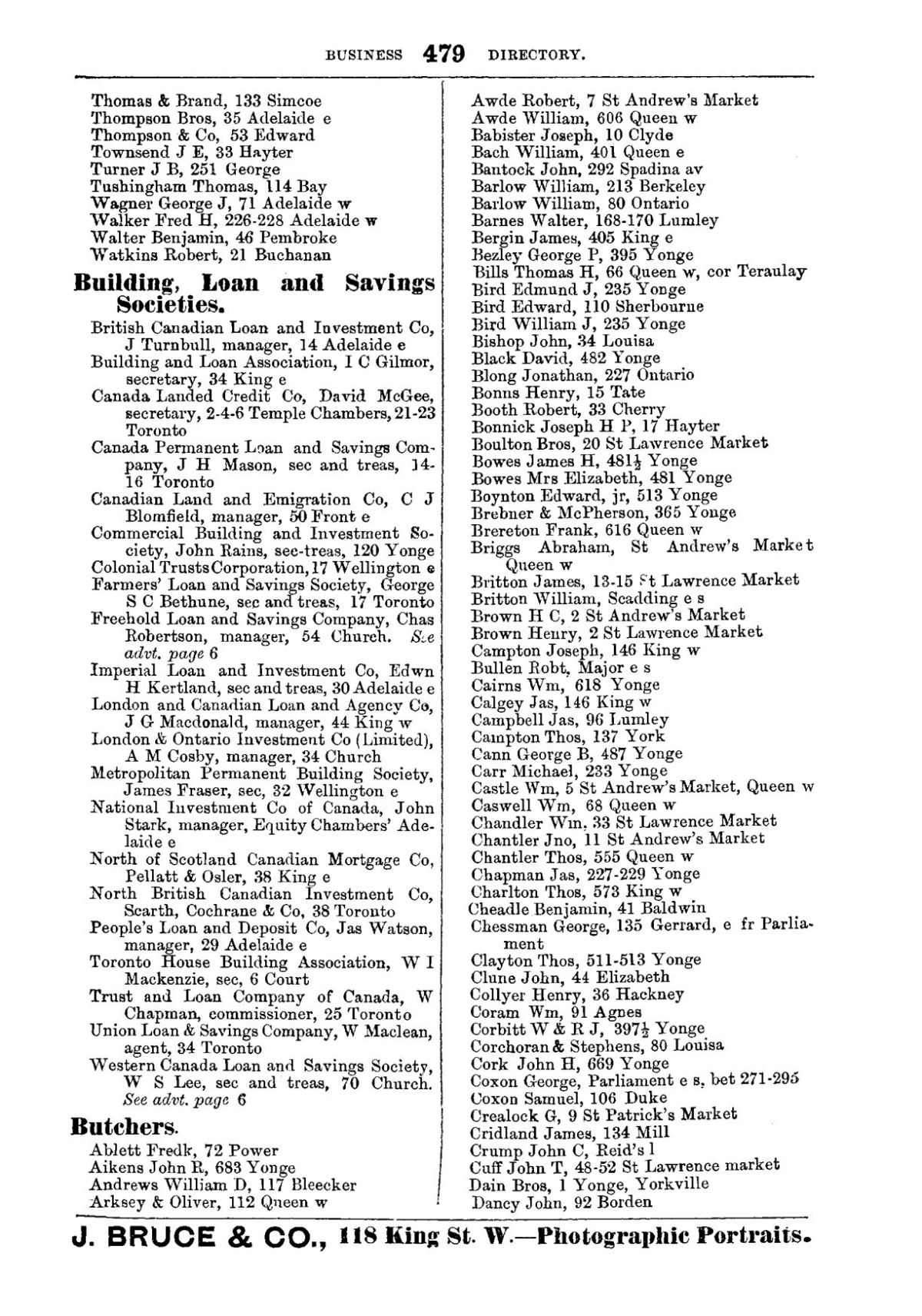
1878 City of Toronto Directory Butchers1
1878 City of Toronto Directory

1878 City of Toronto Directory Butchers2

The Hollands were not alone. There were many small slaughterhouses in Leslieville and soon the abattoirs became bigger. By the 1850s the scale of production began to increase because of Toronto’s growing population and the coming of the railway. In the early nineteenth century most meat came from farmers who slaughtered their own beasts and from village butchers. From the early days of the pioneers, farmers had fattened their hogs up on corn in the summer and butchered them in the fall. At first these farmers, like the Ashbridges, slaughtered pigs only for their own use. Then, with increasing prosperity, they sold what was left over to local butchers, like the Hollands, who cured the meat for the ever-expanding market. Small stockyards and packing houses were scattered through Leslieville. In the mid-1800s Toronto’s wealth rested firmly on the produce of the countryside around it.

St Lawrence Market (2)

In 1880 there were eight families of butchers in Leslieville. Many, though not all, were Irish Catholics like the Hollands, the Gallaghers and the Nolans. Butchers in the nineteenth century did not have just a shop. They had everything they needed to make bacon, ham, sausages and pork chops, along with lard. The butcher would have a sausage machine, horses, delivery wagons, stables, a slaughter house and a piggery, ideally near to a main road and a railway depot.

Cow byres1
Gooderham and Worts Cow Byres (barns) at the mouth of the Don where the Sunlight Soap factory and car dealerships are today. This was essentially a feed lot operation with thousands of cattle fed on whiskey mash piped east across the Don from the Gooderham Worts distillery.

Gooderham and Worts Cow Byres (barns) at the mouth of the Don where the Sunlight Soap factory and car dealerships are today. This was essentially a feed lot operation with thousands of cattle fed on whiskey mash piped east across the Don from the Gooderham Worts distillery.The East End or “Over the Don” eventually filled with stockyards and cow barns on a larger and larger scale. These stockyards were on the lands south of what is now Queen Street to Eastern Avenue and from Pape Avenue all the way to the Don River. Because of the marsh’s reputation for disease and its clouds of mosquitoes, land near it was not desirable for housing. However, its proximity to good rail connections and the Kingston Road, as well as to grass and mash, made it ideal for livestock. The Gooderhams and others brought in cattle, sheep, and pigs and penned them on the flats. Here the livestock were fed and fattened for sale to Toronto’s butchers. Gooderham and Worts  alone fed over six thousand cattle at a time. They pumped the mash from the distillery across the Don to the cattle barns that stood where the Lever Bros. soap factory and a new luxury car dealership stand today.

Blong (2)

Some butchers had larger operations like Eduard Blong’s. The Blongs were Protestant Irish of Huguenot descent. Eduard Blong raised and butchered cattle both for the Canadian market and the British markets.  He owned a large farm on the south side of Queen Street where the Woodgreen Community Centre and Church are now. This will soon be a condominium complex that includes the Red Door Shelter and the façade of the oldest pharmacy in the area.  Blong’s farm, like the Gooderham Worts operation, was essentially what we would call a “feed lot today. He, like most Leslieville butchers, had a stall in St. Lawrence Market. Edward and Henry Blong controlled most of the pastureland south of Queen Street on Ashbridge’s Marsh.

George Morse is remembered in the naming of Morse Street. He was another man who raised cattle in Leslieville. He also got rich off the by-products of the slaughterhouse. In 1878 George Morse sold the Morse Soap Works to Morrison and Taylor. Morse then went back into the feedlot business, this time shipping meat to “The Old Country”.

Butcher1

In 1854 William Davies (nicknamed “Piggy Davies”) set up one of Toronto’s earliest packing houses on Front Street. In 1861 he opened his first meat processing operation at the old St. Lawrence Market in downtown Toronto. By then the Grand Trunk Railway was complete. This railway and the whole rail network made it much easier to bring cattle and pigs to market and to ship the butcher’s products to consumers. Toronto became a major rail hub. This spurred economic growth by providing quick and easy access to markets. In the 1860s, with the American Civil War, there was a huge demand for pork to feed the Union Army. George Morse and others began shipping meat to the U.S.

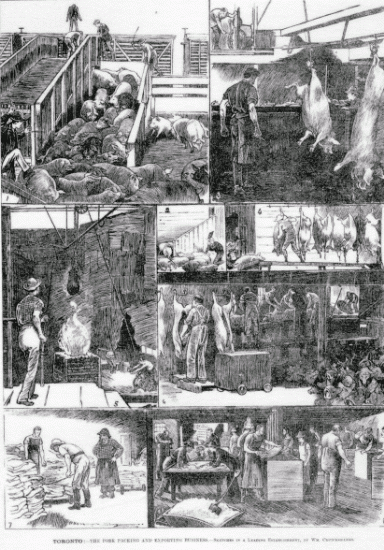
Many village butchers became wholesale butchers, moving into the meatpacking business. They produced hams, bacon and other products for shipment across Canada and for export, particularly for the American market and the United Kingdom. The British bacon market was lucrative. The British liked the lean Canadian bacon. Leslieville butchers slaughtered the hogs, dressed the carcasses and cured the pork. They packed the pork in barrels filled with brine for shipping across the Atlantic. By-products of the slaughterhouse included hides (used to make leather), lard (used in cooking and to make soap), bones and blood (ground into bone meal, and blood meal), etc.

Butcher2William Harris, an enterprising young butcher, arrived in Leslieville from England in 1870. He began making sausage and sausage cases in the Pape/Queen area. He probably completed his apprenticeship as a butcher while working for the William Davies Company between 1870 and 1872.  William incorporated the Harris Bros. business while still working for William Davies, even though he was not yet a qualified butcher.  While working for Davies he found that local livestock dealers like the Blongs and local butchers did not use every part of an animal’s carcass. He moved up on Pape’s Lane (Pape Avenue) to north of Gerrard where he opened a rendering plant using “every part of the pig except the oink”.  It is also reported that William’s initial clientele may have been former clients of William Davies. Later he moved his plant to Danforth and Coxwell, where his rendering business (known as the “glue factory”) became a major employer on the Danforth. A number of years later his firm became one of the founding members of Canada Packers.  A small family concern grew by exploiting a niche market and eventually became a giant, far from its craft butcher roots.

On September 22, 1900, the William Harris glue factory burned to the ground. The three-story brick building was 125 feet long and 60 feet wide (about 38 by 18 meters). Since it was outside the city limits (and city taxes), Harris’ own private fire brigade was left to fight the blaze alone – unsuccessfully. The fire threw 40 men out of work. But Harris moved his business to the newly-created landfill at the foot of the Don River and later to the Strachan Avenue area. In 1901 William Harris experimented in prepared dressed beef and shipping it to Britain on consignment. He had the cattle slaughtered at his abattoir and the chilled meat put in special refrigerator rail cars. It was sent express to Saint John, New Brunswick, where it was put on a refrigerator ship bound for England. The Harris home, Cranfield House, on Pape Avenue still stands.

[1] Globe, April 2, 1867

[2] Globe, June 3, 1845

Drovers and Accidents from MUD ROADS AND PLANK SIDEWALKS: LESLIEVILLE 1880 PART 5


Drovers and Accidents from MUD ROADS AND PLANK SIDEWALKS: LESLIEVILLE 1880 PART 5

by Sam Herbert (1876-1966)

Emile van Marcke de Lummen
The Approach of a Storm, Emile van Marcke de Lummen, oil on canvas. This painting evokes the cattle along Ashbridges Bay where they fattened on marsh grass after their long, dusty trail drive in from the country along Kingston Road and from Dawes Road north and east.
881 883 Queen St Eastb
The Blong House, 881 883 Queen St East (site of Red Door Shelter, Harhay development) and the Blong men hunting. The Blongs were prominent Toronto wholesale and retail butchers.


CATTLE DROVERS.

In the early days it was quite common to see a herd of cattle being driven along the road on their way to the slaughter house, or to a convenient field adjoining one. The drover and his dog kept the herd moving in the right direction, but occasionally, some boy would throw a few stones into the herd and confusion was generally the result.  The drover would use every word at his command concerning the one who threw the stones, then shouting directions to the dog, the dog barking and the cattle bellowing and raising a cloud of dust. It was anything but a peaceful country scene.

18830828GL Cattle stampede
Cattle stampede, Globe, Aug. 28, 1883

Before Heward Avenue was opened through, a large field extended from the Kingston Road to Eastern Avenue, and there were generally twenty-five or thirty head of cattle in the field, that is during the grazing months of the year. There was a small shack in one corner of the field, and it was known as “Danny Arthur’s field.”

On the way home from school it was a habit with some of the boys to lower the bars of the gate, allowing the cattle to stray out on the road.  This went on for some time, until one day, just as the boys were in the act, there was a terrific blast, and a stinging sensation in different parts of the body (so I was told). It was disclosed later that Danny had used his double-barreled muzzle loading shotgun, charged with coarse salt instead of shot, and had given us both barrels. For a long time we lost all interest in cattle.

Ad
Globe, January 5, 1882

Between Willow Street and Carlaw Avenue, on the south side of Eastern Avenue, there stood a large two storied, frame, white-washed slaughter house.

7 Oct 1876 Canada Illustrated News Wm Cruikshank
Illustration by William Cruikshank, Canada Illustrated News, Oct. 7, 1876

As Eastern Avenue was a gravel road there was always plenty of ammunition in the way of stones, and it was an easy matter to pick up half a dozen of the proper size and weight, then, just as we were passing the house to let fly a barrage and run. One day things did not go according to plan. We were ambushed. Two of us got caught, and were taken to the slaughter house.  They had just finished killing and blood was scattered around. While we were being; held, those of the killing gang commenced sharpening their knives. We began to cry.  We implored, begged, and promised everything. Finally one of the men asked us if we would ever throw stones at the house again. We tearfully promised never to do so. They led us separately to the door, and with a well-placed vigorous kick in the seat of the pants which lifted us off the floor, they said “get.” We “got”.  I was running before my feet touched the ground, and I kept right on doing so.

1882 County of York Directory and Gazeteer scales
1882 County of York Directory and Gazetteer

Incidentally, lambs “plucks” could be bought from most slaughter houses at five cents each. The liver and heart were cut off for our own use, and the “lights” or lungs were boiled and cut up for the chickens.

11801019 GL Pigs head

Line of pigs

ACCIDENTS

A neighbour of ours, who had a good-sized market garden, used his shot gun on every possible occasion. He kept it loaded, in his bedroom. One day I heard great commotion at their home, and saw a man wrapping or tying white cloths around our neighbor’s arm. I just noticed the bundle of cloths and the blood, and I ran home to mother and told her the baby had been shot. Mother hastened over to offer help, but found it was not the baby at all.  It seems George had seen a hawk in an Elm tree over across the creek, and opened his bedroom window, reached in for his gun bringing it out barrels first, and one of the hammers tripped on the window sill. George had part of his forearm blown away. The Doctor saved. the arm, but it was always a little deformed.  Mother always remembered that as an example to me to be careful with firearms.

Schools from MUD ROADS AND PLANK SIDEWALKS: LESLIEVILLE 1880 PART 4

MUD ROADS AND PLANK SIDEWALKS: LESLIEVILLE 1880 PART 4

By Sam Herbert (1876-1966)

SCHOOLS

Snap the whip by Homer Winslow
“Snap the Whip” by Winslow Homer, 1872. Oil on canvas.

There were two schools in Leslieville in 1880–the Willow Street school, and St. Joseph’s Roman Catholic School. The one I attended was the Willow Street School, at times known as South Park St. School, and Leslieville School.

1884 Goads Atlas three Schools.jpg
Detail Goad’s Atlas, 1884 By 1880 when Sam Herbert moved to Leslieville, there were three different schools and three different school boards looked after education in Leslieville: 1) York County School No. 6 (now Leslie Street School), County of York School Board; 2) St. Joseph’s School, Toronto Roman Catholic School Board; and 3) Leslieville or Willow School (now Morse Street School), City of Toronto School Board.

It was a two-room brick building on a large lot, at the corner of Willow Street and Eastern Avenue. It faced Eastern Avenue, and as taken from a history of that time, it “was opened October 1, 1874.” For some time only one room was used.

School at Canoe Cove, PEI
A water colour of an early Canadian one-roomed schoolhouse.

Mr. F.G. Spence was the first principal. On February 15th, 1875, Mr. John Phillips took charge, and on January the 4th, 1884, Miss E. Williams took over the duties as principal.

The Assistant teachers in the school from time to time were, Miss Hamilton, November 4th, 1875, Miss Ida Phillips, January 8th, 1877, Miss M.B. Wallace, January 6th, 1879.  Miss Ida Phillips left temporarily to take a course at the Normal School, and returned to duty on September 22nd, 1879.  Miss L.E. Bryant came in January 5th, 1880, and Mrs. Leo Clode, September 6th, 1880. Mrs. Lowry, October 18th, 1880. Mrs. H.B. Laidlaw, January 9th, 1882, Miss M.B. Shier, September 1st, 1882, and Miss Eadie October 8th, 1883.

Some extracts taken from the diary of Mr. F.S. Spence, the first Principal, are rather interesting. The first entry is dated October 1st, 1874, the day the school was opened. “The scholars suffered severely with cold. No stove being put up yet.”  Another a little later, “Monday October 12th, 1874, a very cold day and no stove being put up yet, the temperature in the school room was down to 47, and did not reach 54 all day. Closed school earlier on this occasion.” Another entry past the middle of the month is as follows, “Thursday, October 22nd, 1874, intensely cold, mercury stood at 40 this morning. Dismissed school at 11:30.” Then the last entry, short, but to the point.” Monday, October 26th: “Stove put up to-day. It is also noted that the winter of 1874-5 was one of the coldest on record. Snow covered the fences and cold prevailed all winter.

More interesting entries are from the diary of Mr. John Phillips, second Principal of Willow Street school. The first is as follows: “Greatest snowfall of the season, to-day, March 4th, 1875, all street cars behind time, it being almost impossible to get through the snow drifts. I was late for the first time this morning. Arrived at school at 9:20.” It may be noted that Mr. Phillips at that time lived on Bloor Street west of Bathurst St., and walked down to the corner of King and Bathurst Streets each morning in order to take a King Street car to the Don Bridge, and walked from there to the school, as there were no street cars at that time running east of the Don. All cars in the city were horse-drawn cars.

Just one more quote from the diary of Mr. Phillips dated August 17th, 1875.              “Opened the school again after the summer holidays, there were present 31 boys and 31 girls. Gave them a treat of nuts and raisins to encourage them for being on time for opening day.”

As said before, Willow Street School faced south, and almost in the centre of a large lot. Sheds were on the north side of the property, and these sheds provided protection for the scholars in stormy weather before the bell rang, and also was used for the storage of cordwood, used in the box stoves in the school. One section on each side of a tight board wall provided the necessary conveniences for the use of the scholars. On the boys’ side of this wall almost every square inch of space, and up as high as could be reached conveniently, were names, inscriptions, drawings, etc., cut, carved, engraved and other wise delineated, dealing with a variety of subjects.

strap
The strap

The box stove in each school room was long and rather narrow, and capable of taking a good-sized stick of wood. One cold winter day someone, somehow, managed to sprinkle red pepper on top of the stove. As it burned, the fumes drove everyone outside. Doors and windows were opened, and the room thoroughly aired out before lessons could be resumed. A court of enquiry was held by the principal.  The strap was on his desk. Whoever did it, lied so convincingly that there was no conviction, but that particular type of joke was not tried again.  It was too risky.

When the new Morse Street School was opened in 1885, all scholars were transferred from the Willow Street School to the new school, and the bell from the old school was installed on the new one.       For many years it called the boys and girls of a later generation to their duties and studies.

St. Joseph's plaqueSt. Joseph’s Roman Catholic School came early to Leslieville, about 1863. The first school was a clapboard frame building on Curzon Street, a little north of Doel Avenue. It was mainly the work of Father Rooney, at that time priest of St. Paul’s Church. As a parish priest, he was extremely active in school matters, and for many years was Chairman of the Separate School Board.

RC School

At the time St. Joseph’s first school was built, separate schools were in their infancy and the means for their support were very limited.  The Priest of St. Paul’s had to support their country school in part, out of parochial funds, and in return they had the use of the school for mass each Sunday. He, or one of his assistants, regularly said mass in the school for the benefit of his people in Leslieville.

In 1871 Father McCann, successor to Father Rooney as Pastor of St. Paul’s replaced the frame school with a two-room brick building.  It was not an imposing structure, but it was pretty enough with yellow brick contrasted with the red. It was not a large school. One record gives the number as 35 girls and 25 boys.

In 1887, a Miss Ward was appointed to teach at a salary of three hundred dollars a year.

The first Parish Priest was Father McCarten O’Reilly, a husky popular Irishman. He soon proved himself the building type of priest, and on July 15th, 1886, St. Joseph’ s Church was officially opened.

I must tell you from personal recollection about Father O’Reilly’s annual picnic. It was held in the meadows, on the south side of Eastern Avenue, where a number of factories are now located, approximately between Leslie St. and about opposite Caroline Avenue, and adjoining the marsh and Ashbridges Bay. It was one of the events of the year in the east end.  It was a basket picnic and started in the afternoon. Tables were set out. Tea, Coffee, milk, cream soda and sarsaparilla were donated.  Races and games for the children in the afternoon, and then after supper the youngsters were either sent or taken home. (There were no autos or street cars to worry about.) Tables were cleared, and the odd keg of beer (donated) was tapped and the adult part of the picnic got under way. Fiddlers were on hand and provided the music for the dancing. Coal oil torches provided the light.  There was a darkened area outside the range of the lights where one could stroll if they did not care for dancing.  This was always an interesting section.

The picnic generally broke about midnight, weather permitting, and it could be safely said that “a good time was had by all.”

Father O’Reilly was an affable person with both young and old. On one occasion he stopped me on the street and said, “Well sonny and what is your name? I told him.  He then asked what school I attended. I said, “Willow Street.”  He replied, “Well now and that is fine, be a good boy and do what your teacher bids you”, then patted my head and walked on. This incident stands out very clearly in my memory. That was Father O’Reilly, beloved by all.


Schools: Background Information

Going to schoolIn the mid-1850s land speculators, including George Leslie, laid out housing subdivisions. George Leslie subdivided some farm land in the late 1840s north of Kingston Road between Leslie and Curzon Streets. This subdivision was mostly Irish and Catholic. This subdivisions filled with small houses and market gardens, piggeries and brickyards. Catholics, mostly butchers, including the Hollands and a few market gardeners, like the Wilds, lived here close together. The subdivision north of Kingston Road (Queen Street East) was in the Township of York, County of York. Later subdivisions south of Kingston Road were in the City of Toronto.

1851-leslieville-1851-showing-the-subdivision-near-the-leslie-street-school.jpg
1851 Map of Leslieville showing the first subdivision north of the Kingston Road (Queen St E), between Leslie and Curzon.

By 1855 Ashport (soon renamed “Leslie” or “Leslieville”) had its own public school and advertised for a teacher for their school house on the Kingston Road at Curzon Street:

TEACHER WANTED, a Teacher holding a second-class certificate, for Section No. 6, Township of York. Apply to Geo. Leslie, Toronto Nursery, Toronto January 16, 1855. Globe, January 15, 1855.

Brutality was common in schools, but a York County teacher went too far even for the time, severely beating the son of a Catholic butcher, Terry Holland. George Leslie hired Alexander Muir to replace this violent teacher. Muir did not believe in corporal punishment and never strapped or beat a student.

St. Joseph Catholic School was first established in 1863 as a combined church/school on Doel Avenue, (now part of Dundas Street).  The same year the County of York built a new common or public school at Leslie Street and Sproatt to replace the earlier school at Curzon and Kingston Road (Queen St E). It was a log and clapboard one-room school. Muir became the principal, from 1863 to 1870, and moved to this new County of York school.

Leslie Street School through time


In 1871 a new two-room brick school (St. Joseph’s School) was built on the west end of a 55-foot lot running from Curzon Street to Leslie Street (just north of Dundas Street East) on the property owned by the Archdiocese of Toronto (just south of the playground of the Leslie Street Public School). This, the heart of Catholic Leslieville, was next to an abattoir and a piggery.  At first, priests held mass in the school. Priests, like Francis Rooney, came out from St. Paul’s Church on Power Street.

On September 17, 1873, The City of Toronto Public School Board began to search for a school site “at or near Leslieville” for inhabitants in eastern portion of St. Lawrence Ward which stretched all the way to the Beach south of Kingston Road (Queen Street East).

Rules for teachrsIn February 1874 The City of Toronto Board selected a site “west of Messrs. Leslie & Sons Nursery” on the northeast corner of Eastern Avenue and Pape Avenue.  Aug 24: The two-room school was first called South Park Street School, but was soon officially named Leslieville School. The school was also sometimes referred to as Willow Street School, because it was at Willow Street and Eastern Avenue. Oct: Leslieville School opened. That year the log County #6 schoolhouse was replaced with a typical red brick one-room school house. The trustees enlarged the brick school over the years until in 1962 it was replaced by the current school on the same site.

Brick School

By 1880 when Sam Herbert moved to Leslieville, there were three different schools and three different school boards looked after education in Leslieville: York County School No. 6 (now Leslie Street School), County of York School Board; St. Joseph’s School, Toronto Roman Catholic School Board; and Leslieville or Willow School (now Morse Street School), City of Toronto School Board. There were tensions between Roman Catholics and Protestants, adults and even school children. But, when bullies roughed up Father O’Reilly, even everyone was shocked. This was their local priest and no one in Leslieville would touch him.  It must have been strangers:

Father O’Reilly is deservedly respected in the neighbourhood by both Catholics and Protestants, and does not deserve such treatment. It is only fair to say the young men are not residents of Riverside.  Globe, June 5, 1882.

Ontario ReaderIn 1883 the Leslieville (Willow School) school had 93 students and 2 teachers with an average of 47 students per teacher.  This school was considered overcrowded.

“The writer is informed by the City School Inspector that, on account of the great number of pupils in each class-room, the teachers have not fair play in their endeavour to teach and discipline their classes, and that on account of the want of accommodation, it is impossible for them to enforce the law as to compulsory education.” Toronto Board of Education Annual Report, 1883, 11.

By the time Sam Herbert started school, things were changing in Leslieville. Soon the two public schools would be under the same School Board. In February,1884, the Leslieville or Willow School name was changed to Eastern Avenue School—presumably to avoid confusion with Leslie Street School, also called the Leslieville School, which was annexed to Toronto the same year.  On May 15, the Toronto Public School Board purchased a Morse Street site for a four-room school to replace the Eastern Avenue School. That month the Leslie Street School first appears in the Toronto School Board’s records, with 84 pupils enrolled.  In November 1885, the Eastern Avenue School and site was sold at public auction.

A Meeting of the School Trustees, 1885 By Robert Harris
18981021 TS Women Teachers1
Toronto Star, October 21, 1898 In 1884 Miss Williams had been principal of the Willow Street School. 14 years later some tried to demote her simply because she was a woman.

MUD ROADS AND PLANK SIDEWALKS Part 3

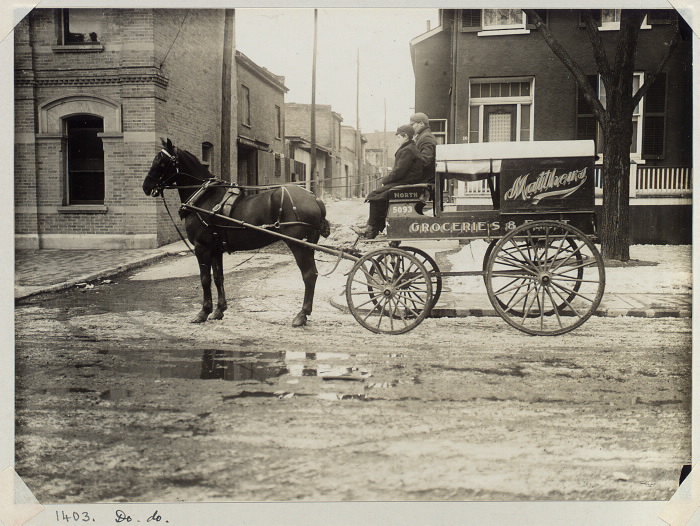
1911 TPL Prince, Grocery Wagon
Grocery waggon, 1911, and “Prince”. From the Toronto Public Library Digital Archives.

MUD ROADS AND PLANK SIDEWALKS: LESLIEVILLE 1880

By Sam Herbert (1876 – 1966)

TRADESMEN

In the early ’80s, a firm of three brothers who kept a grocery store on Queen Street near Seaton came through Leslieville soliciting orders, once a week. The following afternoon the groceries were delivered by another of the brothers in a canvas covered wagon. The name of the firm was painted on both sides of the cover, also the statement “Groceries and Provisions, Tea a specialty.” A grab bag was usually in each box of groceries, and I always helped mother unpack the box until I came to the· grab bag, then I let her finish the job.

1867 TPL Bay St, w side, looking north to King St W
1867 Bay St, w side, looking north to King St W. A confectioner’s delivery horse and wagon left and a grocery store right. From the Toronto Public Library Digital Collection.
1876 TPL Grocers trade card
1876 Grocer’s trade card. From the Toronto Public Library Digital Collection.

Drug store window 1892.jpgOur nearest drug store in 1880 and 1881 was near the corner of King and Berkeley Streets, it was kept by a druggist named Lee, and was next door to Little Trinity Church Parsonage. The building is still there. This will give an idea of the conditions in the early days.

This slideshow requires JavaScript.

Background: Leslieville’s First Drug Store

by Joanne Doucette, Leslieville Historical Society


The Red Door Family Shelter at 875 Queen St. E., is being built on the side of Leslieville’s first drugstore and medical clinic at the southeast corner of Queen and Logan. It was built in 1888 and occupied by the Burgess family of druggists and doctors and was home to Woodgreen Discount Drugs for as long as I can remember. Edward Blong, wholesale butcher and one of the founders of Woodgreen Methodist Tabernacle, owned the property. The Burgess Drug Store and the office of Dr. John A. Burgess  were the building’s first tenants. The Leslieville Historical Society worked with the developer, Harhay, to ensure that the facade of the old drugstore was saved. It has been dismantled and will be included in the new building. Here is the rendering of the new development with the restored facade.

I helped prepare the Leslieville Historical Society’s own Heritage Impact Summary. In February 2016, Toronto City Council approved Harhay’s revised plans. This was the newly-formed Leslieville Historical Society’s first effort to preserve a threatened historical feature. We are currently compiling a list of Leslieville buildings that merit preservation.


More About the Burgess Drug Store

The drugstore at the corner of Logan and Queen in Toronto’s Leslieville had a fascinating history.  By 1889, the Burgess family had opened a drug store and medical practice at the southwest corner of Logan Avenue and Queen Street East. It was in effect, Leslieville’s first medical clinic. The story of that clinic follows below.

In the 19th century Edward and Margaret Blong lived at 881 Queen Street East, the site of Woodgreen United Church. The Blongs were Protestant Irish of Huguenot descent. Eduard Blong raised and butchered cattle both for the Canadian market and the British markets. He owned a large farm on the south side of Queen Street (then called Kingston Road) where the Woodgreen Community Centre and Church are now. His farm, like the Gooderham operation, was essentially what we would call a “feed lot” today. He, like most Leslieville butchers, had a stall in St. Lawrence Market. They had extensive grounds around their large home.

Samuel Thomas Burgess was born in 1828 in Ireland and died 6 March 1901 in Toronto. He married Mary Ann Foster Hastings (1841 – 1922) on 4 July 1860 in Toronto. The family lived in Markham at first where they had a store, but by the late 1860s they had moved to Toronto where Samuel worked as a salesman and later a dry goods clerk or, in other words, as a clerk in a grocery store.

They had four children: John Alfred Burgess (1862 – 1896); Frederick Thomas Burgess (1863 – 1920); Anne Foster Burgess (1867– 1947); and Herbert William Herkimer Burgess (1870 – 1931).

Samuel served as the “midwife” for his son Herbert’s birth (Aug. 29, 1870) as he probably did for all his children. In 1870 the family were living in Cabbagetown at 5 McMahon Street which was renamed “Ontario Street” a year or two later and later to Parliament Street and finally to Queen and Logan. While Samuel may have been an amateur midwife, the rest of the family were thoroughly professional medical people.

Three sons were in health care professions. John Alfred Burgess was a teacher first and then a doctor and a pharmacist. Doctors often became pharmacists in the 19th century, owning their own drugstores and dispensing their own prescriptions as well as those of others. His brothers Frederick and Herbert were both pharmacists.

The family were devout Methodists, members of the Woodgreen Tabernacle (which later became Woodgreen United Church), and typical of many Methodists of the time very involved in delivering the Christian Gospel to the community in deeds as well as words. There is an old saying, “What you do speaks so loud, I can’t hear a word you say”, but the Burgesses backed up their evangelical zeal with action. They probably located near to Woodgreen Tabernacle, a large, active and growing church that featured “hell fire and damnation” preaching because it reflected their faith and was their “church home”.

Historians all too often ignore the women in a family. That is always a mistake, but never more so than with this family. If you ask yourself, how did a dry goods merchant manage to have three sons so deeply involved in medicine? The answer lies with Mary Ann Foster Hastings, mother of the Burgess clan.

She was the daughter of John Hastings (1807-1889) and Maria Louisa Orr (1815-1892). Dr. Joseph Orlando Orr like the Burgesses originally came from Northern Ireland to rural Ontario. Dr. Orr settled in Bond Head between Newmarket and Barrie. His five nephews went on to become doctors. Dr. Rowland Orr practised medicine in Toronto as did Dr. Joseph Orlando Orr who was also the Manager and Editor of the Ontario Medical Journal. He was for a time a City Alderman as well. Dr. John Alfred Burgess was the fifth. His mother, Mary Louise Orr, was Dr. Joseph Orlando’s sister. Her brother Charles Hastings became famous as Toronto’s Chief Medical Officer of Health.


Herbert Burgess
Dr. William Herbert Burgess, 1905.

Dr. William Herbert Burgess, 1905. He was a pharmacist before he became a doctor. The family business was at 887 Queen Street East. A large part of sales at a drug store of the time was in carbonated beverages like Coca Cola which contained the narcotic coca; 7-Up which contained lithium; ginger ale which still contains ginger; and root beer which contained sassafras. These were originally drank for their medicinal qualities, but adding ice cream pumped them up to a whole new level.


Background: Grocers

What was a “Grab bag”? It was a small bag, often of brown paper,  holding a variety of small things such as candies or cheap toys. The bag was purchased with out the customer knowing what was inside. The store put the bags together, often one for boys and one for girls; sometimes the grocer included them free of charge in the delivery.  I remember grab bags at the Crippled Civilians’ store and how exciting they were. Once we had the grab bag we rushed out of the store to open the mysterious paper package and find the treasures within.

Arnold Bros, head office, 956 Queen E.. - April 20, 1926
Arnold Bros, head office, 956 Queen E.. – April 20, 1926. Today Value Village occupies this store.
20171109 Value Village Jd.jpg
Value Village, November 9, 2017 photo by J. Doucette
[A.E.] Gubb Brothers, 370 Rhodes Avenue, Roman Meal window.
[A.E.] Gubb Brothers, 370 Rhodes Avenue, Roman Meal window. Grocery stores carried “dry goods” such as flour, corn meal, baking soda, canned goods, but originally did not sell fruit and vegetables, fresh meat or fresh fish. A green grocer sold fruit and vegetables. A butcher sold meat. A fishmonger sold fish. A confectioner sold candy, etc.
Dominion store, 213 Wellesley St, grocery section. - April 15, 1929
Dominion store, 213 Wellesley St, grocery section. – April 15, 1929 Loblaws was the first self-serve grocery store. Early grocery stores were definitely not self-serve. A clerk, usually a man, served the customer from behind a high counter.
Arnold Bros, grocery section, 773 Yonge St.. - April 22, 1926
Arnold Bros, grocery section, 773 Yonge St.. – April 22, 1926. Arnold Brothers were an East End family and some of the first grocers in Leslieville.


MUD ROADS AND PLANK SIDEWALKS: Water, Outhouses, etc.

MUD ROADS AND PLANK SIDEWALKS: LESLIEVILLE 1880 (continued)

By Sam Herbert

WATER SOURCES

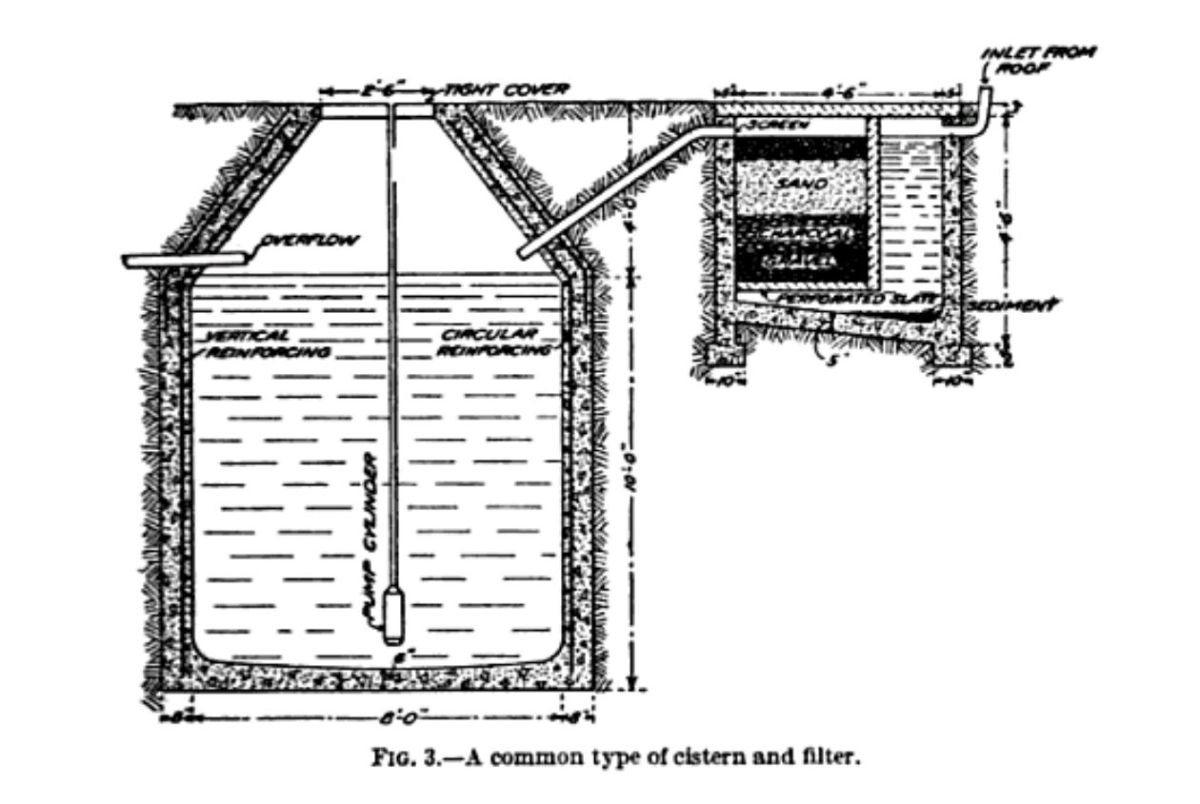
cistern
Cistern, 19th century

pumpSkunk (2)Our water supply was from a well for drinking purpose, and a large cistern and rain barrels for washing. The cistern was sunk in the ground, the top being slightly above the ground level. It was boarded over, and had a small lid in the centre that lifted off when water was required. I remember on one occasion when dipping up a pail of water, I found the body of a skunk floating. I lifted it out and took it to the end of the garden to bury later on. The lid of the cistern had not been replaced properly and acted as a trap. It all taught us all a lesson as it might have been a child instead. We were without soft water for some time, except from the rain barrels on the other side of the house, while the cistern was being pumped out and cleaned.
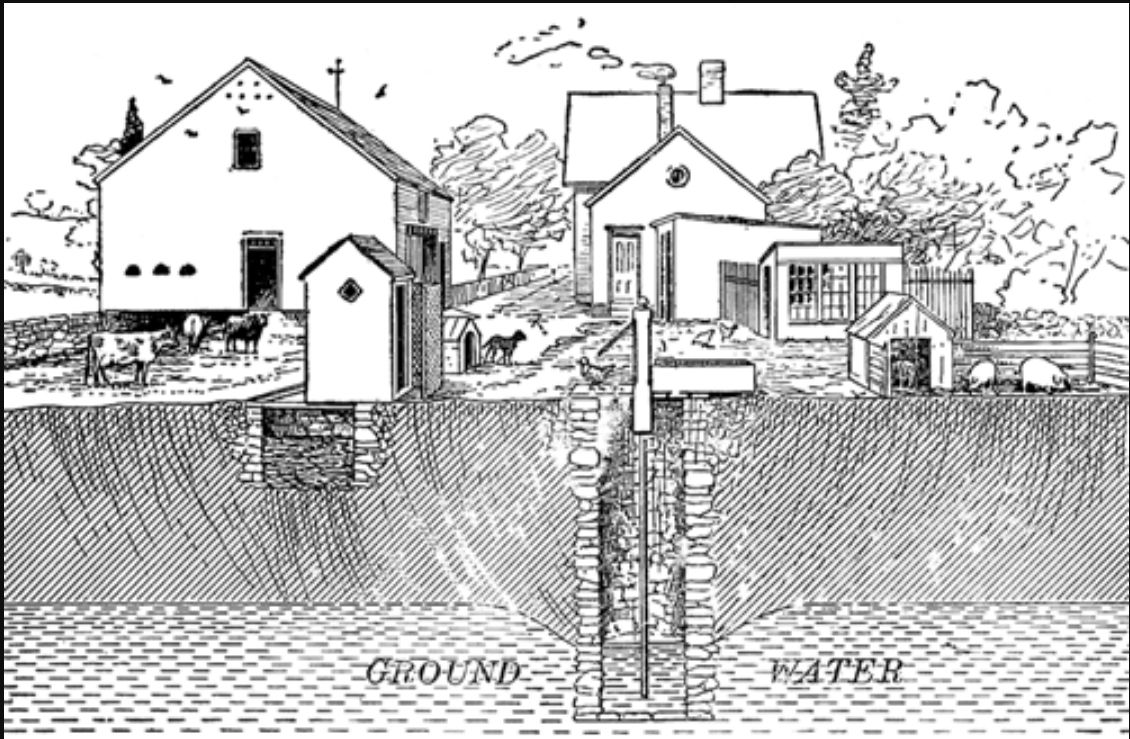
OUTHOUSES

Well and privyOutside conveniences was the rule, we did not know about anything else, except in case of illness, when the “chamber” was used. This was also a part of the equipment in every bedroom.
6bebbd6ca8ae03dd3ca077b450efa3b6--pug-dogs-vintage-postcards
Child, dog and chamber pot. Chamber pots were also known as piss pots, pee pots, potties, thunder pots and thunder mugs.

On Hallowe’en many of these outhouses became portable, and were moved a few feet from their original site. A person going to visit one of them at night under these circumstances very often missed his step with dire results.

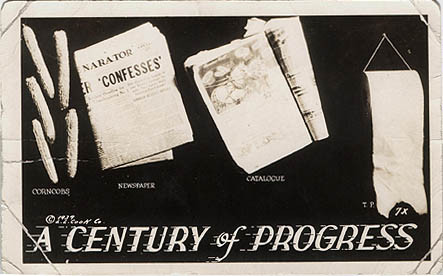
I can still visualize the circus posters and pictures pasted on the inside of these square houses. They served a double purpose, the first to keep out some of the cold, and the other for education of a kind. We did not have the luxury of toilet paper as of to-day, but it consisted of squares of newspapers cut to the required size, and after sufficient were cut, a nail was driven through one corner, and then hammered into the wall within proper reaching distance of the seat. Sometimes interesting bits of news were noticed on these strips of paper, and the reading of them provided additional relaxing moments.

toilet-paper-3The outhouses were all of the regulation two-hole type with a hinged drop cover over each. Of course there was a hook on the inside for the occupant to use, but there was also a wooden button on the outside to secure it when not in use. Sometimes that wooden button on the outside would be cautiously moved to the closed position while the house was in use, and then the indignant cries from the inside to be let out, and the dire results if the culprit was caught. There were quite a few broken buttons on the ground outside.

HEATING

Furnaces were practically unknown in the average home. We had a coal burning self-feeder. I think it was named “Aetna” and made by the Gurney Company. The kitchen stove was a wood burner, but I don’t remember its name. It was a large stove and an excellent cooker. There was a reservoir at the back for holding water. This gave a supply of fairly warm water while the stove was in use. Ashes from the self-feeder were carefully sifted for reclaiming any unburned coal. This job as well as bringing in the coal and wood, also filling the pails with drinking water and water for washing, fell to the boy in the home.

COOKING

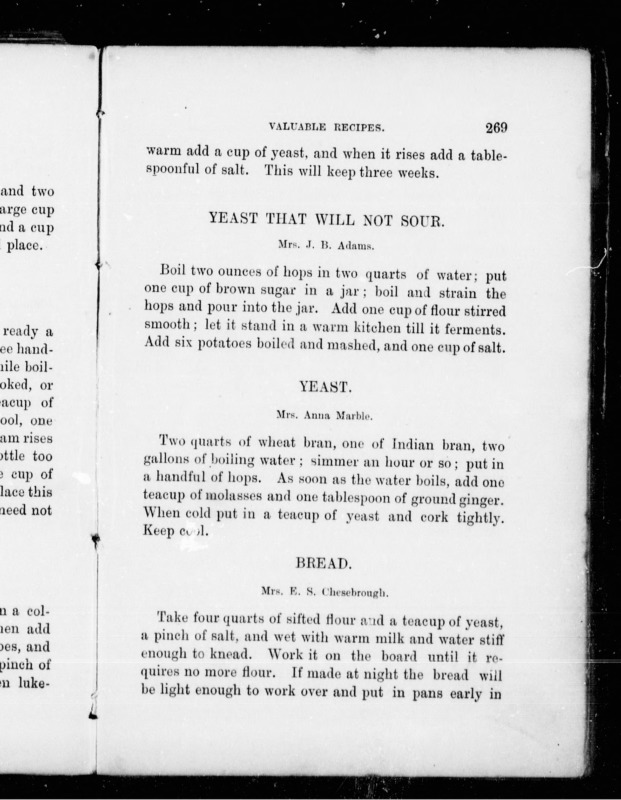
Mother did all her own baking: bread twice a week, slap jacks almost every day, soda bread, potato cakes, and light fluffy buns as required. She used a “Hop” yeast for the bread, and this was sold by the wife of the toll-gate keeper at the corner of Scadding street and the Kingston Road. It was my duty to go regularly for this very necessary product. The covered tin can that I carried on these occasions was in our home until just a few years ago.

If company drove down from the city (horse and buggy), Mother was never ruffled or flustered. She would tell them just to make themselves at home, and my orders were to catch a couple of cockerels, kill them and bring them to her. She would pluck, singe and dress them and have them in the oven in a short time. Then, perhaps, she would make a batch of light fluffy biscuits, and with home-made pickles, jams or jelly, or fresh fruit from the garden, if in season, everyone would be satisfied.

Woman feeding chickens, Oakville. - [1904?]
Woman feeding chickens – [1904?]

There was no corner store at the time where one could buy a few extra slices of cooked meat, or potato salad – in fact such things were hardly thought of then. If it was in the heat of summer, the table was quite often moved to the garden under our apple tree, and supper served there.

Kitchen Interior Occupied March 26, 1912

I always enjoyed visitors coming down from the city, and one party in particular because they had a very pretty dark-eyed little girl, and she always received very special attention as far as I was concerned.

SUMMER KITCHEN

summer kitchen
Interior of a summer kitchen.

We had what was called a “Summer Kitchen”, which was really just a well-built shed with a brick chimney. Chairs, a table, pots and pans and the cook stove were moved out there, and this served as our kitchen during the heat of the summer until early in September.

19th1lg

for more about cooking and cookbooks in early Ontario see the Royal Ontario Museum at 

https://www.rom.on.ca/en/blog/cooking-up-history-historical-recipe-books


Samuel Herbert: Background


Samuel Sydney Herbert, was born October 30, 1834 in Great Coggeshall, near Colchester, Essex, England. His father was an agricultural laborer and the family would have been quite poor. He was still at home in 1851. His older brother, Benjamin, was blind and 15-year old Samuel worked as an errand boy, no doubt to help the family’s ends meet.

D-DU-2950-1 (1)
Agricultural labourers, Essex, England

Samuel S. Herbert enlisted in the 60th Regiment or King’s Royal Rifle Corps army for a period of 21 years probably when he was about 18 so probably in 1852. Colchester was, and still is, a major military base. Thousands of troops were stationed there during the Crimean War when Samuel S. Herbert was a teenager. He served with the First Battalion of the King’s Royal Rifle Corps in India and probably helped put down the so-called “Indian Mutiny” in 1857.

Rifle Brigade, Iron Bridge, India 1857
Rifle Brigade, Indian Mutiny, Iron Bridge

In 1862 the First Battalion of the Royal Rifle Corps returned to England for several years and was stationed at the Aldershot Barracks. In 1864 they were sent to Ireland. In 1867 they sailed to Canada to garrison Montreal and Quebec City during the threatened Fenian invasions. In 1868 they were still at Montreal and Quebec. In 1869 the 60th was in Montreal, Ottawa and Toronto as the Fenian threat materialized. In 1870 the First was still in Toronto when it took part in the Red River Expedition. It also served at Ottawa, Montreal and Quebec City that year.

First Battalion Rifle Brigade Canada


Rifle Brigade 1871
Rifle Brigade, 1871

He was in the 60th Regiment of Foot when, on July 12, 1870, he married Mary Butler. Mary Butler was born about 1831 in Ireland but in 1852 she was living in Quebec City which strongly suggests that her family were connected to the Garrison there.

Methodist Cherry Nook

Their marriage certificate shows that they were married in Leslieville at the Wesleyan Methodist Chapel and, intriguingly, he is given the title “Prophet”.

Camp meeting.jpg
from Thomas Conant, Upper Canada Sketches, 1898

In the early 1800s, a Great Revival swept North America and Methodism was at the heart of this religious awakening. The Methodist Church grew rapidly through its preaching especially at open-air camp meetings. It was a dynamic, evangelical and lively church with an emphasis on prophecy that might seem strange to members of the United Church of Canada, formed in 1925 out of the union of Methodist, Presbyterian and Congregationalist Churches. If you were at a Methodist camp meeting you would be surrounded by people singing, shouting, prophesying and exhorting sinners to come forward and be saved. Not only ordained ministers, but ordinary Methodists could be prophets, endowed with supernatural visions and gifts, including the laying on of hands. Many adherents later went on to found the modern day Pentecostal churches as the Methodist Church grew more restrained and staid.

FAH_Red_River_Expedition
Frances Anne Hopkins, The Red River Expedition at Kakabeka Falls, Library and Archives Canada, Acc. No. 1989-400-1

More Battalions of the 60th came to Canada during the Fenian invasions. The 4th arrived in 1866 and the 1st in 1867. The 1st Battalion of the Regiment of Foot formed the main body of the troops of the Red River Expedition of 1870. It seems very likely that Private Samuel S. Herbert went to Fort Garry to put down the First Manitoba Uprising led by Louis Riel. In November 1871, part the First Battalion left the Quebec Citadel to return to England, but others went to Halifax to help protect the naval base there until 1876 when they too returned to England. Mary Butler was 45 when, on August 15, 1876, she gave birth to Samuel Benjamin Herbert in Quebec City. Another son, had died the year before; official cause of death, “teething”.

Samuel Sydney Herbert moved back to Toronto in 1880, settling in Leslieville. After leaving the army Samuel Sydney Herbert worked mostly as a laborer, but from time to time as a porter at one of the Toronto hotels downtown, such as the Walker House. The address of their house on Pape Avenue varies as the street was renumbered at least twice. Sometimes it was 39 Pape, sometimes 99 Pape, and finally 199 Pape. The house was described as being on the east side of Pape, two houses north of Queen in an 1886 City of Toronto Directory.

Greenhouses Leslieville
Greenhouses, Pape Avenue, Leslieville and the Toronto Hunt Club

Samuel Sydney Butler died on April 23, 1890 of tuberculosis or phthisis. He was buried on 26 Apr 1890 in the Necropolis Cemetery. Mary Butler died of an abdominal abscess on May 12, 1891, in Toronto General Hospital. She is buried beside her husband.

Samuel Benjamin Herbert married Lottie Maud Briggs (1880-1937) on April 19, 1899, in Toronto, Ontario. They had two children during their marriage. He died on May 2, 1966, at the age of 89, at his home 116 Pape Avenue, Toronto.  He is buried in St John of Norway Cemetery, Woodbine Avenue, Toronto.


MUD ROADS AND PLANK SIDEWALKS: LESLIEVILLE 1880 Part 1

MUD ROADS AND PLANK SIDEWALKS: LESLIEVILLE 1880

By Sam Herbert

I would be useless to search for Leslieville on any map of to-day.

It simply is not there.

1878 Map
Leslieville, County Atlas Map, 1878

A Directory for the year 1871 gives it the following description:

Leslieville, a thriving village on the Kingston Road, Township and County of York, named after George Leslie, one of the first settlers and owner of extensive nursery grounds in the neighbourhood. The manufacture of bricks is carried on to a great extent. Stage, to and from Toronto, twice a day. The Montreal Telegraph has an office there. The distance from Toronto is two miles. Mail daily. Population about four hundred.

Our family came to Leslieville in the year 1880 and purchased a house and large garden on the east side of what was then Pape’s Sideline, just north of the Kingston Road. At that time there were only four houses on the street between the Kingston Road and the Grand Trunk Railway crossing, the rest was meadow and market gardens.

Leslieville 1884
Goad’s Atlas, 1884
Globe, Oct. 26, 1912 Onions Pape Ave
Globe, Oct. 26, 1912
Gerrard looking towards Pape, 1904
Looking east on Gerrard Street towards Pape Avenue, February 2, 1904

The following are mostly personal recollections with some history gained from local sources and incidents during my early life in Leslieville, and the Toronto of sixty or seventy years ago. I am still a resident on Pape Avenue and have grown up with this part of Toronto from the horse and buggy days to this era of Automobiles, Aeroplanes, Jets, Radio and Television.

veggies

Seeds3
The Steele Briggs nursery was on Queen Street East near Coxwell Avenue

For the early period I will use the names of streets as we knew them at that time. King and Queen Streets came only as far as the Don Bridge. From there easterly it was the Kingston Road. Broadview Avenue, south of the Kingston Road was Scadding Street, then Lewis Street, Grant Street, Saulter Street, Boulton Avenue, Strange Street, DeGrassi Street, McGee Street, Logan Avenue, Carlaw Avenue, — south – nothing north but fields and meadows. Pape’s Sideline, Willow Street, Curzon Street, Leslie Street, Lake Street, Laing Street, Greenwoods Sideline, and The Woodbine.

Brick yards and Market Gardens were the principle industries. The Leslie Nurseries were a unit in themselves. Almost everyone owned their own home, and most places had good-sized market gardens. We had quite a large one – about a quarter acre. We grew almost everything necessary for our own table, Apples, Pears, small fruits [berries] and vegetables, we had everything in season. Mother occasionally sold some of the surplus for extra pocket money.

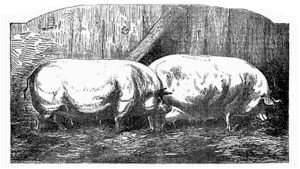
Pigs

We had chickens, rabbits, a couple of pigs, and at one time a Nanny goat. In the lower garden there was a large root house, and periodically throughout the winter months it was opened, and a supply of vegetables taken out. They had the fresh earthy flavour that is entirely missing in the vegetables sold to-day.

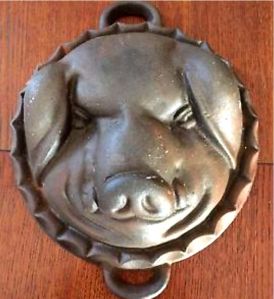
head cheese mold ebay ie
Cast iron head cheese mold from ebay Ireland

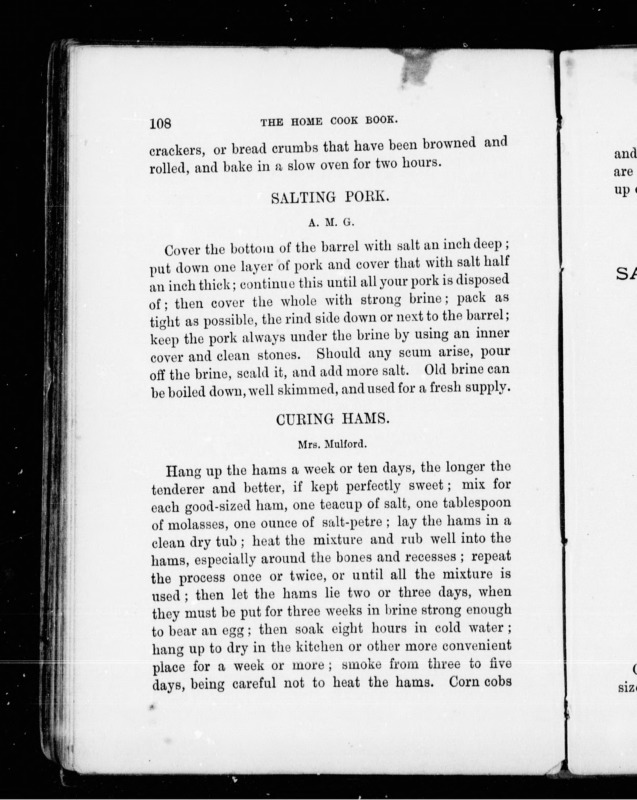
In the coal and wood shed, during the winter months there was generally a part of a hind quarter of beef hanging. We killed a pig each fall and some of the meat was used at once for roasts and headcheese. The rest was cut up and put in pickle. In the winter we always had a barrel of pickled pork and one of beef. Occasionally on Sunday Mother would cook a large piece of corned beef with cabbage. On Monday we would have cold corned beef with hot vegetables. On Tuesday there would be a change, but on Wednesday the meat would be cut away from the bone, and chopped fine in a wooden bowl. Potatoes and parsnips were boiled and mashed, then the cut up corned beef mixed in thoroughly with it, and placed in a flat baking pan, smoothed over, and several dabs of butter spread over it, and then put in the oven until nicely browned on top. Mother said it was “Calcannon” – I don’t know where the name originated – perhaps from her early home in the south of Ireland.

About head cheese

http://www.meatsandsausages.com/sausage-types/head-cheese-sausage

How to make colcannon

https://www.youtube.com/watch?v=I2AbLUtNSMI

In the late spring, summer and early fall (roads permitting) a butcher, with his covered waggon, stocked with fresh meat, and a pair of scales would call once a week and sell direct from the waggon. As we had no ice, the meat was bought rather sparingly.

Butcher+'s+wagon Custer Museum
Butcher’s wagon. Photo from the Custer Museum.

Oh yes, and for the same period of the year, a fish peddler came around every Friday, selling really fresh fish, caught locally, perhaps that morning.

fishmonger 1884 to 1887
Fishmonger and interested cat, 1884 to 1887