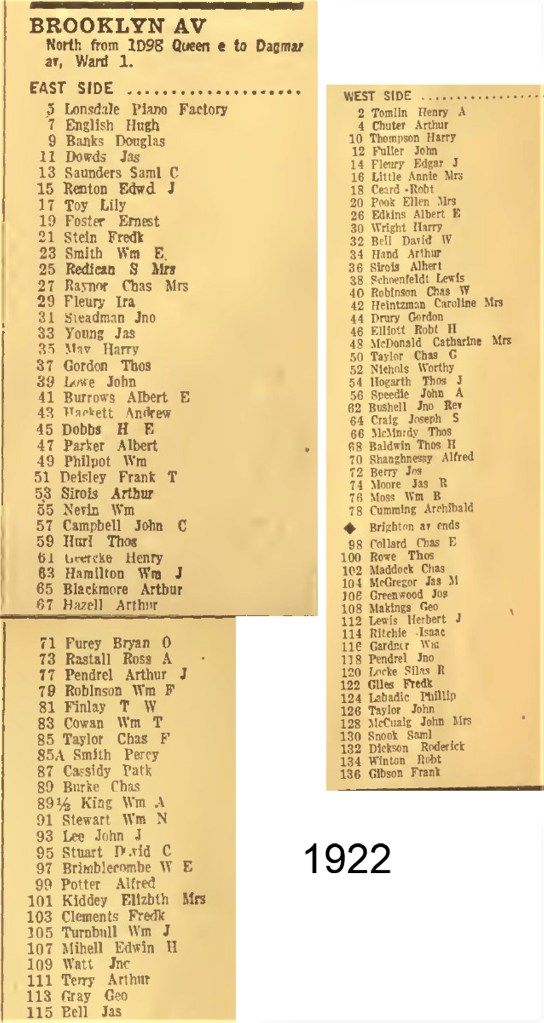
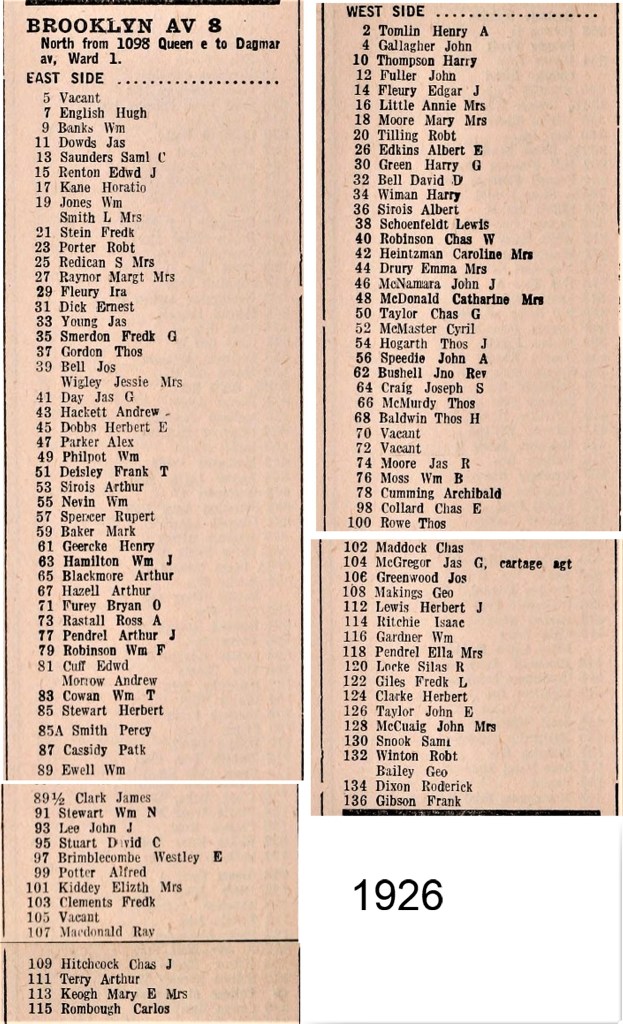
Brooklyn Avenue: The Oldest Houses on the street

by Joanne Doucette (liatris52@sympatico.ca)
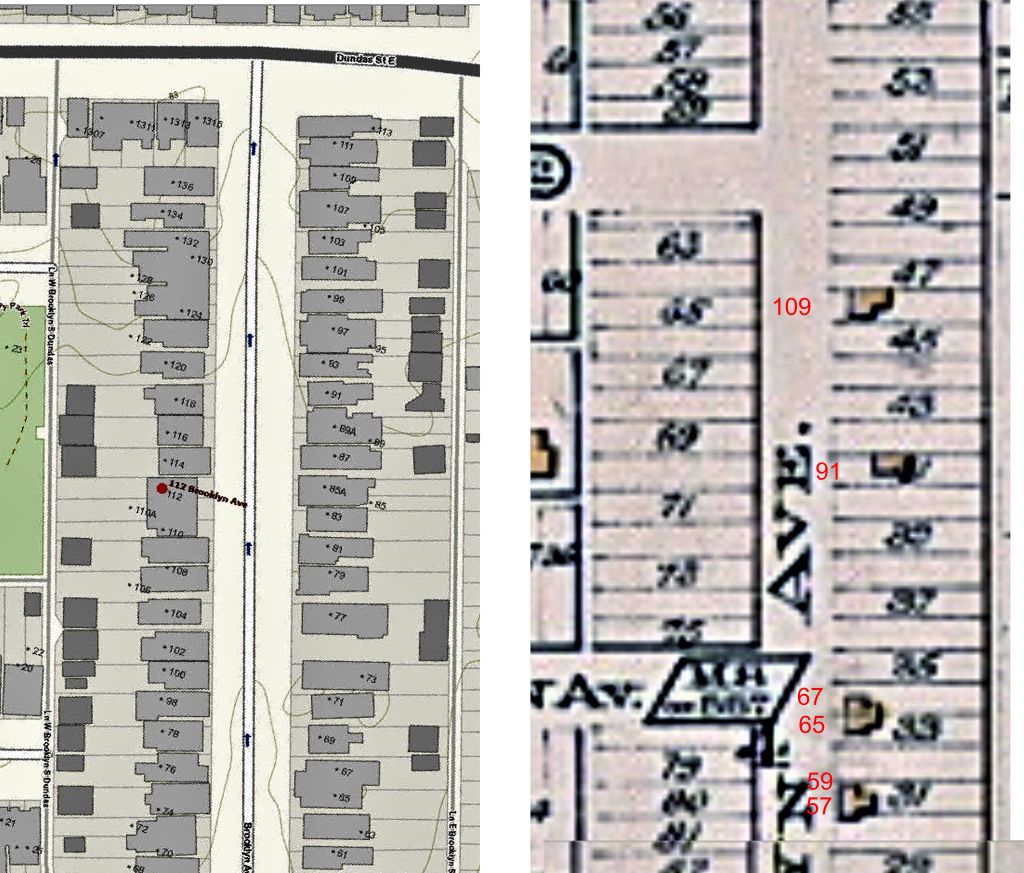
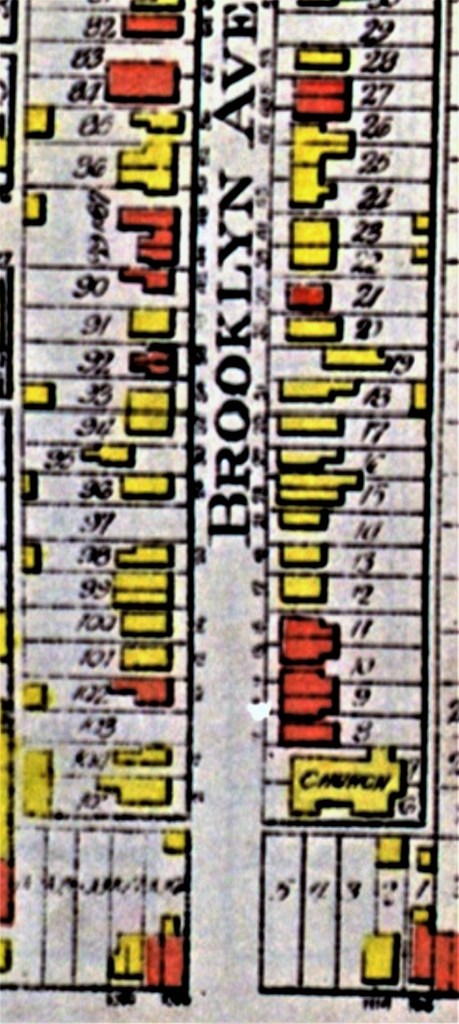
Modern Map (left) and 1890 Goad’s Atlas (right)

It was a challenge to sit down with a modern map and old street plans to determine exactly which are the oldest houses on the street. But when the job was done, it made total sense! These houses all stand out as distinct. They have all were built in the 1880’s.

For more about Victorian architecture in Ontario go to: http://ontarioarchitecture.com/Victorian.htm

The Heritage Resource Centre at the University of Waterloo has a guide to the architectural style in the province: https://www.therealtydeal.com/wp-content/uploads/2018/06/Heritage-Resource-Centre-Achitectural-Styles-Guide.pdf

Features of the Gothic Revival Style from the Ontario Architectural Style Guide, Heritage Resource Centre, University of Waterloo, p. 8

This article includes:

  1. The Oldest Houses
  2. Some Architectural Terms
  3. Some Online Resources for Maps and Plans

1. The Oldest Houses

57-59 Brooklyn Avenue https://www.google.ca/maps/place/53+Brooklyn+Ave,+Toronto,+ON+M4M+2X4/@43.6640366,-79.3367381,3a,75y,66.74h,86.6t/data=!3m7!1e1!3m5!1sNw0nb9w4BFJDLolfsMuH_A!2e0!5s20210901T000000!7i16384!8i8192!4m5!3m4!1s0x89d4cb781e6ffebf:0x61b1120f6e31940d!8m2!3d43.6639421!4d-79.3364562?hl=en

57-59 is a “double house”, no doubt built by a brickmaker as it is a masterpiece showing off fancy bricklaying — from the lozenge-shaped diapering in the gable to the subtle hood moulds over the windows and doors and the banding. It would originally have had a verandah and fancy bargeboards under the eaves. Appearances are deceiving though. Only the front has the brickwork. The sides of the house were originally clapboard or lathe and stucco. [They won’t let me take a jackhammer to the exterior walls so that I can verify the construction material. Just guessing.] It is in the Gothic Revival style and, like the other houses mentioned here was built between 1884 and 1889.

65-67 Brooklyn Avenue https://www.google.ca/maps/place/53+Brooklyn+Ave,+Toronto,+ON+M4M+2X4/@43.66422,-79.3368214,3a,75y,57.3h,91.21t/data=!3m7!1e1!3m5!1sstTmdmPLjRLBdjXfeH50Ng!2e0!5s20190601T000000!7i16384!8i8192!4m5!3m4!1s0x89d4cb781e6ffebf:0x61b1120f6e31940d!8m2!3d43.6639421!4d-79.3364562?hl=en

65-67 is another “double house”, but emphasizes the vertical aspect so dear to neo-Gothic architects more than 57-59. This is a bay-and-gable design similar to the one on the website here: http://ontarioarchitecture.com/Victorian.htm#Gable%20and%20Bay

Like 57-59 these narrow, two-storey houses had dirt-floor basements, a brick front and wood side and rear walls, with a summer kitchen at the back.

Recommended exterior colours. Andrew Jackson Downing, Cottage Residences (New York: Wiley & Halstead, 1856)

67 has the original double door which would have allowed the lady of the houses and her feminine visitors to sweep through the entrance in their hooped skirts. It also is a show home for fancy bricklaying. It has bay windows on each side, but the verandah is a later Edwardian addition. It would have had a smaller but no doubt fancier front porch. It would also it would have had fancy bargeboards under the eaves and probably a finial topping the centre gable, leading your eye up to heaven and away from the mud of the surrounding brickyards. It also would have concealed the all-important lightning rod.

All these houses speak to the Victorian love for elaboration coupled with order — they are all symmetrical. Now we usually paint the trim of these lovely old houses in subtle shades of cream, brown or white. But the late Victorians loved colour and the original paint scheme may have been eye-popping with purples, reds, blues and yellows.

Check the lancet-arch ventilators at the top. They look like tiny windows or miniature medieval cathedrals, but helped improve the air circulation in the house.

91 Brooklyn Avenue https://www.google.ca/maps/place/53+Brooklyn+Ave,+Toronto,+ON+M4M+2X4/@43.665118,-79.3371535,3a,75y,74.28h,87.65t/data=!3m7!1e1!3m5!1sW1rn_j_sW_LBYrpREhabRQ!2e0!5s20130501T000000!7i13312!8i6656!4m5!3m4!1s0x89d4cb781e6ffebf:0x61b1120f6e31940d!8m2!3d43.6639421!4d-79.3364562?hl=en

This detached house retains its beautiful, flowing bargeboards and the yellow (called white at the time) bricks at the corners of the house imitate the much more expensive stone quoins that only the rich could afford.

109 Brooklyn Avenue https://www.google.ca/maps/place/53+Brooklyn+Ave,+Toronto,+ON+M4M+2X4/@43.6655559,-79.3373562,3a,75y,71.58h,92.27t/data=!3m7!1e1!3m5!1suPO7wQ__chkD_ruuui6kVg!2e0!5s20180201T000000!7i16384!8i8192!4m5!3m4!1s0x89d4cb781e6ffebf:0x61b1120f6e31940d!8m2!3d43.6639421!4d-79.3364562?hl=en

This Gothic or “Ontario cottage” hides its dichromatic face under paint, but probably looked very much like those at the Ontario Architecture site: http://ontarioarchitecture.com/gothicottage.htm
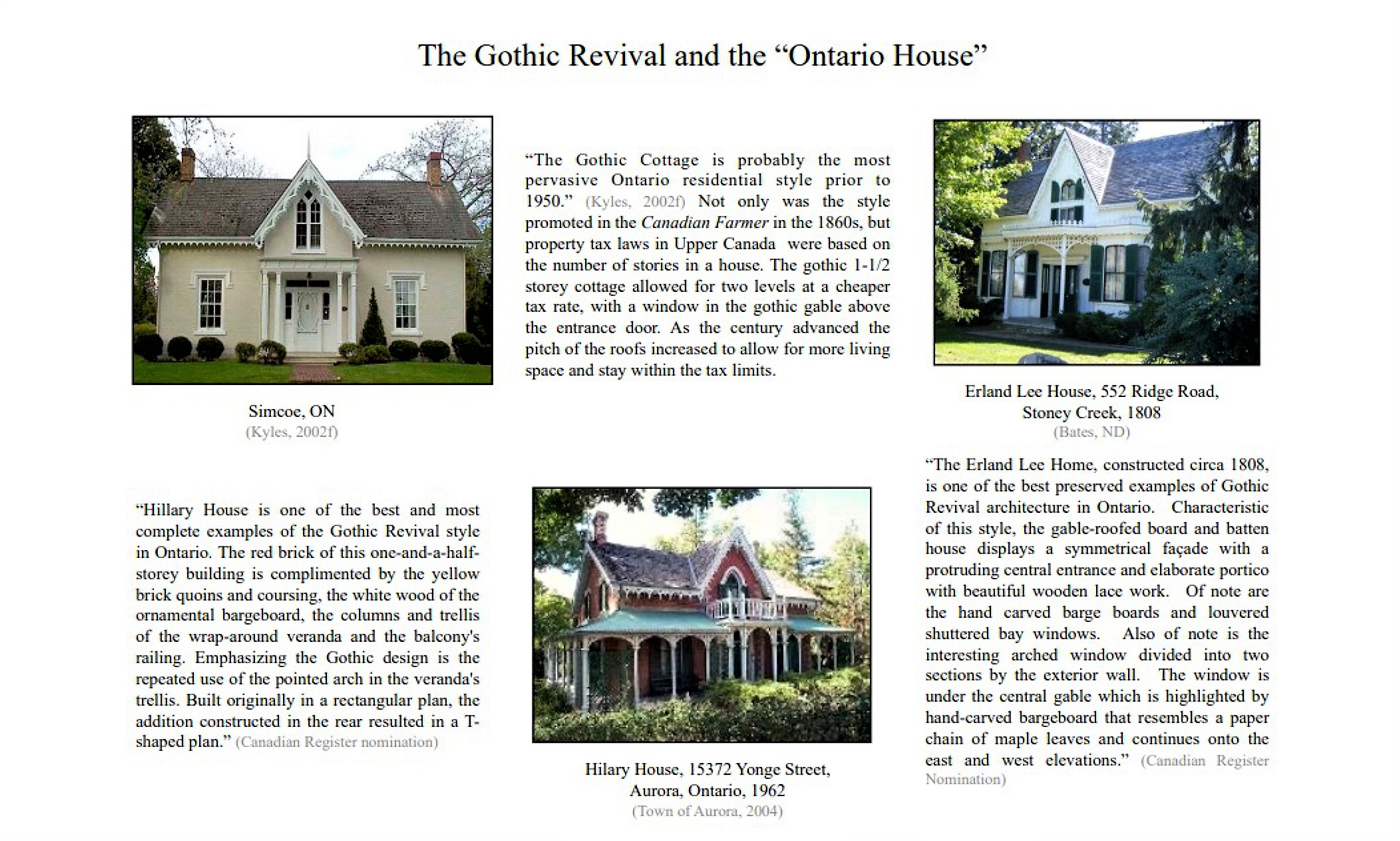
From the Ontario Architectural Style Guide, Heritage Resource Centre, University of Waterloo, p. 9

The Urbaneeer also has a good article on the Ontario Gothic revival cottage: http://urbaneer.com/blog/ontario_gothic_revival_cottage

2. Some Architectural Terms

Diagram showing typical features of a Gothic Revival villa.

Arch: Curved structure used as support over an open space or recess. The wedge-shaped elements that make up an arch keep one another in place and transform the vertical pressure of the structure above into lateral pressure.

Architecture: The art of designing and building according to the rules regulated by nature and taste.
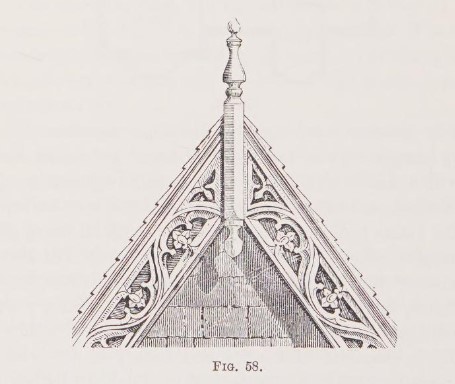
Finial and bargeboard, Andrew Jackson Downing, Cottage Residences (New York: Wiley & Halstead, 1856)

Bargeboard: fancy, wooden ornately carved scrollwork, attached to and hanging down under the eaves of the projecting edge of a gable roof.

Bay Window: A window forming a bay or recess in a room or an alcove projecting from an outside wall and having its own windows and foundation.

Bay: A unit of interior space in a building, marked off by architectural divisions;  sections of a building, usually counted by windows and doors dividing the house vertically.

Brick bonds from Tomkin Brothers, Face Brick – Technical Information, 1955

Bond:  the pattern in which bricks are laid, either to enhance strength or for design.

Hand-moulded brick, Leslie General Store and Post Office, Curzon and Queen Street E., Photo J. Doucette.
Brick pressed in a brick machine. Photo by J. Doucette.

Brick:  was a much more expensive cladding than plaster and lathe or wood and as a result, there were very few houses built with this material until the 1860s. Early bricks were somewhat irregular in size, averaging less than 8″ x 4″ x 2″. They had flat surfaces but were often rough, warped, and cracked. The rough cast plaster house or brick-fronted house would have been cheaper to build than an all-brick structure, while still offering some fire protection. Di-chromatic brick: red and white (yellow). Commoner as local brick production increased.

Builders: lacked formal training – there were few master builders or architects at the time.

Carpenter Gothic:  ornate wood decoration; also called gingerbread, carpenter’s lace (for an example, see the house on the north side of Dundas Street directly across from Brooklyn Avenue).

Cladding: exterior surface material that provides weather protection for a building

Clapboard (weatherboard): a house siding of long, narrow boards with one edge thicker than the other, overlapped to cover the outer walls of frame structures.

Cottage: in the Victorian era this was not a get-away retreat on a Muskoka lake, but a small house. In the late 1800’s the most common form of a small house in Ontario and much of the US was the “working man’s cottage”. This loose design was influenced by British and American architects who were trying to reduce the unsanitary and crowded conditions of working-class housing. A model cottage was built at the Crystal Palace industrial exhibition in London in 1851, giving momentum to its appearance in construction pattern books and magazines (e.g. The Canadian Farmer in 1865) that were used all over North America and Britain.

Innovations included water, internal sanitation, fresh air, and separate bedrooms for children – although sanitation was treated as an option in many cases. The style applied to the cottage was influenced by its location. In Ontario, with many immigrants from Britain, the style leaned to Gothic, with details such as finials, bargeboards (gingerbread), and window trim carrying the Gothic elements. 

A variation of this home is the “Side Hall Plan” cottage, defined by having the front door to the right or left of the façade’s center

Course:  a continuous horizontal row of brick or stone in a wall.

Overdoor porch and door. The door has a hood mouding also known as a drip moulding. Andrew Jackson Downing, Cottage Residences (New York: Wiley & Halstead, 1856)

Decorative wooden trim: Most homes include a street-facing gable decorated with wood trim such as brackets, patterned millwork, bargeboards, or shingling; this decoration is also occasionally used on the porch gable.

Diaper: A pattern formed by small, repeated geometrical motifs set adjacent to one another, used to decorate stone surfaces in architecture.
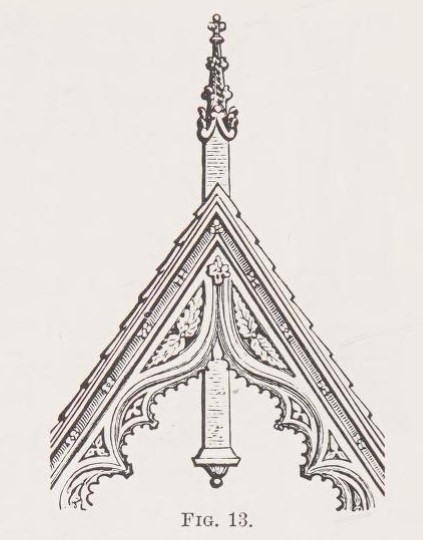
Bargeboard with finial. Andrew Jackson Downing, Cottage Residences (New York: Wiley & Halstead, 1856)

Doors and windows: Front facades of homes in this district are typically narrow, which means that architectural elements like windows and doors take up a large proportion of space.

Ell: an addition or wing to a house that shapes it like an “L” or a “T”.

Facade:  the faces of a building, often identified by the cardinal direction (N,S,E,W) which it faces.

Finial: An ornament at the tip of a pinnacle, spire or other tapering vertical architectural element.
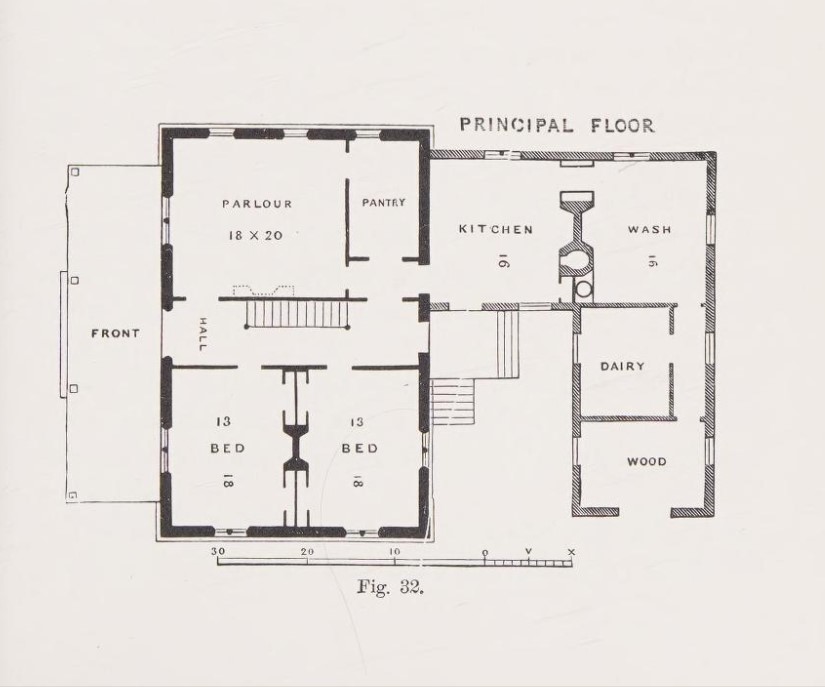
An ornamental farmhouse floor plan. Andrew Jackson Downing, Cottage Residences (New York: Wiley & Halstead, 1856)

Floor plan or ground plan: Horizontal cross-section of a building as the building would look at ground level. A ground plan shows the basic outlined shape of a building and, usually, the outlines of other interior and exterior features. The main floor and upper floor plans (if any) are always included. In addition, depending upon the scope of the survey, plans at the following levels may be required: foundation plan, reflected ceiling plans (crawl space, main and upper floors), attic joist plan, rafter plan, and roof plan.

Foundation wall, beam, column, footing: Many houses were placed directly on the ground. These deteriorated if they were not raised above the soil. Sometimes houses were set on mud sills on the ground. Masonry walls (bricks and mortar) were used for footings from c. 1850 – 1900. Poured concrete foundations became popular in the late 19th century. Houses on brick foundations tend to settle over the years and are prone to moisture in the basements.

Gable:  (1) that part of the wall, triangular in shape, defined by the sloping sides of a double pitch or gable roof;  (2) the end wall of a building.

Glazing:  the glass in a window. Glazing was expensive and it is very likely that all of the houses in this article had shutters to protect the glass.
Gothic Revival 1845-1890:  The Gothic Revival style first appeared in England in the late 1700’s.  Around 1840, shortly after Queen Victoria’s accession to the throne, the Gothic Revival in Britain became very popular.  The Victorians who saw it as a way to recapture both medieval romance and a sense of national relevance. Three forms were revived: Early English-squat high steeped with masonry cladding and pointed single light windows; middle pointed, featuring windows of a curvilinear design; and attenuated Perpendicular, marked by slender spires, elongated pinnacles, and crenellations. Late high Victorian Gothic homes usually featured two colours of brick, usually red with yellow for decoration (dichromatic brick) and heavier ornamentation especially bargeboard. Much of Toronto’s cheap housing of the 19th century was built in a simplified Gothic style, and faced with wood lathes and stucco or even mud.

Head:  the top of the frame of a window or door.

Header:  the end of the brick seen in a brick course.
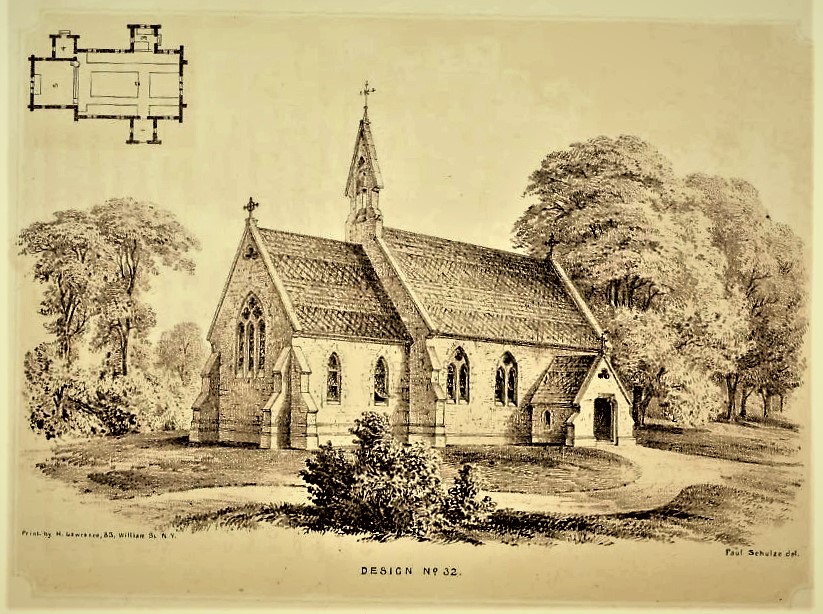
Church with lancet windows. Henry Hudson Holly, Holly’s Country Seats. This church is almost identical to the one I attended as a child (St. George’s Anglican Church, Pickering Village). The three-holer outhouse was hidden by the tree to the right at our church.

Lancet: A slender, pointed window.

Leaded glass:  small panes of glass held in place with lead strips; glass may be clear or colored (stained).

Light: small panes of window set into an individual sash.

Lime mortar:  lime + sand + water; used prior to the late 19th century to lay brick and stone, and for parging exterior masonry walls.

Lintel: A flat horizontal beam that spans the space between two supports.

Lozenge: A diamond shape.

Mortar:  a material used in the plastic state and troweled into place to harden, used to consolidate brick, stone, and concrete blockwork.

Mullion: The vertical element that separates the lancets of a window.

Muntin: the thin vertical bars that vertically divide a window or other opening into small lights.

Ontario Cottage on the west side of Broadview Avenue, south of Dundas Street East – July 21, 1982, City of Toronto Archives

Ontario Cottage: These one-story homes typically built between the 1830s and 1880s include gingerbread trim and formal symmetry on the front façade, an entry door centered to align with the steep-sloped, gable or hip roof designs, and a peaked central gable dormer. This style featured a central gable with windows flanking a central doorway.

Pitch: the degree of slope of a roof, usually given in the form of a ratio, such as 6:12.

Porch: a roofed exterior space on the outside of a building.

Quoins:  rectangles of stone or wood used to accentuate and decorate the corner of a building.

Rafter: a framing member supporting the roof.

Repointing: removal of old mortar from joints of masonry construction and filling in with new mortar.

Sill:  the horizontal water-shedding element at the bottom of a window or door frame.

A brick country house. Note the dichromatic brick over the door. Andrew Jackson Downing, The Architecture of Country Houses (1850)

Stained glass windows and transoms: Stained glass decoration is sometimes found used in homes, especially in large, arched windows in the front of the house, and in transoms over the front doors.

Stretcher: the long side of a brick when laid horizontally.

Stringcourse: A continuous projecting horizontal band set on the surface of a wall and usually molded.

Stucco or roughcast The earliest homes were constructed quickly with the easiest and most available materialsr. Lake stone, river stone and glacial erratics picked up from farm fields were used for the cellar walls and footings. Stucco or roughcast was common up to the 1850’s and even after as housing for the poor. Roughcast plaster was laid over wooden laths. The finishing coat was a thick mixture of thin mortar and small pebbles, thrown or “cast” against the wall. Lumber was plentiful. The narrow boards turned out from the mills were not esteemed for export so the narrowest, about six inches in width, were made use of. These were placed on the foundation timbers and securely nailed, one on top of another, the edges of alternate boards projecting so as to form a groove into which the mortar was pressed.  Early stucco used animal hair (often horse), straw, or other binders. Sand or fine gravel was used to create texture.

Studs:  the upright framing members for a wall.

Trim:  the framing of features on a façade which may be of a different color, material, or design than the adjacent wall surface.

Andrew Jackson Downing, Cottage Residences (New York: Wiley & Halstead, 1856)

Two-story Victorian houses with side entry:  Another vernacular house type that appeared in the Victorian period is the two-story house with side entry.  They use a variety of Victorian treatments on the narrow, front facades which face the street.

Verandahs: Verandahs and porches provided shade for the home and offered a sheltered place to sit, especially during warm summer evenings. They also gave homeowners a place to observe and interact with their neighbours. Porches were initially made of wood, which could warp, leak or rot if improperly constructed. By the 1910s, porches were constructed from concrete and brick. As the world became less rural, demand for porches declined; cars stirred up dust and people became more private, spending their spare time indoors with their families and televisions. Most pre-1914 homes in this district were designed to have some sort of covering for the front door entrance, whether it is a front porch, verandah, or a small overhang called an “over door”. Homes built during the 1920’s feature porches that are integrated into the roofline. Porches include a variety of features, including columns, spindles, and handrails.

Verge board: see bargeboard.

Vernacular: used to describe buildings with little or no stylistic pretension, or those which may reflect a rural interpretation of high-style architecture of the day.

Water table: a slight projection of the lower masonry or brick wall a few feet above the ground as protection against rain.

Windows:  glass set into a sash, or frame double-hung — a window with two sashes, one above the other, arranged to slide vertically past each other. Casement: a window with the sash hung vertically and opening inward or outward. Components of windows included frames, sash, muntins, heads, hood mouldings, decorated jambs, mouldings, exterior shutters.

3. Some Online Resources for Maps and Plans

To see more Goad Atlas plans go to: http://goadstoronto.blogspot.com/

For more early maps of Toronto go to: http://oldtorontomaps.blogspot.com/

For an excellent City of Toronto map go to: https://map.toronto.ca/maps/map.jsp?app=TorontoMaps_v2
Brooklyn Avenue: Stories by the number: 1 Brooklyn Apts #4

By Joanne Doucette (liatris52@sympatico.ca)

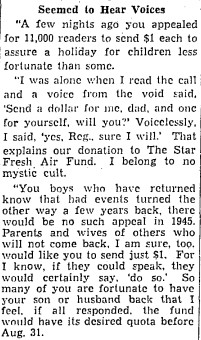
A Ghostly Voice

Brooklyn Apartments, 1944
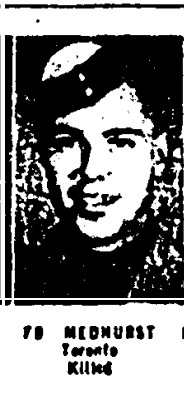
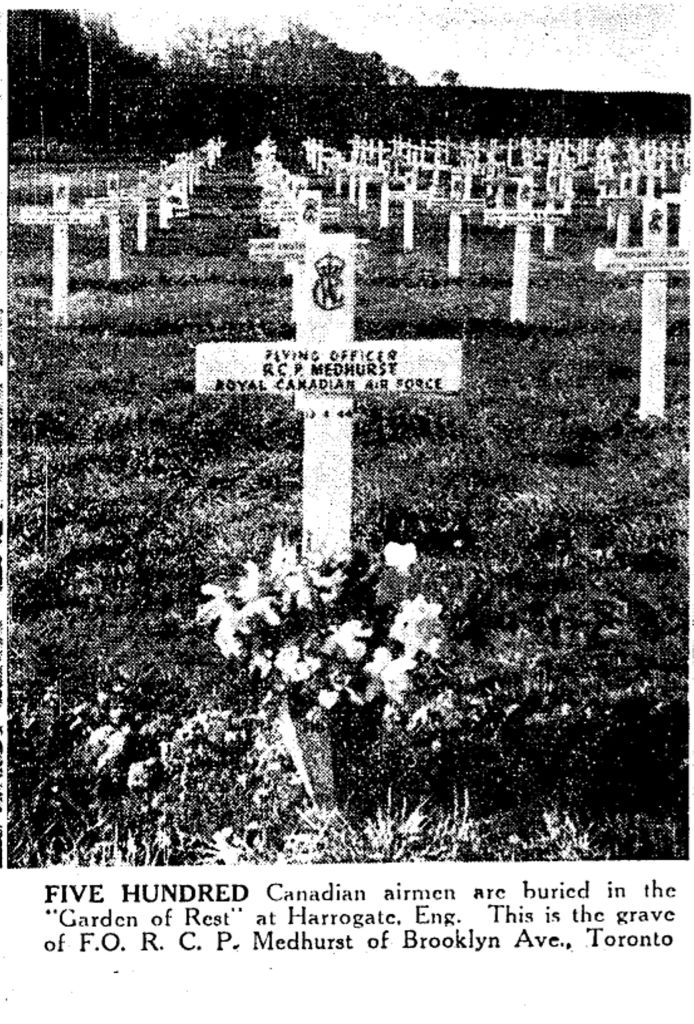
Flying Officer Medhurst arrives in England
Toronto Star, April 19, 1943
Bombardier killed, Medhurst, Globe and Mail, January 27, 1944
A Royal Air Force Handley Page Halifax B.V Series 1 (Special) (s/n EB151, “OO-R”) of No. 1663 Heavy Conversion Unit based at Rufforth, Yorkshire (UK), getting airborne from RAF Holme-on-Spalding Moor, Yorkshire, during a training flight. Flying Officer W. Bellamy, Royal Air Force official photographer – This is photograph CH 11529 from the collections of the Imperial War Museums.

From his military records:
Name:  Reginald Chester Pelham Medhurst
Rank:                                    Flying Officer
Death Age:                           27
Birth Year:                             abt 1917
Death Date:                          13 Apr 1944
Military Base:                        Lissett, Yorkshire, England
Service Number:                    J23727
Unit:                                     1663 Heavy Conversion Unit, attached from 158 Squadron
Command:                            Bomber Command
Ship [Airplane]:                     Handley Page Halifax V
Occupation:                          Air Bomber
Casualty:                              Killed whilst flying
Residence Place:                  Toronto, Ontario, Canada
Burial Place:                         Harrogate (Stonefall) Cemetery, Yorkshire, England
Notes:                                  stalled and crashed at Healaugh moments after taking off from Rufforth on a night training flight, one survivor

For more about this airforce base see https://en.wikipedia.org/wiki/RAF_Rufforth

Toronto Star, August 10, 1945
Toronto Star, September 15, 1945

Brooklyn Avenue: stories from the street, 1886-1899

By Joanne Doucette (liatris52@sympatico.ca)

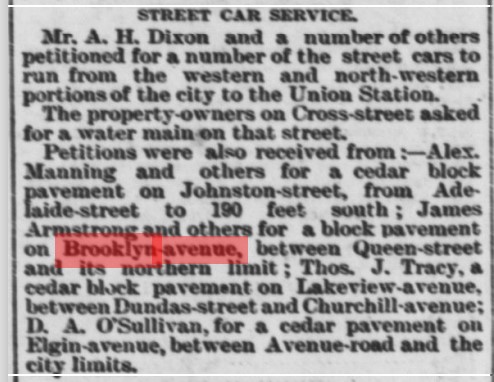
James Armstrong was of the realtors responsible for developing the former clay quarries as a new street: Brooklyn Avenue. Paving the street was highly in his company’s interests. Globe, May 4, 1886

City Engineer’s Report, Globe, May 9, 1886
Lots sold Brooklyn Ave, Globe, February 15, 1887
Lots sold Brooklyn Ave, Globe, March 26, 1887
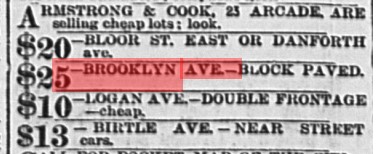
Lots for sale, Armstrong & Cook, Globe, November 8, 1887
Lots for sale, Globe, February 18, 1888
Petley lots for sale, Globe, July 21, 1888
Ontario election polling station, Globe, May 31, 1890
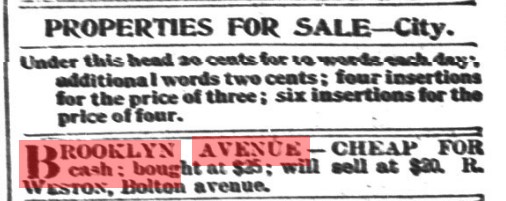
Lots for sale cheap, Globe, August 27, 189
James Frame runs for Alderman, must own land to be eligible, Toronto Star, January 1, 1907
Found watch, Globe, September 23, 1897
Warden York Co Stokes tax arrears, Toronto Star, November 5, 1897
Patronage and appoints: R.B. Oxley appointed Customs, Liberal supporter, Toronto Star, August 26, 1898
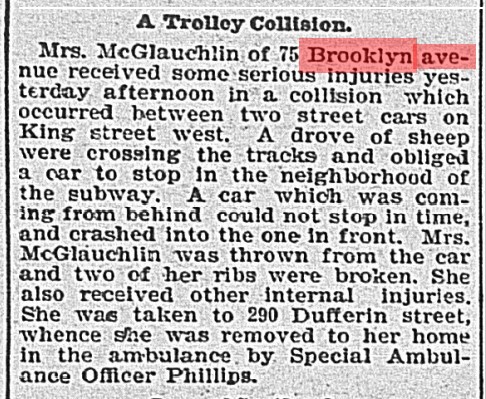
A flock of sheep causes chaos for the streetcars and injures Mrs. McLauchlin of Brooklyn Avene. Trolley collision, Globe, August 31, 1898
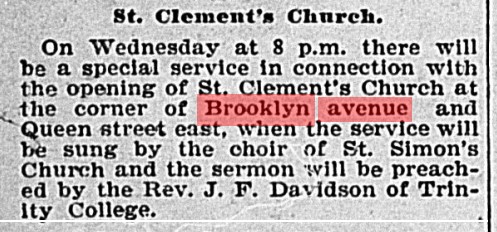
The Canadian architect and builder [Vol. 13, no. 11 (Nov. 1900)] St Clements Brooklin ave
Cornerstone St. Clement’s Anglican Church, Globe, October 8, 1898
Clements Church, Globe, January 4, 1899
St Clements, Globe, April 4, 1899
Property for sale, brick house, coach house, stabling, Toronto Star, July 4, 1899

Leslieville Map 1909, showing Brooklyn Avenue
1909 Sankey Map showing the creeks that ran through the brickyards

Brooklyn Avenue: More Resources 1900-1920

By Joanne Doucette (liatris52@sympatico.ca)

Loans to builders, Armstrong & Cook, April 5, 1900
McCarten will build a two-story brick front house on Brooklyn Avenue, Toronto Star, November 7, 1900

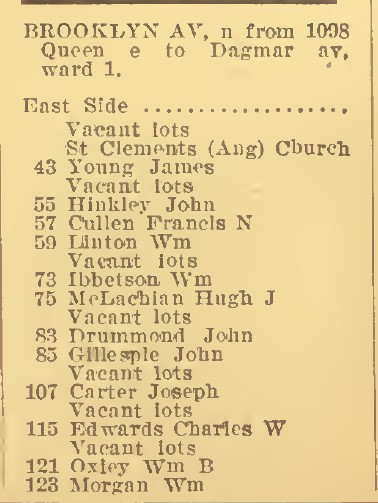
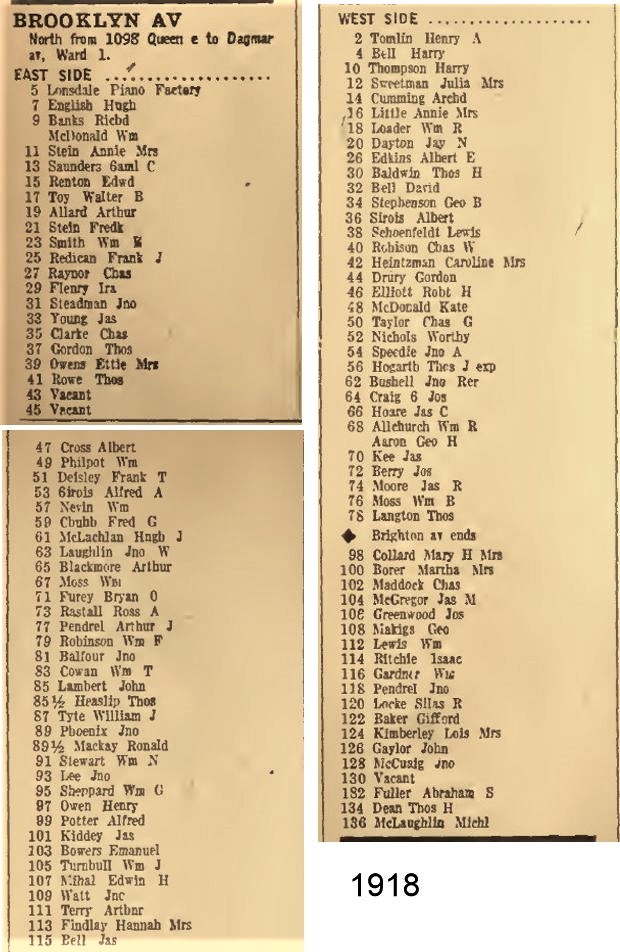
City of Toronto Directories

1900
1900
1901
1901
1902
1903
1903
1904
1905

1906
1906
1906

1907
1908

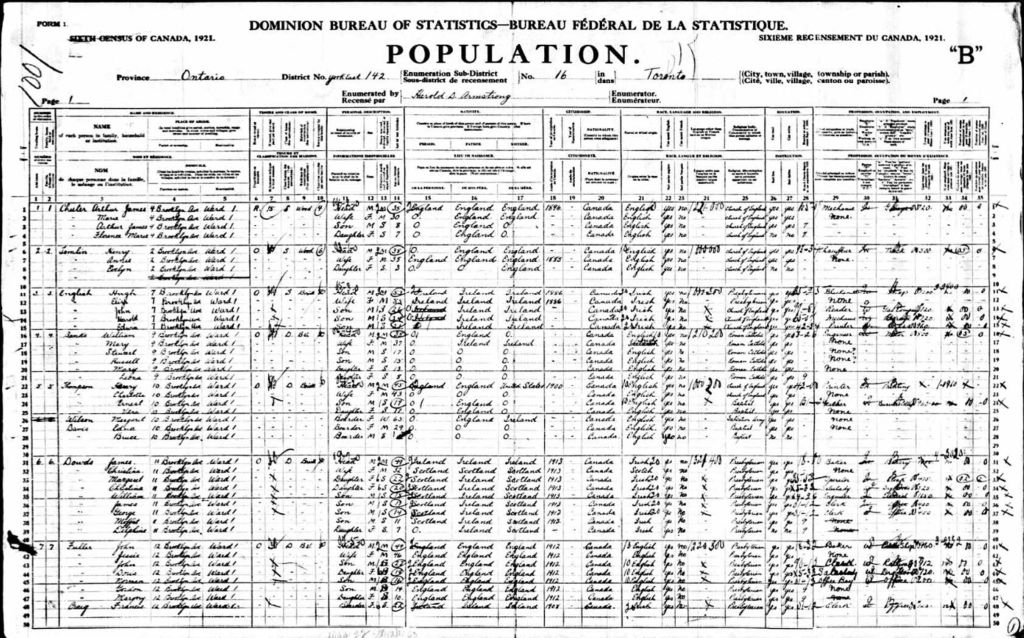
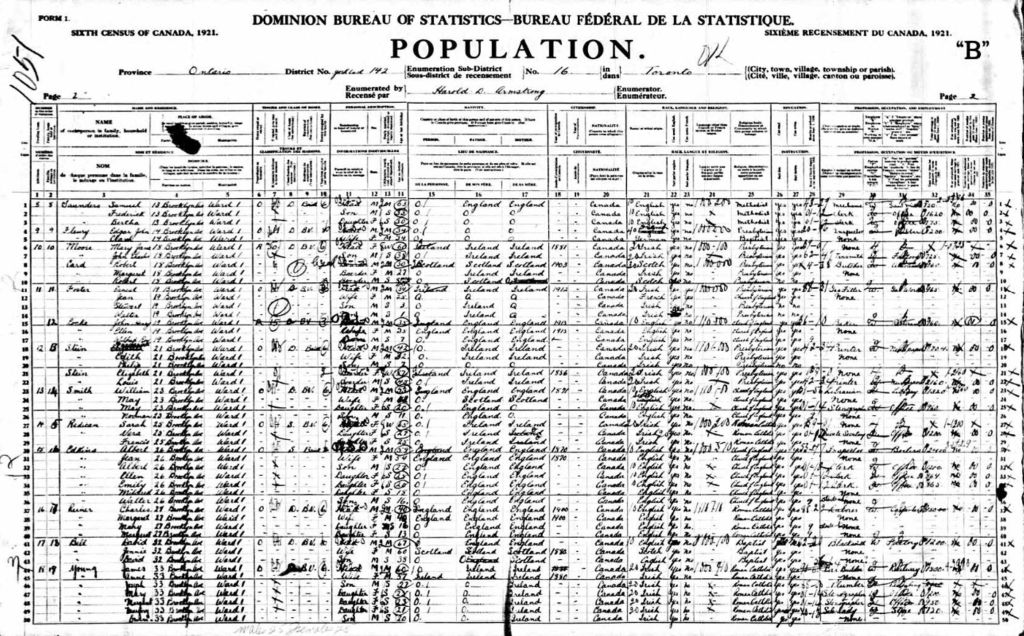
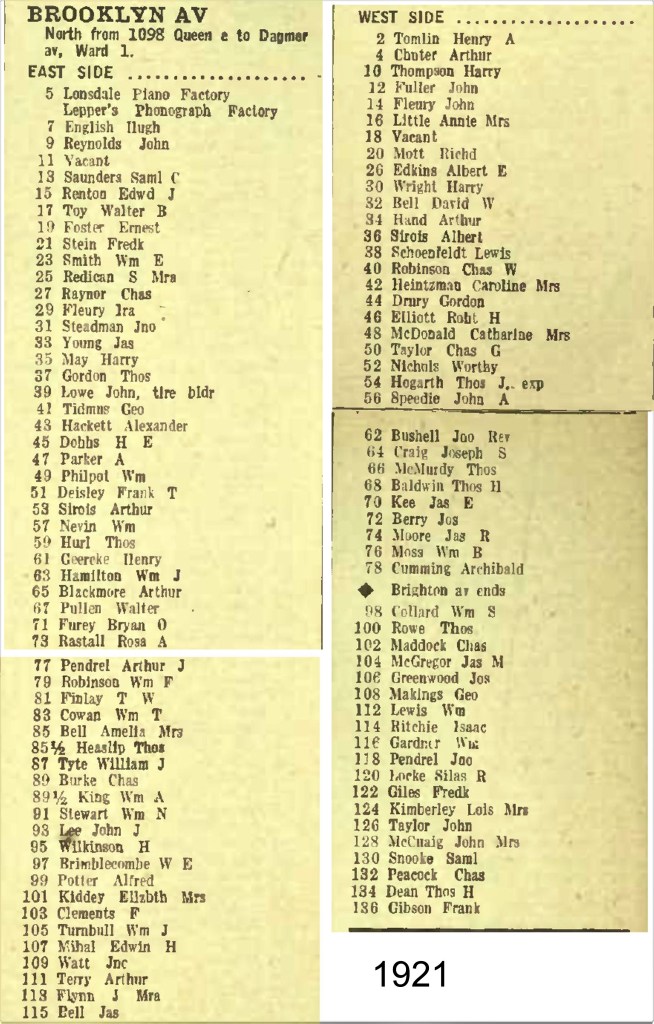
1921 Census

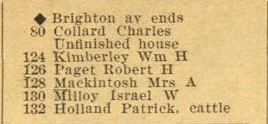
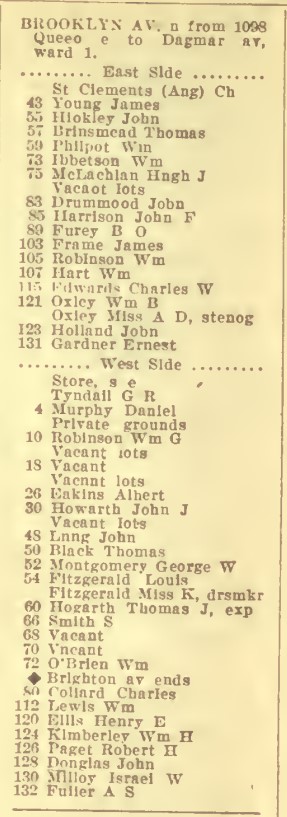
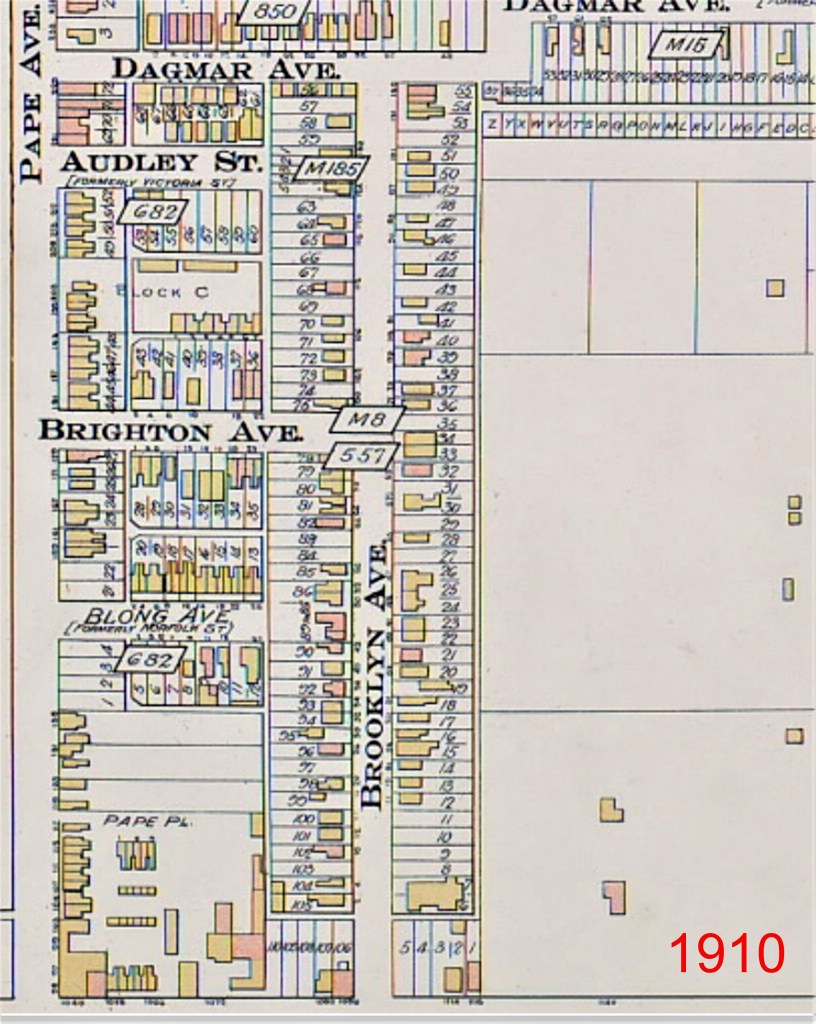
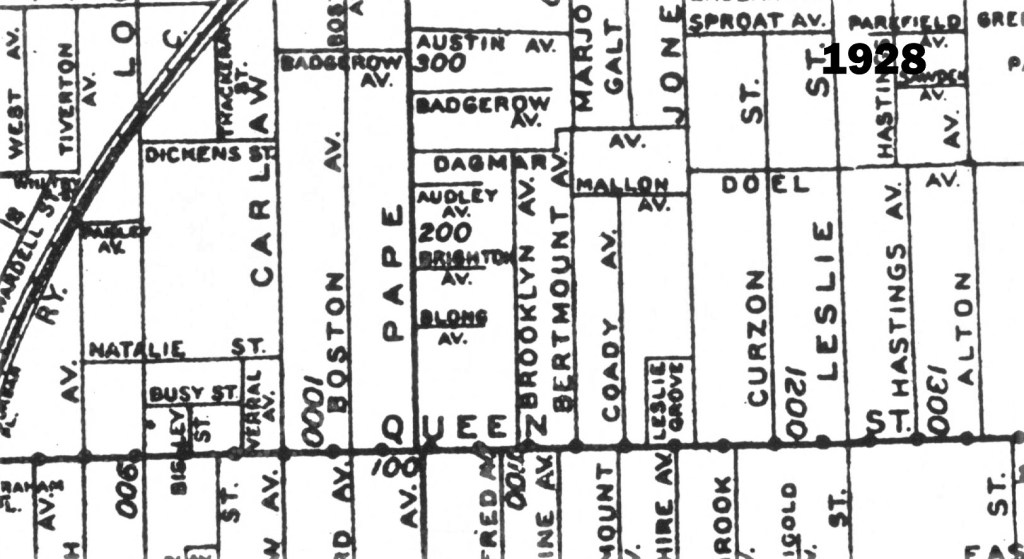
Goad’s Atlas Plans

1913 top
1913 bottom

Brooklyn Avenue: Some Resources from the Early Days of the Street (Updatd October 22, 2022)

By Joanne Doucette (liatris52@sympatico.ca)

This post includes:

  1. The Owners & Real Estate Developers
  2. Maps
  3. An Assessment Roll, 1897
  4. List of landowners owing back taxes
  5. City Directories
  6. 1891 Census

The Owners & Developers

Typical Ontario brickyard 1880s

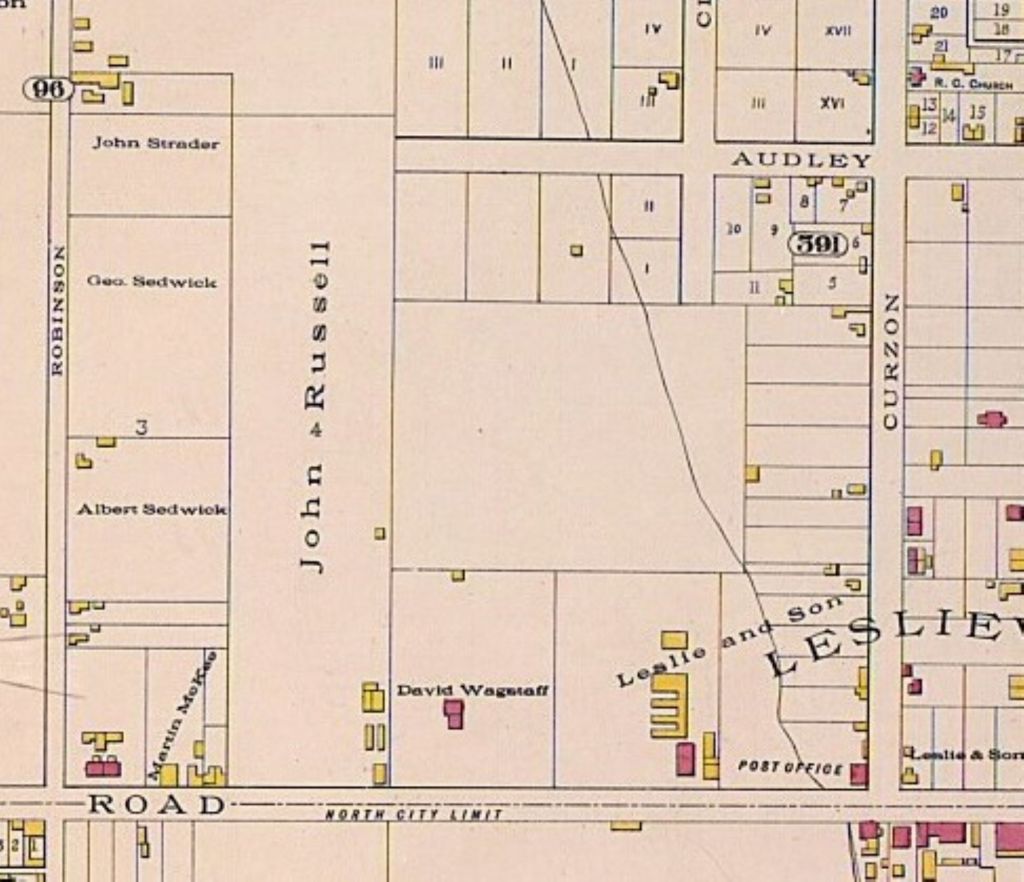
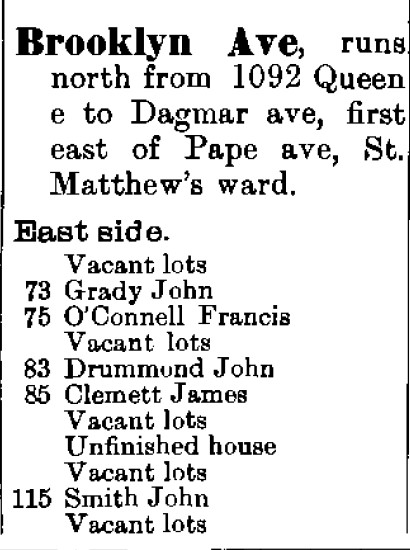
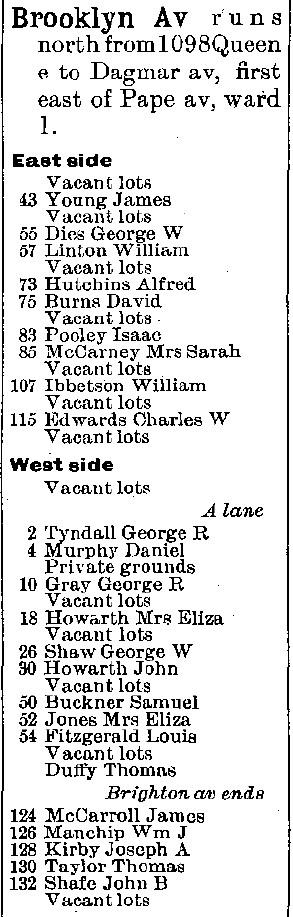
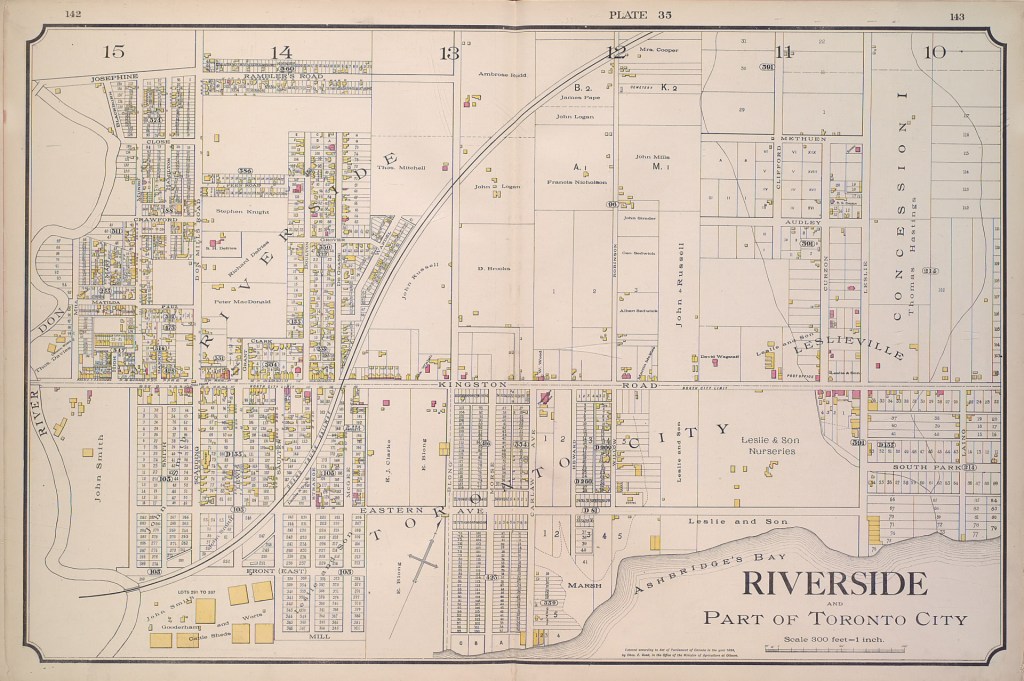
In 1884 when the area was still Leslieville there was no Brooklyn Avenue and it is not listed in the 1885 Polk’s City Directory or the 1886 Polk’s City Directory.  A real estate company owned by James Armstrong and John J. Cook sold most of the property on the street. Brooklyn Avenue was named for a small creek that ran down through it, across Queen Street and down to Ashbridges Bay. Brickmakers followed the banks of these rivulets to look for deposits of the blue clay that they could use to make good bricks. Brooklyn Avenue ran through two brickyards. John Russell owned the brickyard on the west side of Brooklyn Avenue and David Wagstaff owned the brickyard on the east side.

John Russell Globe, July 5, 1902
James Armstrong, Brooklyn Avenue, pavement, Globe, May 4, 1886
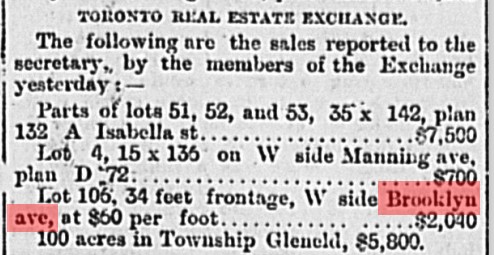
Lots sold on Brooklyn Ave, Globe, June 24, 1886
Lots sold Brooklyn Ave, Globe, February 15, 1887
Lots sold Brooklyn Ave, Globe, March 26, 1887
Lots for sale, Armstrong & Cook, Globe, November 8, 1887
Lots for sale, Globe, February 18, 1888
lots for sale, Globe, July 21, 1888
Lots for sale cheap, Globe, August 27, 1892
James Armstrong, Armstrong & Cook dead, Globe, October 13, 1919
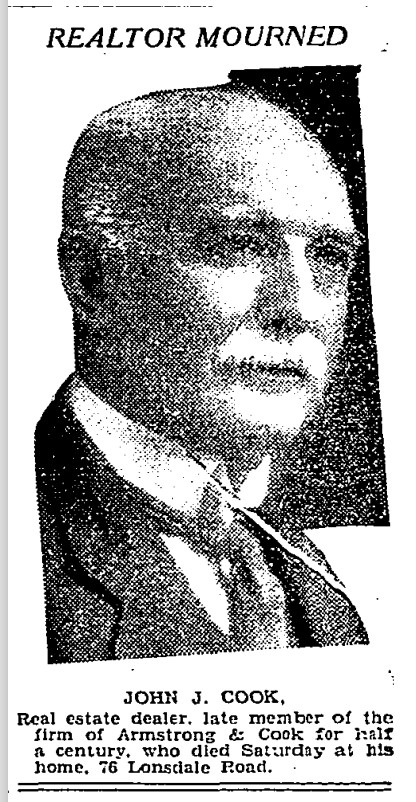
Both John Cook and James Armstrong died very wealthy men. James Armstrong, Armstrong & Cook, will, Globe, December 4, 1919
Realtor mourned John J Cook, Armstrong & Cook, Globe, June 5, 1933
The women of the family rarely get a mention. She was an exception and must have been an exceptional woman. Mrs John J Cook obituary, Globe, March 28, 1935

Maps

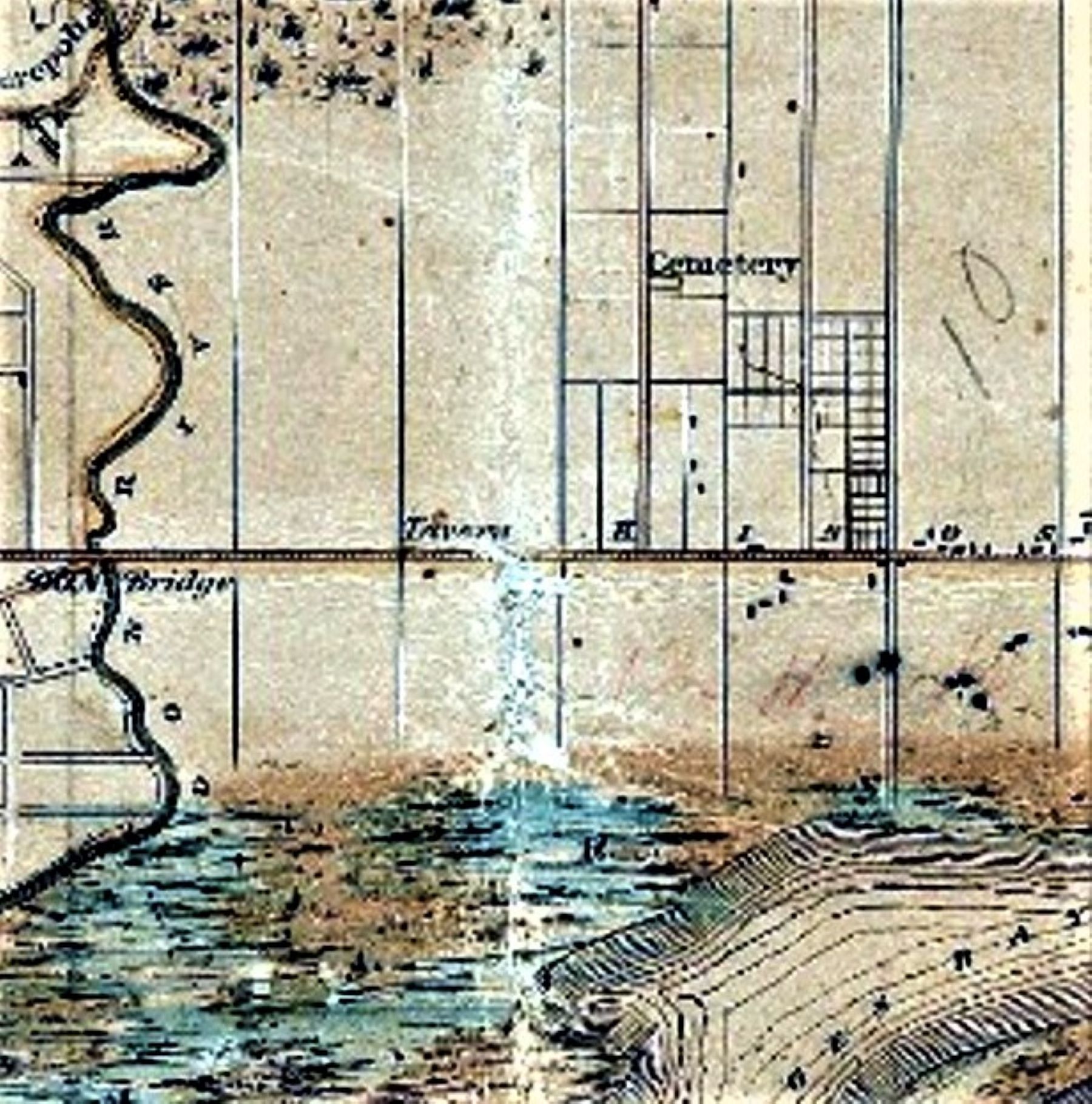
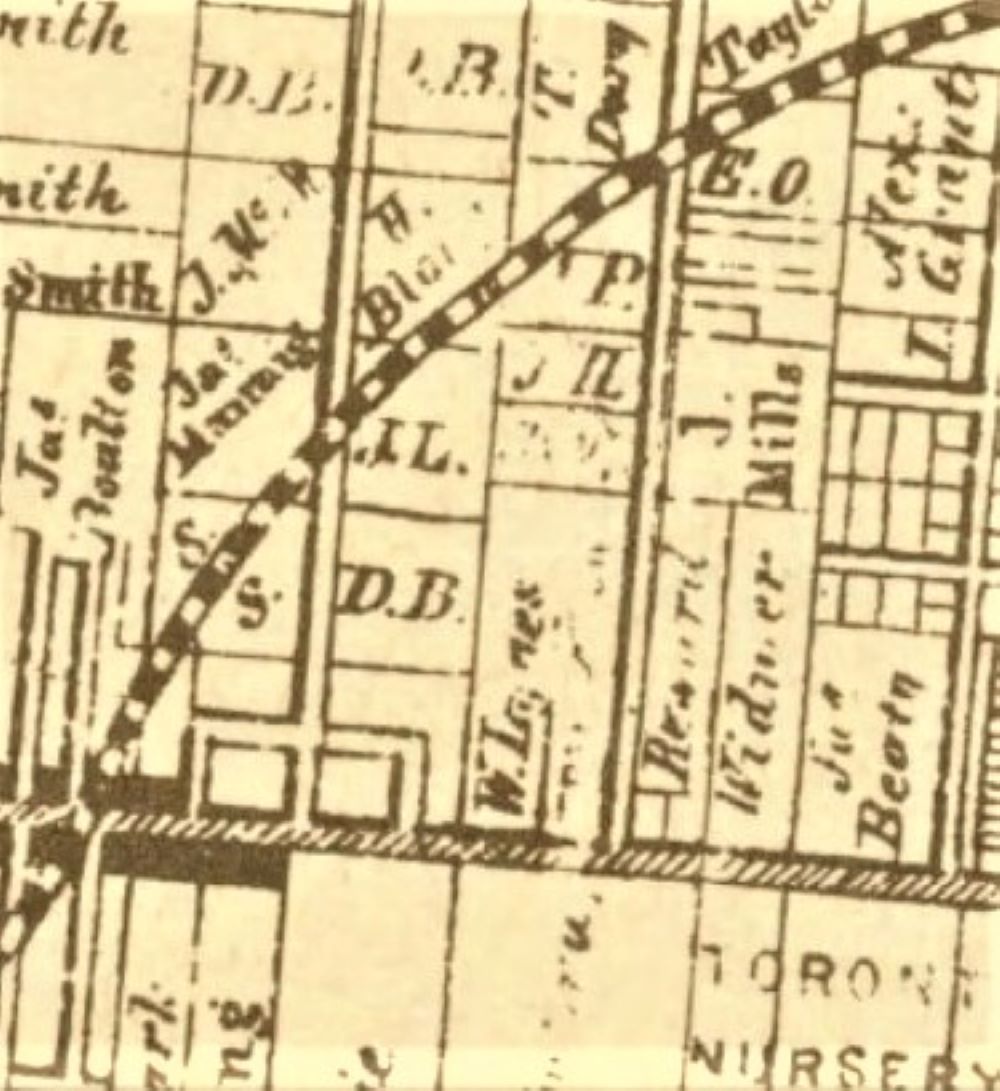
1851 map showing the area before the construction of the Grand Trunk Railway (now the GO Train line). The Holy Blossom Cemetery is on Pape Avenue.
1860 map shows the new Grand Trunk Rail line. George Leslie’s nursery is in the lower right, but he had not yet made his fortune and purchased the Widmer property on the west side of Jones Avenue or the Beaton property on the right.
Brooklyn Avenue doesn’t yet exist in 1884
Goad’s Atlas Plan, 1884
Plan of the City of Toronto 1885 Brooklyn Avenue area. Three creeks ran through the area. Holly Creek on the left crossed Gerrard and Carlaw Avenue. Leslie Creek in the middle gave Brooklyn Avenue its name — “brook” meaning a small creek and “lyn” from “linn” — A waterfall or cataract, or a ravine down which its water rushes https://en.wiktionary.org/wiki/linn#English The creek on the right is Hastings Creek.
1888 Plan of the City of Toronto and Suburbs by Penson, showing a new street: Brooklyn Avenue

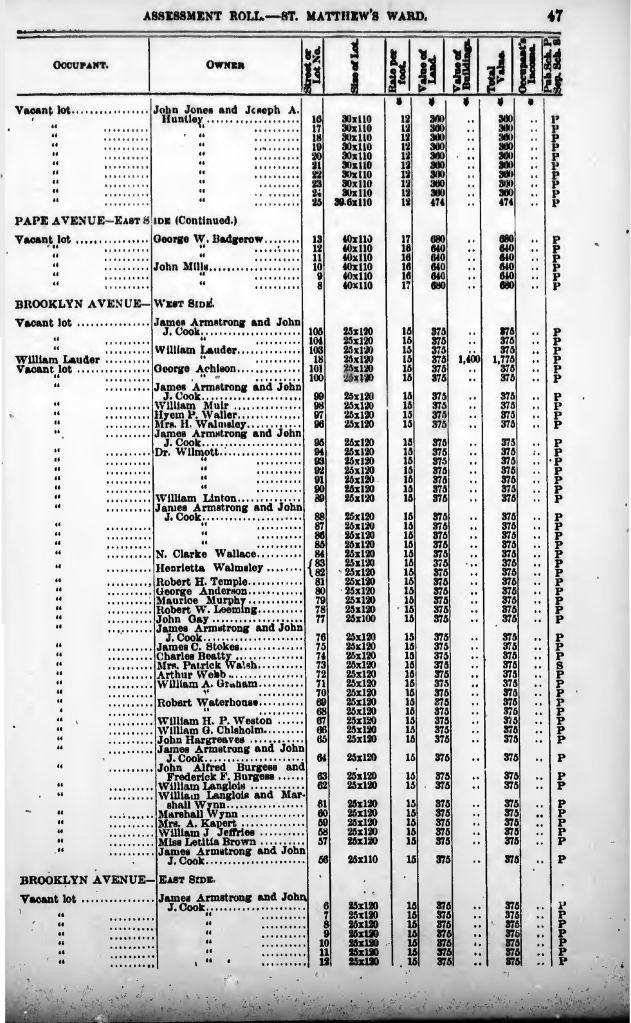
Assessment Roll, Brooklyn Avenue, 1897

1890 Assessment Roll p. 47
1890 Assessment Roll p 48

Often property owners were slow, sometimes very late, in paying their property taxes. Brickyard owners and those with connections at City Hall made a practice of this at times. John Russell found that sometimes too late was really TOO LATE. When he didn’t pay his taxes on one of his many brickyards, the City of Toronto seized it for back taxes and sold it to create an industrial park on Carlaw Avenue that still stands today albeit re-invented as condos and boutiques. Russell fought it all the way to the Privy Council in London, England, but lost. Below is a list from the Toronto Star of November 4, 1897, of those property owners who were in default of their taxes. Many were absentee landowners, holding on to lots as investment opportunities.

Tax arrears, Toronto Star, November 4, 1897

Assessment appeals, Armstrong & Cook, Globe, June 9, 1897

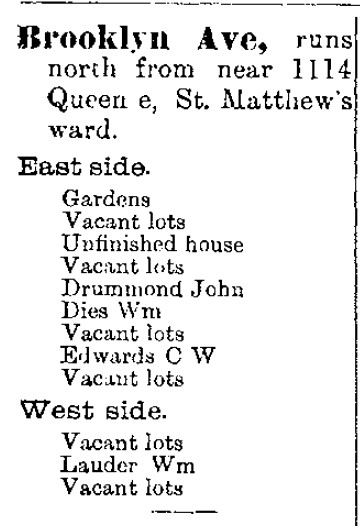
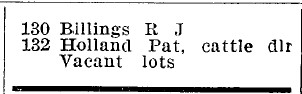
City of Toronto Directories, 1887-1899

1887 City Directory
1888 City Directory
1889
1890
1890
1891

1891

1892

1893
1894
1895
1896
1896
1897

1897

1898
1898

1899
1899

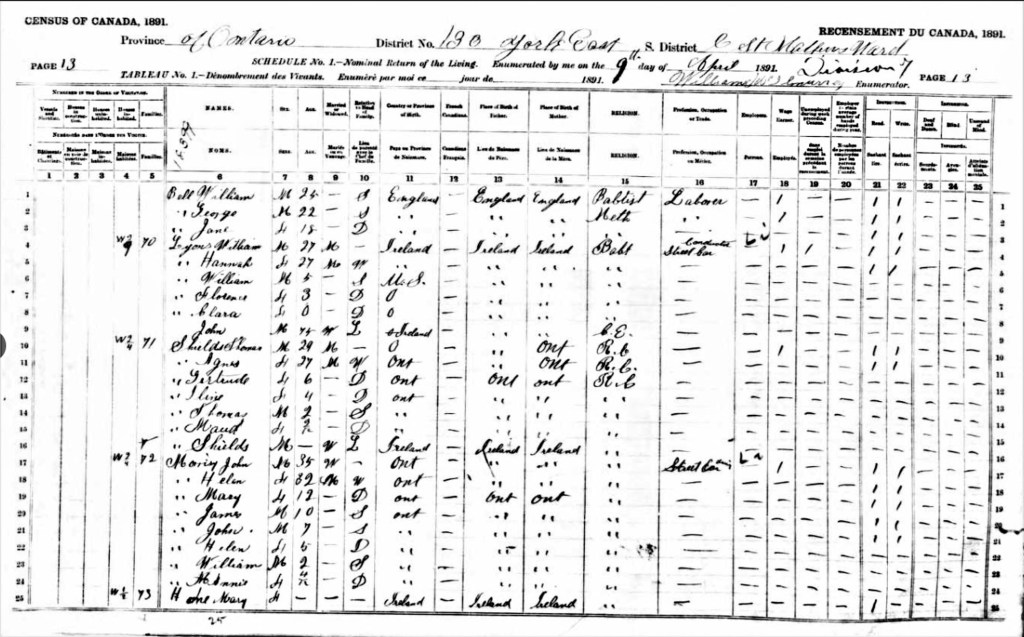
1891 Census

Building Leslie Gardens

From 1836 to 1837 workers had straightened and planked the Kingston Road. It became a toll road, providing a reasonably good route for transporting products in and out of Toronto. Here, in 1842, Scottish gardener and tree grower, George Leslie, leased 20 acres of land from Charles Coxwell Small for a 21-year term. George’s landlord, Small, a member of the Family Compact and Clerk of the Crown, was the owner of extensive lands in the area. (Coxwell Avenue is named after him.) Small may have thought he got the better of the deal when he found someone foolish enough to lease his 20 acres of mucky swampland on the shores of Ashbridge’s Bay. The Toronto Nurseries was built on a tamarack-covered swamp (Larchmount Avenue recalls this). These 20 acres of rich black mud were the core of his nursery which would expand to 200 acres, the largest in Canada. George Leslie did not buy that land until the lease ran out in 1863. Then Small demanded an exorbitant price from Leslie and apparently got it. George Leslie valued that soft, rich dark muck and others recognized its worth, as shown in the Annual Report of the Bureau of Forestry for the Province of Ontario.

The memory of the tamaracks and reeds remained for decades. Marigold Gardens, the subdivision on Toronto Nurseries land, was nothing but “bulrushes and swamps”. Ward 8 News. “Short Stories of Leslieville” in Ward 8 News, February 9, 1979. Marigold Gardens is one street in the former Leslie Gardens subdivision built by realtor and contractor H. Addison Johnston.


Leslie Nurseries 1884 I’ve added notes and marked where the creeks were.
George Leslie attributed to John McPherson Ross ca 1907. John McPherson was a poor Scottish boy when George Leslie took him on as an apprentice. He rose to become foreman of the Toronto Nurseries and Leslie’s right-hand man. After George Leslie died, his sons made unwise investments, became embroiled in scandal, and lost the Toronto Nurseries. Most of it become housing, but a small portion along Eastern Ave continued under the ownership of John McPherson Ross. Caroline Avenue at the west side of Leslie Gardens is named after George Leslie’s first wife.

George Leslie died on June 14, 1893. George Leslie left a large estate with considerable real estate, including properties on Queen Street East, on Jones Avenue, on Curzon Street, on Eastern Avenue, and on Leslie Street, worth almost $115,000 in 1893. Not long after George Leslie died most of the Nurseries was sold. Before long most of the land was mortgaged to the Gooderhams and sold off around 1910. Some Leslie descendants still remember the grudge against the Gooderhams who “took” their land; others remember how like prodigal sons, John Knox and his brother George Leslie Jr., between the two, spent like millionaires, gambled, drank and womanized. The Leslie family’s loss was another family’s fortune.

Success Came by Giving People Made-to-Order Homes, The Canadian Builder and Carpenter, April 1916
H. Addison Johnston had made a name for himself building high-end homes in the Beach. He gained a reputation quality — “honestly built”… “genuine Johnston-built homes.” Toronto Star, March 1, 1919
The economy was still in the grip of a depression and Toronto City Council was hesitant about incurring more costs to provide work. Councillor Gibbons nailed it when he said, “These men are going hungry. We have been at this since last September and nothing done.” The municipality had few choices: make-work projects, welfare (the dole) or hungry, angry veterans who had already demonstrated that they could and would riot. But Council took a risk and agreed to put the sewers for Leslie Gardens out to tender. Addison Johnston was a canny man and an experienced builder and developer. Toronto Star, February 2, 1922
Leslie Gardens sat on the easternmost section of George Leslie’s Toronto Nurseries. A semi-bungalow was a house with a second story with slanted walls to the rooms –not full head-height walls. Globe, December 16, 1922
Globe, January 24, 1923
The Roaring Twenties was beginning to roar finally after the economic downturn that followed World War One. Globe, February 27, 1923
Leslie Gardens School construction, Globe, March 20, 1923
City Council approved laying the sewer system for Leslie Gardens at a cost of $63,618. Globe, April 17, 1923
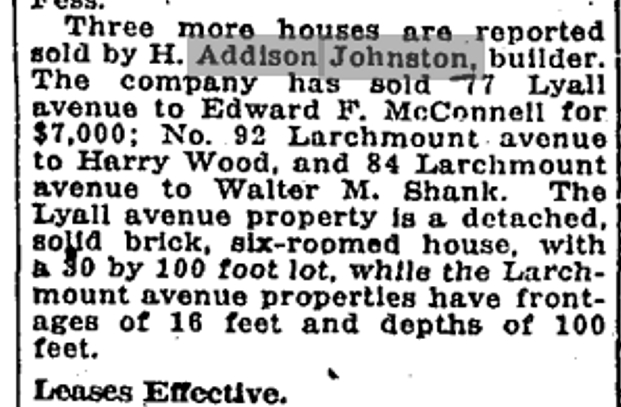
Addison Johnston’s house-a-day plan explained. Larchmount was a new street in 1923 and built up quickly as was the rest of Leslie Gardens. Johnston used pre-fabricated or kit homes and an assembly line approach to putting them up. The fact that they were put up quickly does not mean that the construction was shoddy. However, because Leslieville Gardens was built on an old marsh at the edge of Ashbridge’s Bay, some of the houses may have settled and/or may have problems with wet basements. The black wet marsh mud was great for George Leslie’s nursery but didn’t necessarily make for the best residential building sites. Globe, May 10, 1923
Sales Larchmount Avenue Globe June 4, 1923
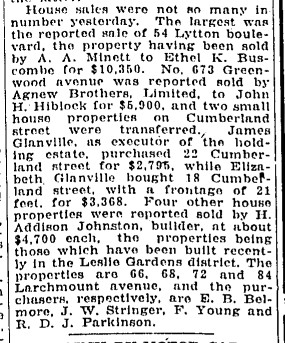
Globe, July 31, 1923. A building boom took off in the spring of 1923 after a short but sharp post-war depression and houses at 66, 68, 72 and 84 Larchmount Avenue sold quickly.
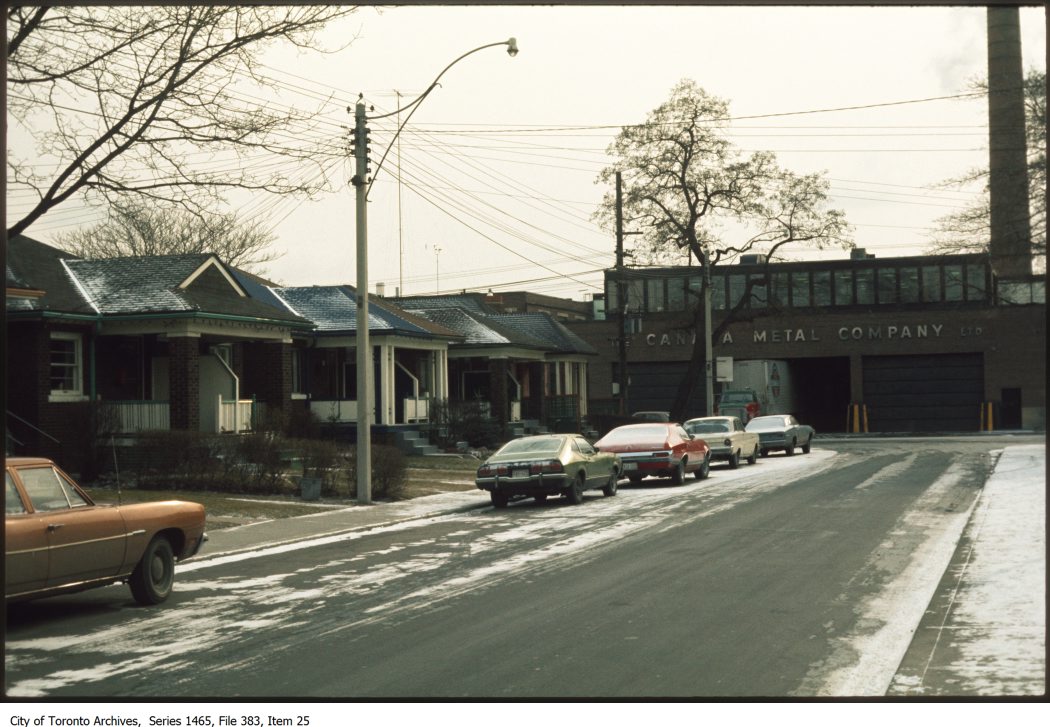
Looking east on Moseley Street with the Leslie Gardens Service Station on the left.

“The market for small house properties continues to be very active.” Toronto Real Estate News Aldridge and Leslie Gardens, Globe, July 21, 1923

This is a photo of the Leslie Gardens gas station on Eastern Avenue and Mosley Street, just west of Leslie Street. The view is looking east towards Leslie Street. The Leslie Garden’s Service Station’s address was 780 Eastern Avenue
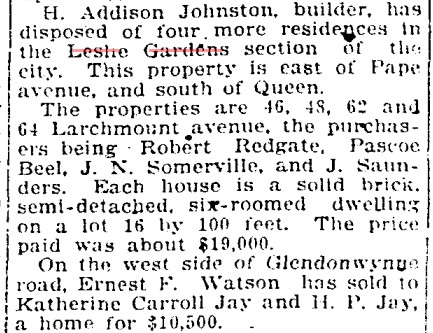
42, 60 and 70 Larchmount Avenue were sold. The lots were narrow with 16 feet of frontage on the street but long at 100 feet. Toronto Star, July 26, 1923
photo from the 1970s
Globe, July 31, 1923
Leslie Gardens Service Station, Imperial Gasoline, ca. 1929
Toronto Star, August 13, 1923. Most of the new home buyers worked in the factories along Eastern Avenue and up Carlaw. To supplement their income and pay a portion of the mortgage, many let rooms or took on boarders.
Globe, August 17, 1923
Leslie Gardens, 1970s
The school was completed but the Board of Education needed to level the playground and parking area. Globe, October 31, 1923
Leslie Gardens, 1970s
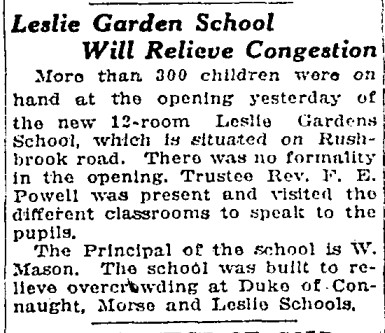
Leslie Gardens school opens, Globe, December 4, 1913
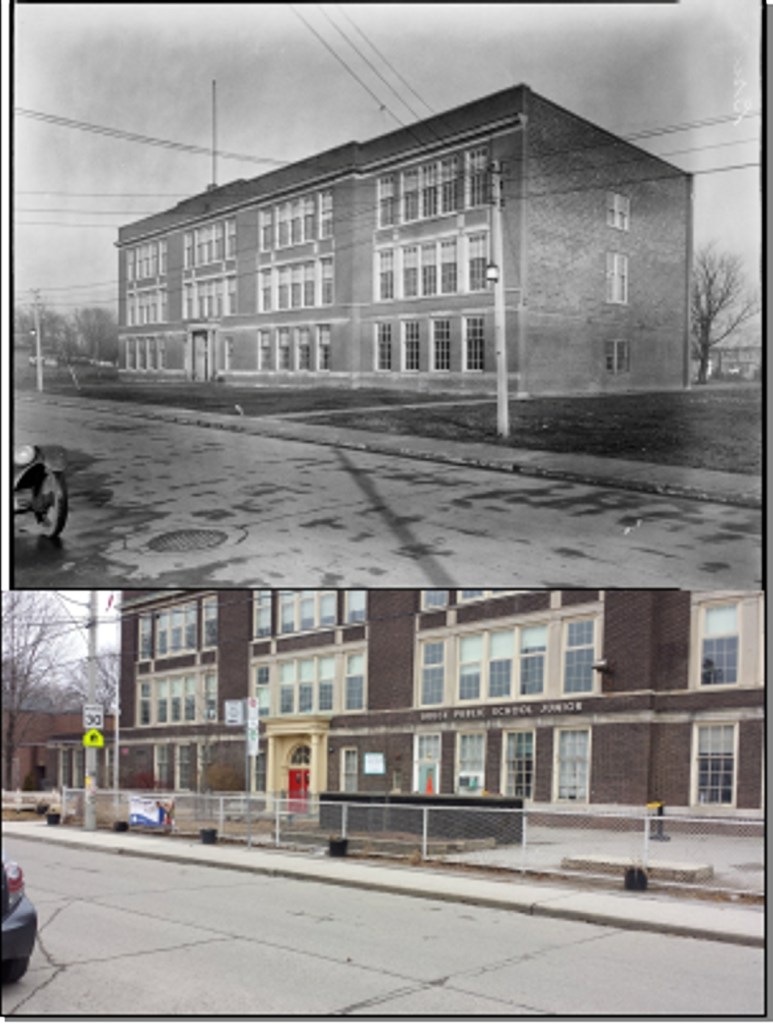
Leslie Gardens School, 1923 (probably on the opening day) and Bruce Public School, 2014
Leslie Gardens 1924 included the east side of Caroline Avenue, Larchmount Avenue, Berkshire Avenue, Rushbrooke Avenue, Marigold Avenue (now Marigold Gardens) as well as the triangle of land at Eastern and Leslie Street.
Building the infrastructure of the Roaring Twenties, Toronto Star, January 18, 1924
photo from the 1970s
Leslie Gardens house for sale, Toronto Star, June 13, 1924
Leslie Gardens School was renamed Bruce Public School, June 28, 1924
Globe, July 1, 1924
Leslie Gardens, 1970s
Globe, October 2, 1924
Leslie Gardens, 1970s
For rent Globe, October 29, 1925. Some of the houses in Leslie Gardens were built for investment income and rented out.
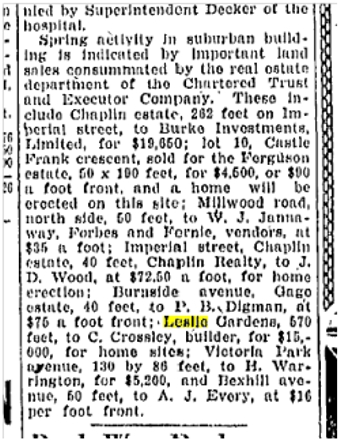
Leslie Gardens, Toronto Star, March 11, 1926. In the early days of subdivision development, an investor or group of investors or sometimes a real estate company bought up a block on land and sold sections of 6-12 houses to builders. This was not true for Leslieville Gardens. Most of the houses there were built for and by Addison Johnston. However, 570 feet of street frontage was a sizeable amount of land enough for 20-30 houses.
Leslie Gardens, 1970s

The Difference Between a Local Historian and an Academic Historian

By Joanne Doucette

Do you enjoy reading local history? Would you like to know more about the past of your neighbourhood? If you do, please read this.

Most, but not all, people who research and write about the history of neighbourhoods do not have advanced academic degrees, such as the very Harry Potterish picture of Professor John Ashley Soames Grenville, historian, taken in 1950 (Public Domain) featured above. The local historian is, like me, an amateur not a professional.

Many academic historians look down on local historians as muddlers who don’t get the big picture. And sometimes that is true, but often not.

Local history is a very democratic kind of practice, drawing on community histories (e.g., in the local history collections of our branch libraries), family history, genealogy and oral history. The best local history relies on meticulous and careful use of original and secondary sources as well as ongoing discussion with professional historians. But local historians have limited resources. Not everyone has the money to get those letters behind the name. We do not have access to the records, the peer-review process, conferences and journals of the academic historian. We rely on sources and our works are published informally – on blogs, Facebook groups, etc. My peers are those who read my posts and blogs and respond. And I am very grateful to you. But I rely on sources and sources are not always right.

There are basically two kinds of sources – primary sources and secondary sources.

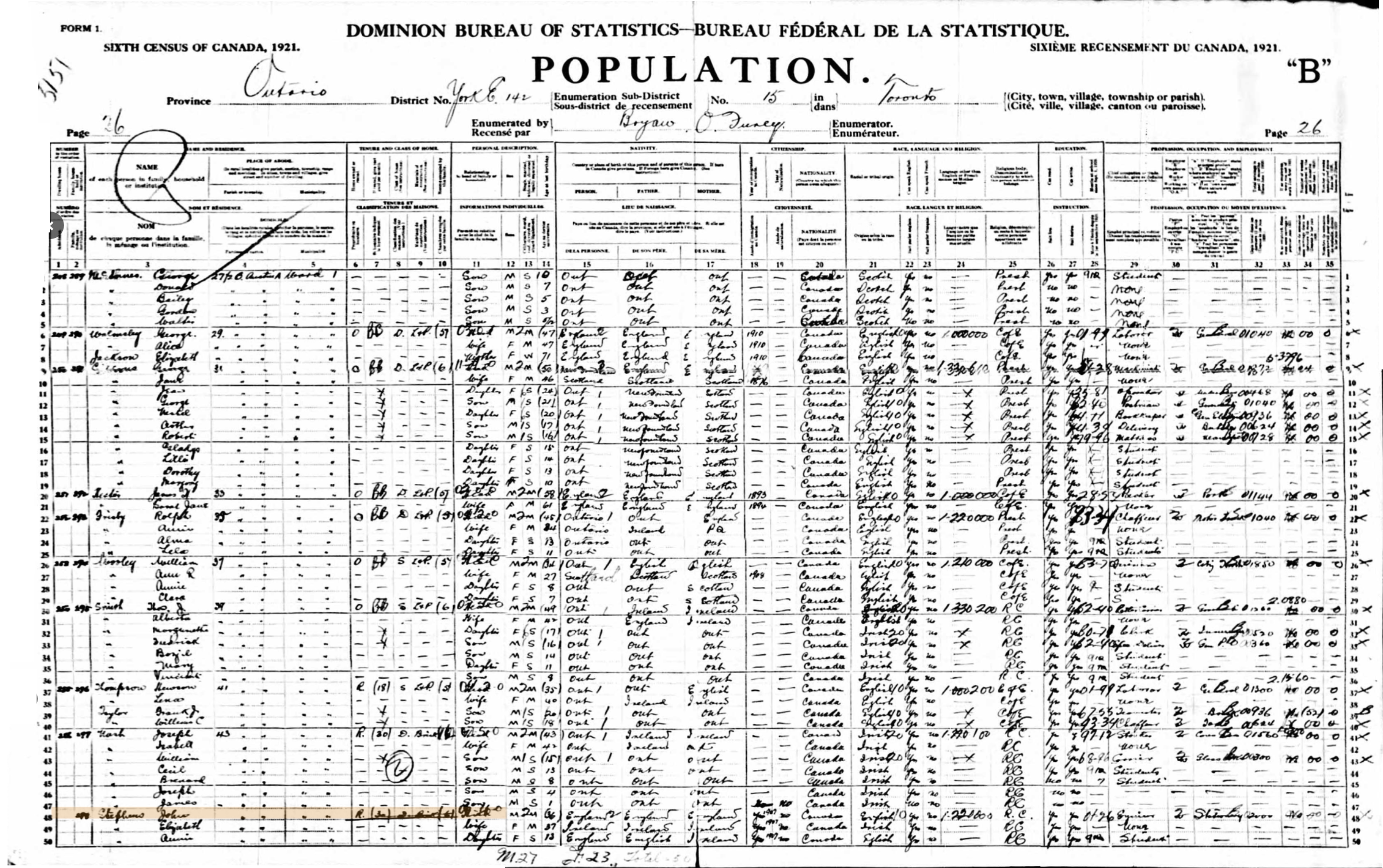
A Census is an example of a primary source.

Primary Sources

Primary sources are things like newspaper accounts, letters, marriage licenses, death certificates, baptismal certificates, tax assessment rolls, etc. They are usually reliable but have to be “handled with care”. Sometimes original sources contain simple mistakes. Sometimes the originator actually lied. Sometimes they didn’t know what they were talking about. Not so different than today. Usually, the records are biased in ways that we now recognize – racist, sexist, etc.

This is an example of a secondary source. The writer of the caption was not there in 1783 when King George presented the fire engine. Fire Engine, Maclean’s, September 1, 1929

Secondary Sources

Secondary sources are records written after the event. The writers rely on records that they might not understand or they may not have researched adequately. Or they too can intentionally distort the truth, often with “little white lies” that romanticize things – the “good old days”, etc.

The story of my family’s mixed MI’kmaq and European ancestry is oral history passed down by word of mouth through the generations depicted here. Family photos: Susan Brewer (nee Doucette), Thomas Leo Doucette and Agnes Lucy (nee Devenish) and Thomas Vincent Doucette.

Oral History

And then there’s oral history. Memories fail and stories passed down often begin to stray from the facts though there’s usually a core that can be verified through researching primary and secondary sources – which leads me back to where I wanted to go.

An original baptismal record confirming the Indigenous roots of my family

Why am I saying all this?

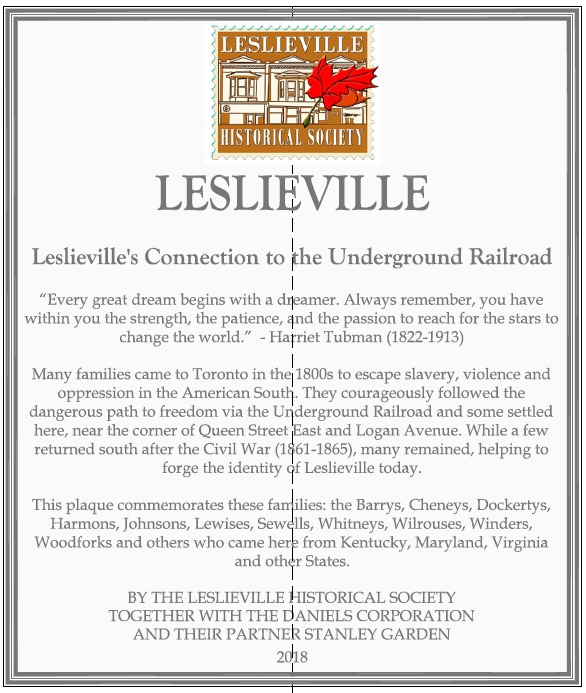
When the Leslieville Historical Society wrote up a plaque to the Underground Railroad two years ago, we made a mistake. The quote didn’t begin to appear until 2007. We relied on secondary sources, even a leading U.S. politician, and the Harriet Tubman Monument and other apparently reliable sources for the following quote:

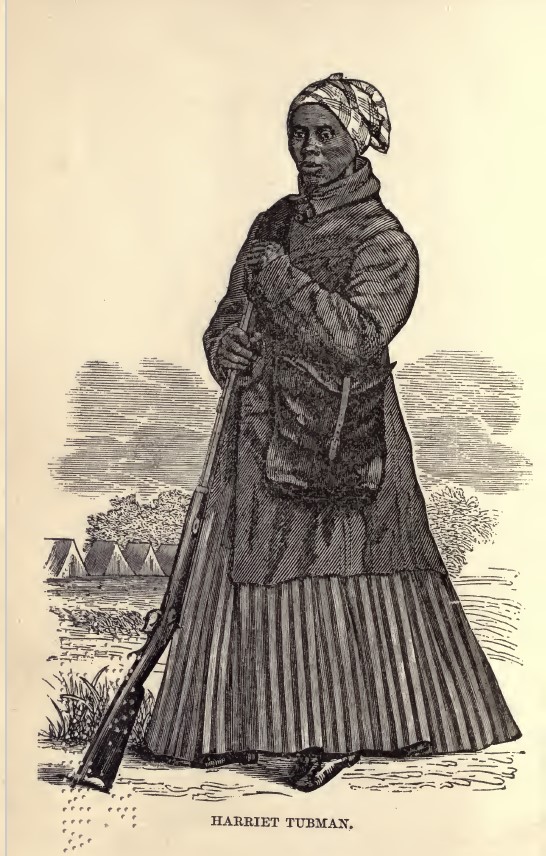
A contemporary illustration of Harrriet Tubman

“Every great dream begins with a dreamer. Always remember, you have within you the strength, the patience, and the passion to reach for the stars to change the world.” -Harriet Tubman (1822-1913)

https://www.harriettubmanmonument.com/

The Harriet Tubman Monument, Beaufort, South Carolina, from a Global News report

https://chaplain.senate.ca.gov/content/prayer-offered-january-25-2016?fbclid=IwAR3_bT1Ma8RcVItlJOkP4E5XtHZdomDZ5yEXPitSMzOHd_qFWwN16czUAG8

But, as a Toronto historian brought to my attention, Harriet Tubman said no such thing.

Here’s the back story. We did our best three years ago in terms of due diligence, believing our sources were valid and checking with various authorities, including some friendly folks with PhDs. We also ran the wording by the Ontario Black History Society which suggested some changes which we duly made. They shared generously of their time and sent representatives to the unveiling. While they gave us the go-ahead, the responsibility lies with us and more particularly me.

Here’s a quote from Harriet Tubman in a book from 1869 that we could have/should have used.:

“When I found I had crossed that line, I looked at my hands to see if I was the same person. There was such a glory over everything; the sun came like gold through trees, and over the fields, and I felt like I was in Heaven”.

Harriet Tubman

Sometimes, as when I wrote a small paragraph about Black World War one hero, Jeremiah Jones seven years ago, I did not have access to primary sources. I found nothing in the news of 1914-1920 about him and could not access his military records as they were not digitized yet.

So, I followed the lead of the CBC and noted that he was wounded at Vimy and Passchendaele. The journalist apparently relied on family history as recounted by a descendant, Adam Jones.

https://www.cbc.ca/…/jeremiah-jones-black-wwi-war-hero

Jones was wounded at Vimy Ridge but not the other battle. (Yesterday I downloaded his military records online and double-checked.)

The Historian as Detective by Matt (CC BY-NC 2.0) FlickR

We work diligently to uncover lost histories but ask for fairness and respect for the work we get right and the service we provide to our communities. It is fair to ask for some courtesy when our sources fail us.

Public shaming is far from helpful and comes across as an attempt to silence. If local historians were to be silent, then the stories of ordinary families on ordinary streets would be lost. And I for one think that would be a shame because all families are extraordinary and all streets have stories to tell. We need to respect each other.

To quote a perceptive article:

“The academic historian is the discipline expert. They therefore have a responsibility to provide leadership. They should inspire amateur historians to increase their standards of scholarship. This needs understanding, trust and encouragement from academics. Not paternalism.”

The Conversation, April 3, 2012

https://theconversation.com/academic-snobbery-local…

This photograph is from the Schlesinger Library on the History of Women in America and has no known copyright restrictions.

Afterword

A Local Historian & Oral History

Biography: Kathleen Adams, a graduate of Atlanta University in 1911, taught in the public schools of Atlanta for about 34 years, and also at the Carrie Steele Pitts Home, an institution for the care of orphans. She retired from teaching in 1957. A member of one of the prominent Black families of Atlanta, Mrs. Adams showed an early interest in history. She has preserved the history of her family in documents and memorabilia and has made tapes for the local historical society on the history of the Atlanta public schools. At the time of her interview, she was the historian and oldest active member of the First Congregational Church in Atlanta. 

Description: The Black Women Oral History Project interviewed 72 African American women between 1976 and 1981. With support from the Schlesinger Library, the project recorded a cross section of women who had made significant contributions to American society during the first half of the 20th century.

Photograph taken by Judith Sedwick 

Repository: Schlesinger Library on the History of Women in America. 

Collection: Black Women Oral History Project”

Back to photostreamSchlesinger Library on the History of Women in AmericaFollow

November 9: Leslieville’s History

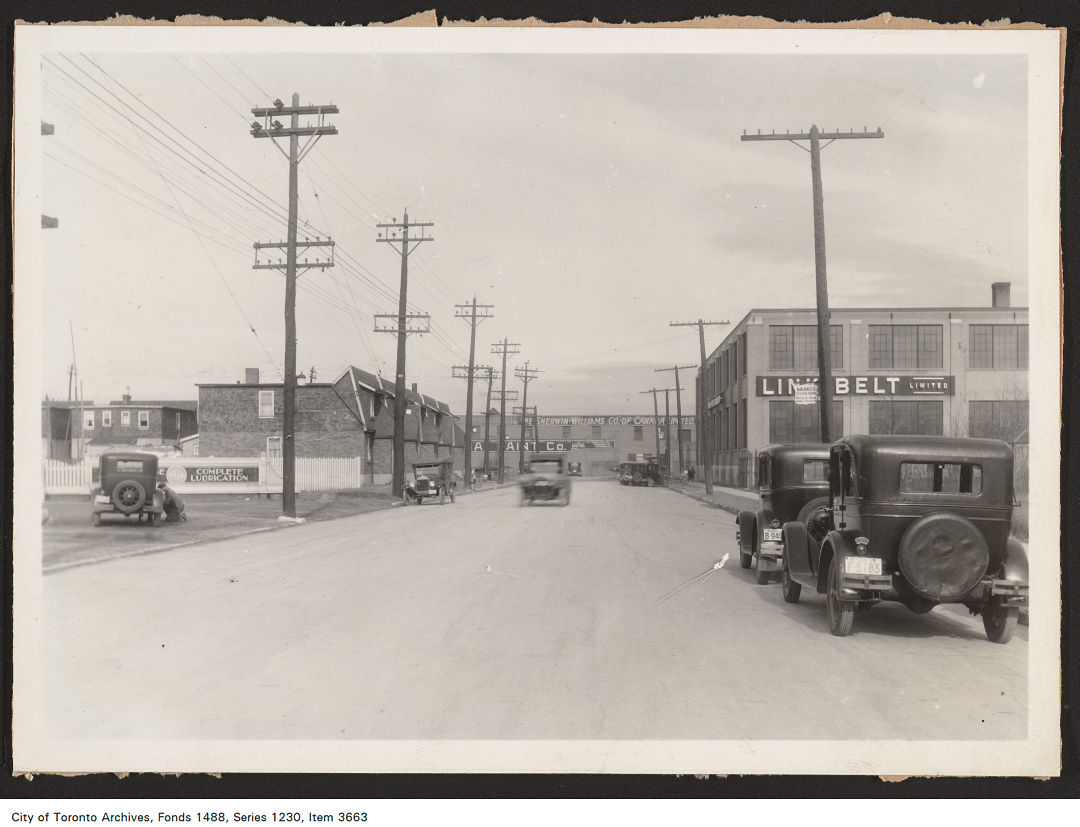
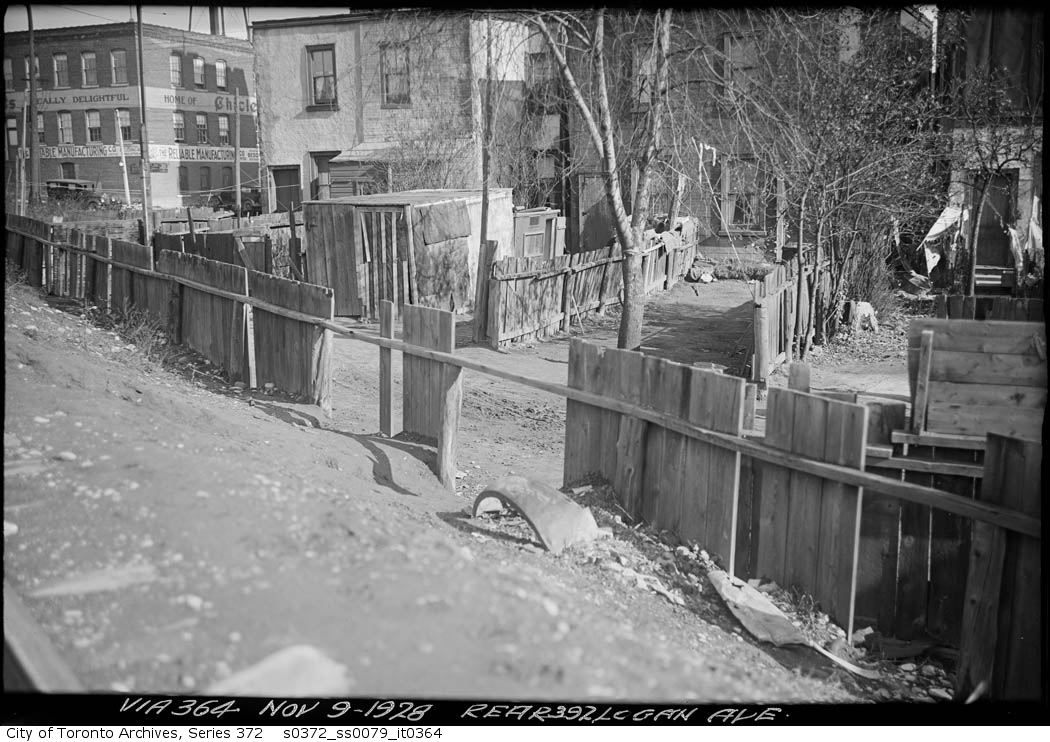
In the distance can be seen the Canadian Chewing Gum factory, makers of Chiclets. The photographer took this shot from the railway line into the backyards during the construction of the raised railbed that they called “the Toronto Viaduct”.
This scene shows the raised rail bed under construction and the old rail bed next to it, as well as two women taking a dangerous but commonly-used shortcut.
Disputing their property taxes seemed like an annual game in the old East End, including Leslieville. Globe, Nov. 9, 1895
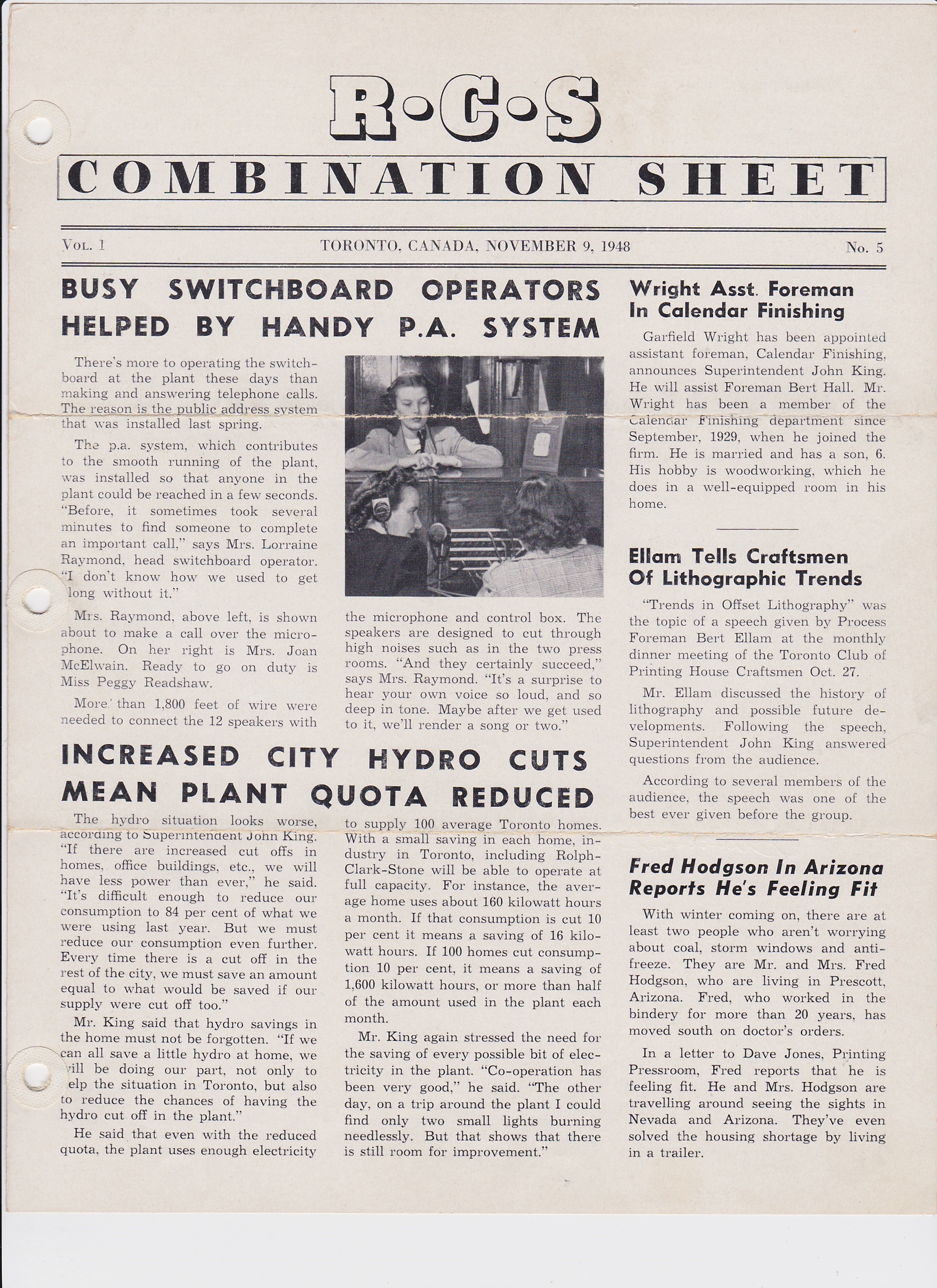
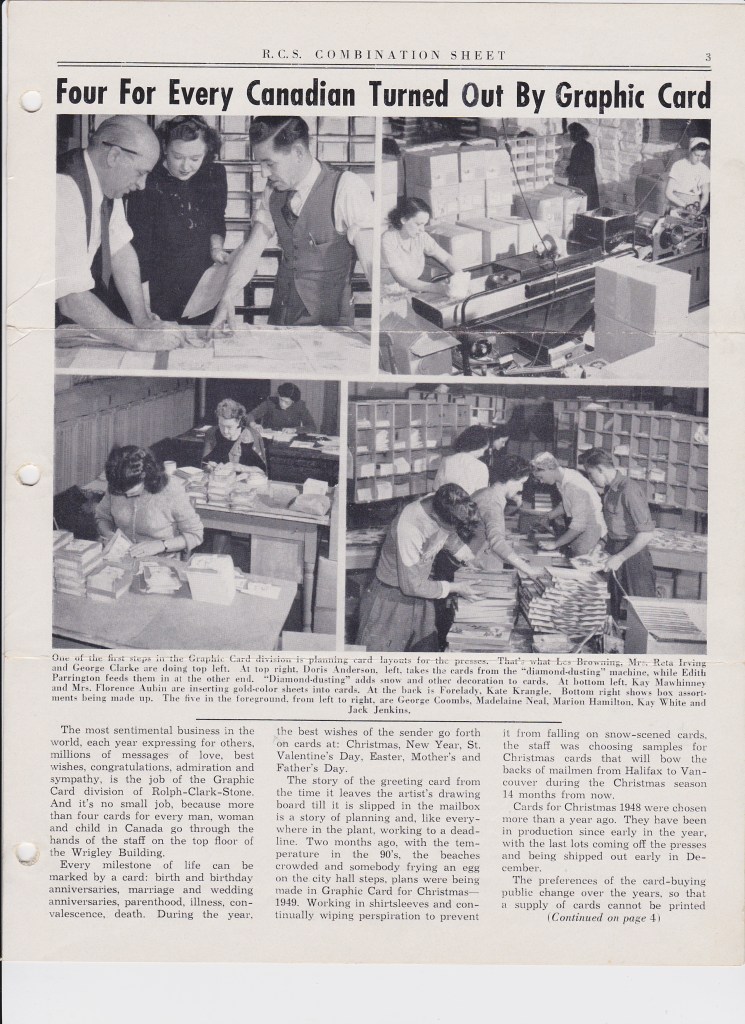
Rolph Clark Stone’s employee newsletter, November 9, 1948