The Secret History of Our East End Streets: 1 – 17 Austin Avenue

London, England has a BBC show, The Secret History of Our Streets. The series claims to explore “the history of archetypal streets in Britain, which reveal the story of a nation.” Our streets are just as interesting and our stories goes back millennia before Austin Avenue existed to when Leslie Creek was full of salmon and Anishnaabe, Haudenosaunee and Wendat gathered wild rice in Ashbridge’s Bay. I hope you enjoy this page. My research ends in 1919, a century ago. I have not explored the history of every family, Austin Avenue has more secrets to tell.

Here are some of those stories — those from 2 to 17 Austin Avenue

2 Austin Avenue

Walter Gray was born on November 9, 1857 in at Gray’s Mills, York Township, now part of the Donalda Golf and Country Club. He married Annie Emma Clifford on January 30, 1884 and they had five children in 11 years. The Grays had a grocery store at 2 Austin Avenue and lived above the store. They moved to 100 Boulton Avenue about ten years later.

His wife Annie Emma passed away on July 29, 1916, on Bolton Avenue, at the age of 49. They had been married 32 years. Walter Gray died on April 8, 1938, in Dunnville, Ontario, at the age of 80.

Son William John was born on December 19, 1885, in Toronto, Ontario. He Gray married Annie Mary Norris on June 28, 1907, in Toronto. They had two children during their marriage. He died in 1948 at the age of 63, and was buried near his parents. Annie Mary Norris died in 1960 and was laid to rest next to her husband. The Gray family plot is in Saint Johns Norway Cemetery and Crematorium, Woodbine Avenue.

Ironically both the Gray family homestead and Leslie Street School principal Thomas Hogarth’s house have been honoured with historical plaques.

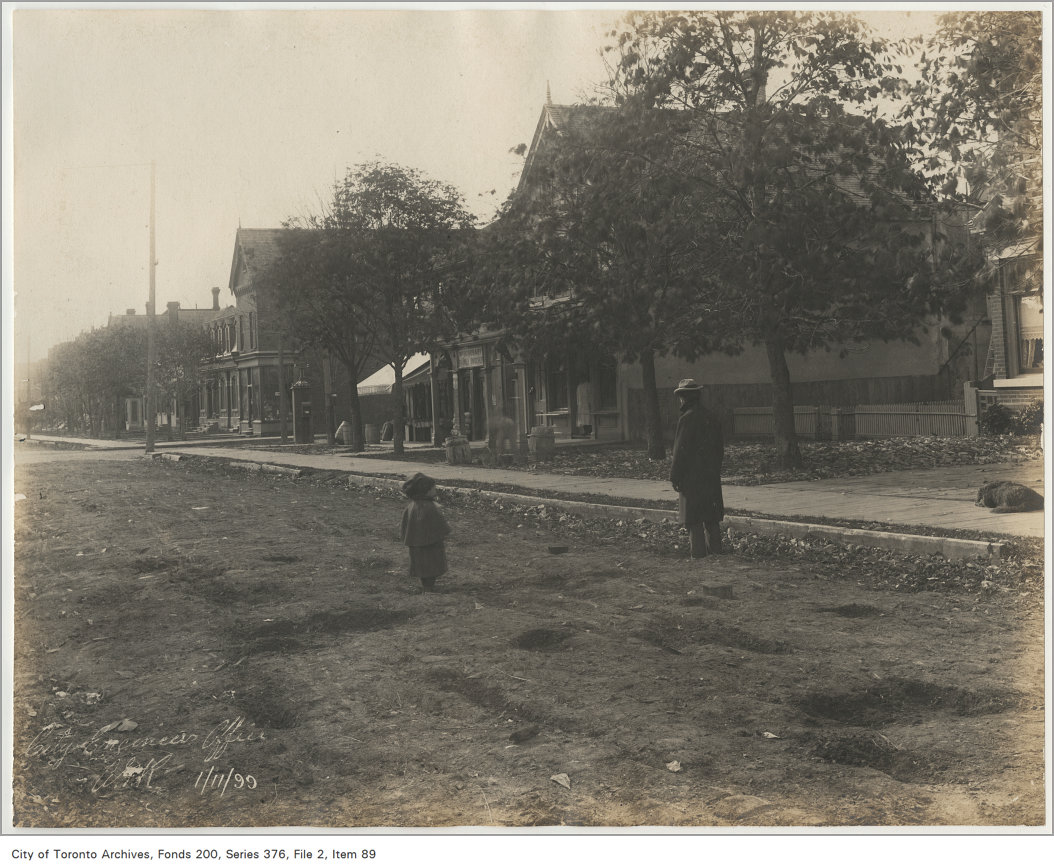
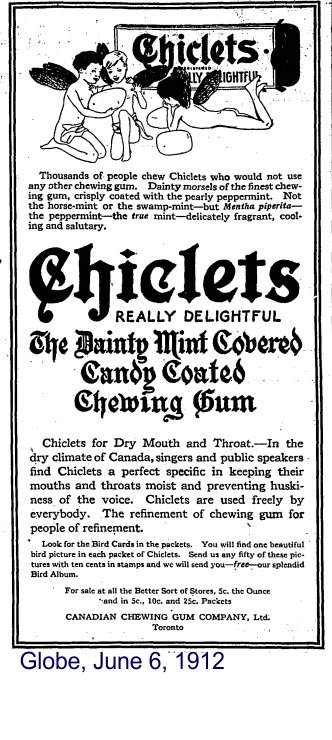
2 Austin Avenue, Many of these small family businesses have been converted into homes. Globe, May 25, 1909

4 Austin Avenue

4 Austin Avenue was the home of Henry Bowins in 1919 and, in 1921, by widow, Mrs. Louisa (Beckett) Greenslade and her five children, ranging in age from 7 to 17. in 1921. Her husband, William Henry Greenslade, a market gardener, had dropped dead of a heart attack in 1915. The family lived in Etobicoke at that time.

6 Austin Avenue
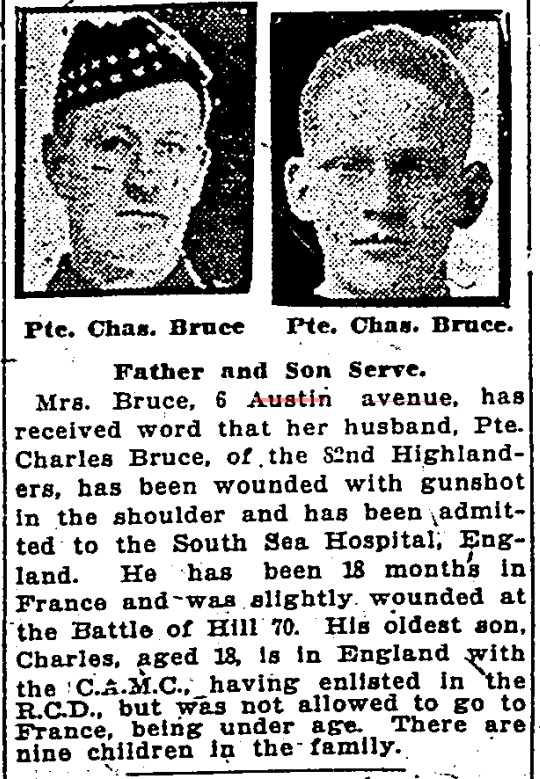
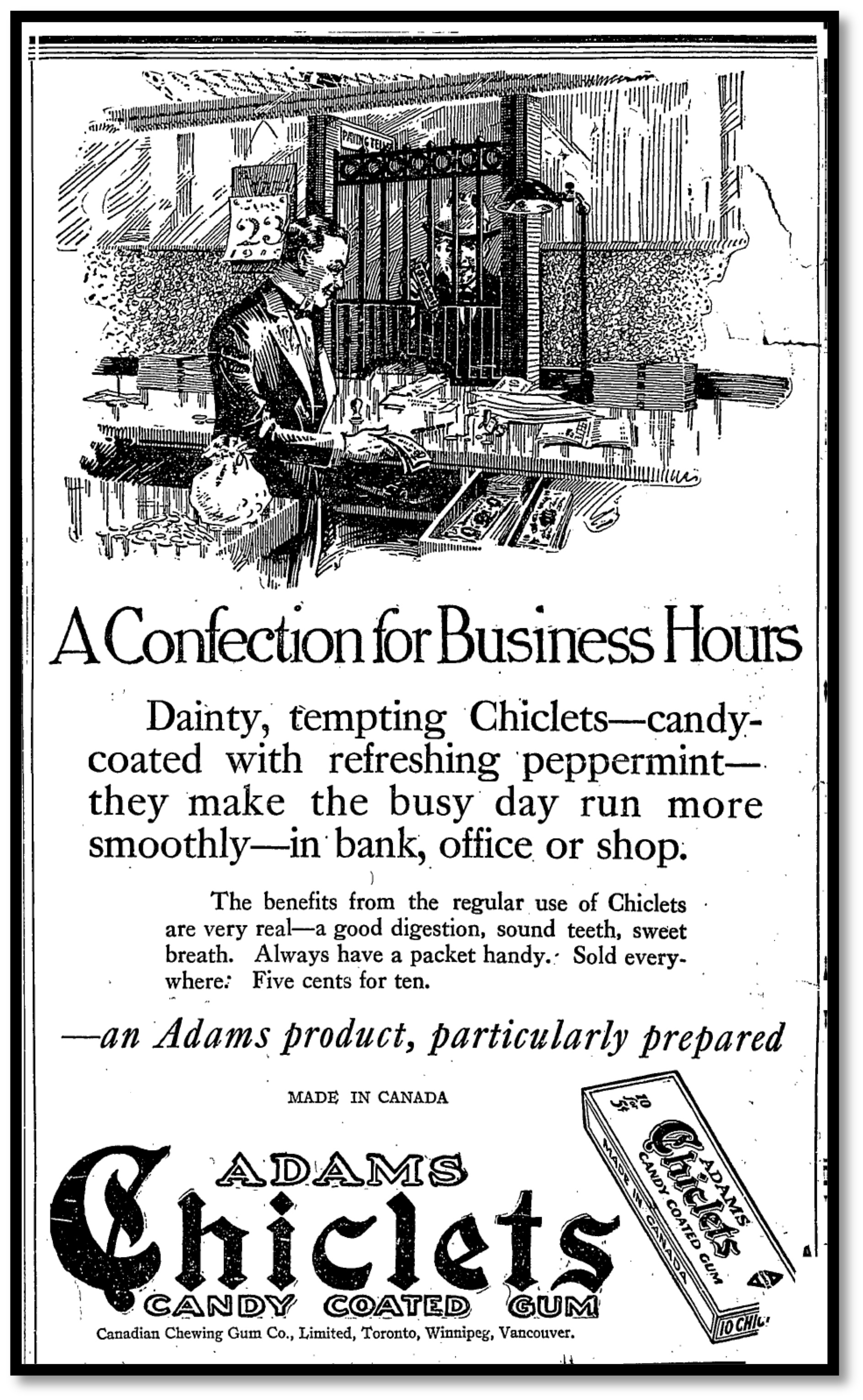
6 Austin Avenue, Toronto Star, October 6, 1918

8 Austin Avenue

8 Austin Avenue William Robertson Hodge
8 Austin Avenue, William Robertson Hodge, Circumstances of Casualty
8 Austin Avenue, Globe, November 9, 1918
8 Austin Avenue, William Hodge’s death was reported on the day the Great War ended: now known as Remembrance Day. Toronto Star, November 11, 1918
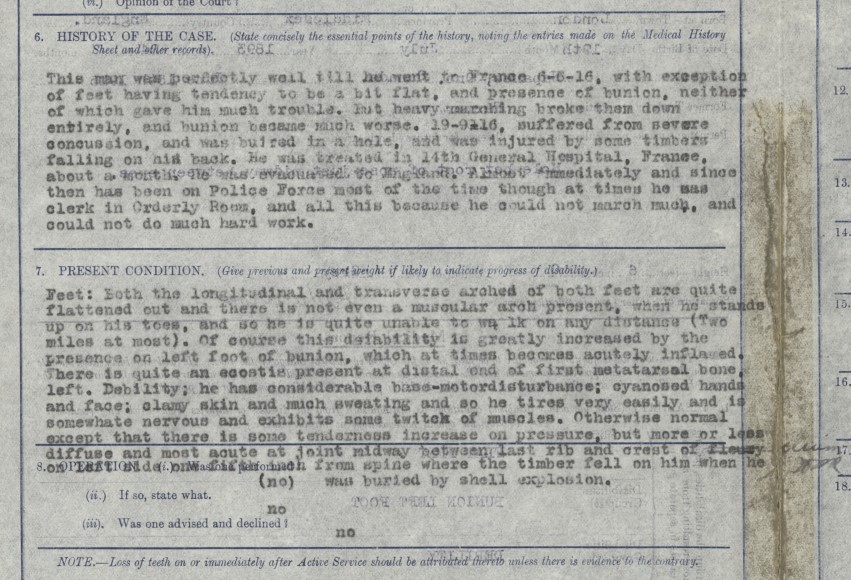
8 Austin Avenue, discharge papers for John Christopher Waldron, marked “medically unfit”.

John Christopher Waldron married William Robertson Hodge’s sister Eveleen in 1919 and was lived with her, sister Jean, and their mother, Mary. Like his brother in law he was a tall man for the time (5’11”) and fit. He was an Irish Catholic while Eveleen Hodge was an Irish Protestant. Both were from Dublin. Unlike his brother-in-law, he was not conscripted but volunteered. Like his brother-in-law he was hit by shellfire. Clearly from the medical records doctors had a hard time identifying just what was wrong with Pte. Waldron, apart from flat feet which was easy. The blast buried Waldron completely under mud, timbers and rubble, causing a severe concussion and what was known as “shell shock “. He died in 1964.

10 Austin Avenue

10 Austin Avenue: Highway Robbery Globe, September 10, 1909

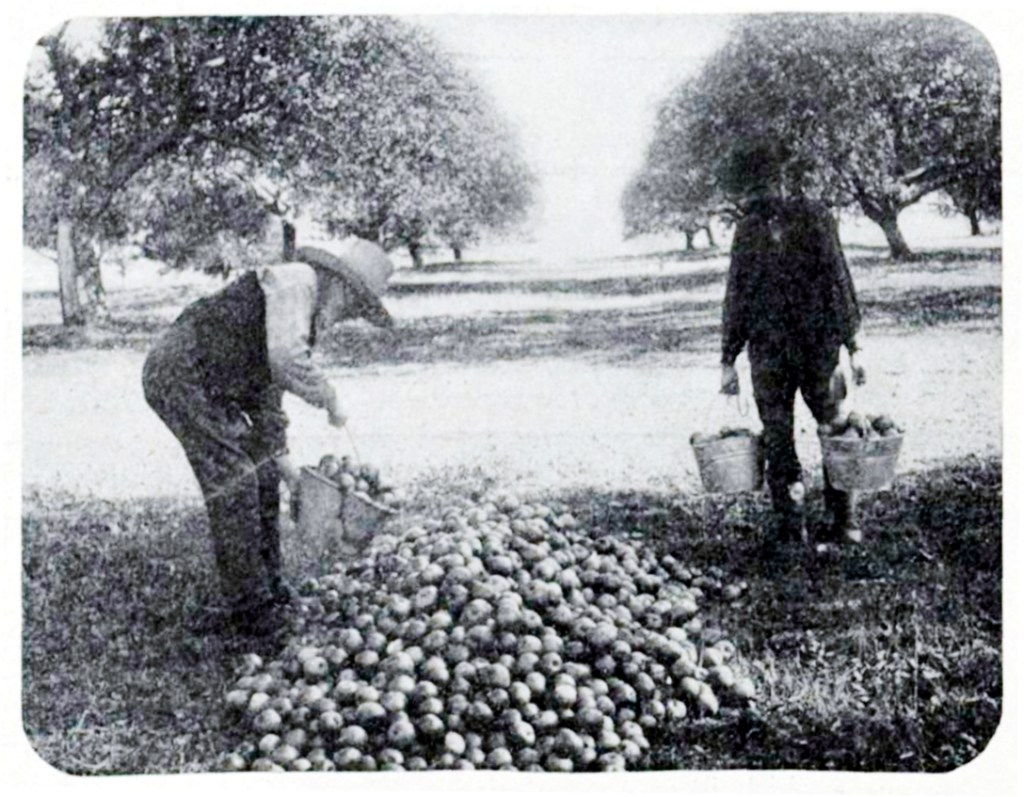
It appears that Mrs. Robinson at 10 Austin Avenue took in lodgers, as many widows did. Since the lodgers were mostly young men who moved frequently, it is difficult to determine just which Frank Mulhern was responsible, but it appears to have been Frank Beauchamp Mulheron (1881-1917) who moved to the U.S. permanently shortly after this assault occurred. Strong-arm tactics to hijack valuable cargo was not uncommon though this was particularly audacious. Often the motive was to re-sell the produce and sometimes simply to get something to eat. The perpetrators usually knew their victims and counted on intimidation to keep the victims from reporting to the police. Gangs were a reality back then too. Timothy Lynch of 51 Austin Avenue took the law into his own hands shooting those who robbed his orchard. But that’s another story.

10 Austin Avenue, Globe, January 2, 1917

Dudley Seymour Robinson was born on July 6, 1892, in San Jose, California, USA,. Both his parents were English. He married Gladys Elsie Moffat on October 6, 1920, in Toronto. They had two children during their marriage. He died in March 1963 in Michigan, USA, at the age of 70. In 1911 he was living with his widowed mother Rosina Alice Robinson at 10 Austin Avenue and working as a Foreman in a leather shop. Dudley Seymour Robinson enlisted on February 16, 1916 and sailed to England where he became an Acting Sergeant but injured his left knee while training. A torn meniscus kept out of the trenches, he was discharged from the army on Dec. 17, 1916 and sailed on the troop ship Metagama back to Canada, arriving in St. John, New Brunswick on Christmas Day 1916. He married Gladys Elsie Moffat in Toronto, Ontario, on October 6, 1920, when he was 28 years old and they lived in an apartment on Silverbirch Avenue. His mother Rosina Alice passed away at home 10 Austin Avenue on November 9, 1922, at the age of 55 from pneumonia. After his mother’s death Dudley Robinson moved to Detroit and died at the age of 70 in March 1963 in Michigan, USA.

William Edward Harrold, 14 Austin Avenue, is likely in this photo of the band of the 48th Highlanders.

14 Austin Avenue

William Edward Harrold was born in March 1873 in Monkton Combe, Somerset, England, his father, William, a wheelwright, was 54 and his mother, Amelia Ann, was 29. Though in 1871 the family owned their own home and even had a servant, Ten years later family was destitute and he was educated in a pauper school. In 1881 his father was in the Poor House as a pauper, as was William and his brothers, Alfred and Henry, but there was no sign of his mother. His father died in 1887. In 1890, at the age of 17, he immigrated alone to Canada. He was related to the Billing family, another Somerset family, for whom Billings Avenue is named. William Harrold married Ellen Sophia Eva Cox on June 15, 1897, in Toronto, Ontario. They had two children during their marriage: Alfred William Badgerow Harrold and John E Harrold. He died at home 14 Austin Avenue on November 11, 1936 of heart disease. Though he spent his working life in a foundry, his death certificate lists his true vocation: musician.

Nominal Roll and Paylist, band of the 48th Highlanders, 1904
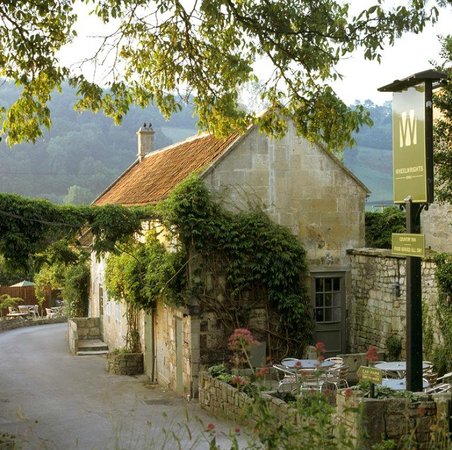
Wheelwright Arms, Monkton Combe, Somerset, England

The Wheelwright’s Arms pub in Monkton Comb, now part of the City of Bath, was likely the family home of the Harrolds. To see photos of the pub go to: https://the-wheelwrights-arms-gb.book.direct/en-us/photos

17 Austin Avenue

Every family has stories and secrets. We don’t know why 17-year-old Kate Wellings mysteriously left home, alarming her parents. But perhaps the numerous articles about the Wellings family might hold a clue. My sympathies are with Kate. I was a teenage daughter of a man with some “unique” ideas, obsessed with politics and who wrote numerous Letters to the Editor. I was sometimes proud of him and sometimes embarrassed. Perhaps Kate felt the same or perhaps there was another reason.

The Wellings family were the first to live at 17 Austin Avenue and built the house there where Katherine “Kate” Wellings was born on January 31, 1887, but their story, like every family’s, goes back further.

An early map of Birmingham, England, showing Duddleston, now a downtown industrial area, but home to the Wellings family 150 years ago.

Father George Washington Wellings was born in 1855 in Birmingham, England, the centre of Britain’s steel industry. His grandfather had been a blacksmith. His father, George Wellings Sr., was a “steel toy maker”. However, at the time, “toys” were not the playthings we think of today, but the term meant small metal items like buttons and buckles, and was part of the jewelry trade.

In 1830 Thomas Gill described the production of steel jewelry in Birmingham, from cutting the blanks for the steel beads or studs, to final polishing in a mixture of lead and tin oxide with proof spirit on the palms of women’s hands, to achieve their full brilliance. Gill comments: No effectual substitute for the soft skin which is only to be found upon the delicate hands of women, has hitherto been met with.” from Revolutionary Players Making the Modern World, published by West Midlands History at https://www.revolutionaryplayers.org.uk/birmingham-toys-cut-steel/

George Sr. also worked as a gun maker during the 1850’s and 1860’s. This was a lucrative business during that period. Between 1855 and 1861, Birmingham made six million arms most went to the USA to arm both sides in the American Civil War. Not long after George Wellings Sr. father retired from gun making and opened a pub, The Wellington, in the Duddeston at 78 Pritchett Street. German aircraft bombed the area heavily in World War. The pub no longer remains.

For more about Birmingham’s gun making history go to: http://www.bbc.co.uk/birmingham/content/articles/2009/02/18/birmingham_gun_trade_feature.shtml

George Jr. became a jeweller specializing in engraving on gold.

George Washington Wellings married Anna Maria Johnson in 1875 in Birmingham. They and their five children immigrated to Toronto in 1884. They would have seven more children, all born in Toronto.

Walter was their first child born in Canada – at home 13 Munro Street. Dr. Emily Stowe delivered the baby. Florence was born at home 17 Austin Avenue in 1889 and was soon joined by sister Hilda Marie was born on October 4, 1891. Harold was born on July 14, 1893. Another son Howard George was born on January 1, 1896, but died two years later on March 21, 1898. Irene Wellings was born on September 18, 1897.

listing from the Canadian Trade Index 1900
Toronto Star, December 28, 1896

In 1896 George Wellings ran for Alderman for the first time and was beaten badly by brick manufacturer John Russell.

Toronto Star, January 5, 1897
Toronto Star, November 17, 1897

Wellings a proponent of the ideas of Henry George, popular at the time, but still on the fringes. For more about the Henry George Club, go to:

http://www.dollarsandsense.org/archives/2006/0306gluckman.html
or
http://henrygeorgethestandard.org/volume-1-february-26-1887/

Toronto Star, April 19, 1901

A tireless activist, George Wellings persevered. In the days before social media, Letters to the Editor had to fill the need for expressing political ideas.

Toronto Star, December 11, 1901

Unsuccessful in his attempt to enter municipal politics as an Alderman, in business George Wellings prospered, renovating his home at 17 Austin Ave and building a new factory downtown on the site of his previous manufacturing plant.

Toronto Star, July 18, 1904
Toronto Star, August 22, 1904 Building permit factory George Wellings Mfg Co, 67 Richmond Street East.
17 Austin Avenue, Globe, May 19, 1905

Katherine “Kate” Wellings married Albert Edward Ward in Toronto, Ontario, on November 13, 1911, when she was 24 years old.

Toronto Star, September 16, 1911

Wellings Manufacturing Company continued to proper, turning out buttons, badges, etc., what were known as “toys” in Birmingham in the mid-nineteenth century. Many thousands of Wellings cap badges, buttons and medals went overseas on the uniforms of Canadian soldiers during World War One.

Kate’s husband died of a heart attack on January 8, 1927 at their farm on the 3rd Line West, Chinguacousy, Peel, Ontario.

Canadian Jewish Review, February 17, 1922
Toronto Star, May 30, 1931

George Washington Wellings passed away on May 31, 1930, in Toronto, Ontario, at the age of 75. Though he tried and tried again, he never succeeded in becoming a Toronto alderman.

Katherine Wellings married James Templeman in York, Ontario, on March 27, 1937, when she was 50 years old. Both were widowed. Katherine was living at 17 Austin Avenue at the time of her marriage. James Templeman was a truck driver from Todmorden Mills. Her mother Ann Maria passed away on April 12, 1938 at her son-in-law’s home on Oakdene Crescent. Kate Wellings died in 1960 when she was 73 years old. She is buried in Mount Pleasant Cemetery. 67 Richmond Street East is now a Domino’s Pizza take-out.

To see all of this large table drag the bar below across. The table shows who lived where and when on this part Austin Avenue from 1887 when the street was born to 1921. The 1888 City Directory was based on 1887 date and there were no street numbers as it did not get mail delivery. Postal service required numbers. Joanne Doucette

1888 City DirectoryLot # Subdivision 549#1889 Directory1890 Tax Assessment Roll Occupier1890 Tax Assessment Roll Owner1890 Directory1891 Directory1894 Directory1895 Directory1900  Directory1903 Directory1904 Directory1905 Directory1906 Directory1907 Directory1912 Directory1919 Directory1921 Directory1921 Census
North
Vacant lots 3 frontage on Pape2Vacant lotsGray Walter, grocerGray Walter, grocerGray Walter, grocerGray Walter, grocerGray Walter, grocerHannigan & Gunn, grocersBest Wilbert EWells George A, Hardware
Vacant lots34Vacant lotsLowman CharlesLowman Charles ELowman Edwin CPettit John EPettit John EPettit John EPettit John EBurkholder Albert/Pettit John EKing SamuelBowins HenryGreenslade Louisa MrsGreenslade Louisa  
Vacant lots36Vacant lotsPerkins Charles EFortier William JOverdale Christian SOverdale Christian SOverlade Pauline MrsOverlade Pauline MrsMundy WilliamMundy WilliamVacantBruce CharlesBruce CharlesBruce Charles
Vacant lots38Vacant lotsField Emma GFarmery CharlesBooth AlbertBooth AlbertBooth AlbertHalliburton JamesPettit William HPettit William HBrittain Rev DavidHodge Mary MrsHodge Mary MrsHodge Mary  
Vacant lots310Vacant lotsVacantCosgrove John JMulheron Mrs SarahTurner JosephRobinson FrederickRobinson FrederickRobinson FrederickRobinson FrederickRobinson Rose MrsRobinson Rose MrsRobinson Rose MrsRobinson Rose  
White Henry312White HenryWhite HenryWhite HenryWhite HenryJarrett GeorgeDoxsee George WVacantCrawford Walter LCrawford Walter LCrawford Walter LMontgomery Norman HMontgomery Norman HMontgomery Norman HNicholson JohnMacdonald WmIreland LouisIreland Lewis
Vacant lots314Vacant lotsPrivate GroundsVacantKordell George HLiley HenryTaggart Thomas RMontgomery Norman HStewart William HStewart William HStewart William HHarrold William EHarrold William EHarrold William EWilliam Harrold
Vacant lots316Vacant lotsPrivate GroundsVacantStewart WilliamSimmonds AlfredSimmonds AlfredMurphy JohnRidley JosephRidley JosephRidley JosephRidley JosephRidley MarkRidley JosephRidley Joseph
LANEA LANE
South
Vacant lots4  frontage on Pape1Vacant lotsStore, s eStore, s.e.
Vacant lots43Private Grounds
Vacant lots45
Vacant lots47
Vacant lots49
Vacant lots711
Vacant lots713
Vacant lots815Unfinished houseTaylor EdwardClifford C HTaylor Edward STaylor ESClifford JamesFredenburg George AClifford Caroline MrsClifford Caroline MrsClifford Caroline MrsClifford Caroline MrsClifford Caroline MrsClifford Caroline MrsClifford CharlesClifford CharlesClifford Charles
Vacant lots817Wellings GeorgeWellings GeorgeWellings, Annie M. and George WellingsWellings GeorgeWellings GeorgeWellings GeorgeWellings GeorgeWellings GeorgeWellings GeorgeWellings GeorgeWellings George WWellings George WWellings George WWellings George WWellings George WWellings George W
Private GroundsPrivate grounds

Austin Avenue’s Ghost Creek

by Joanne Doucette This is a follow up to: https://leslievillehistory.com/austin-avenue-subdivision-549-by-joanne-doucette/

Part 1: Austin Avenue blocked by A Creek

Did you know that there was a creek at the east end of Austin Avenue?

Severn Creek (Rosedale Ravine) 1850: A creek similar to Leslie Creek

In 1918, the foreman of George Leslie’s nursery recalled Leslie Creek:

a creek … also started near the sandpit and ran through the gardens of Cooper’s, Bests and Hunters, crossed the road by the Leslie Postoffice. Here it joined a small creek that drained the nursery, and both crossed Leslie street under a bridge that has since been filled up by intersecting sewers.

John McPherson Ross (1859-1924), Globe, January 18, 1918

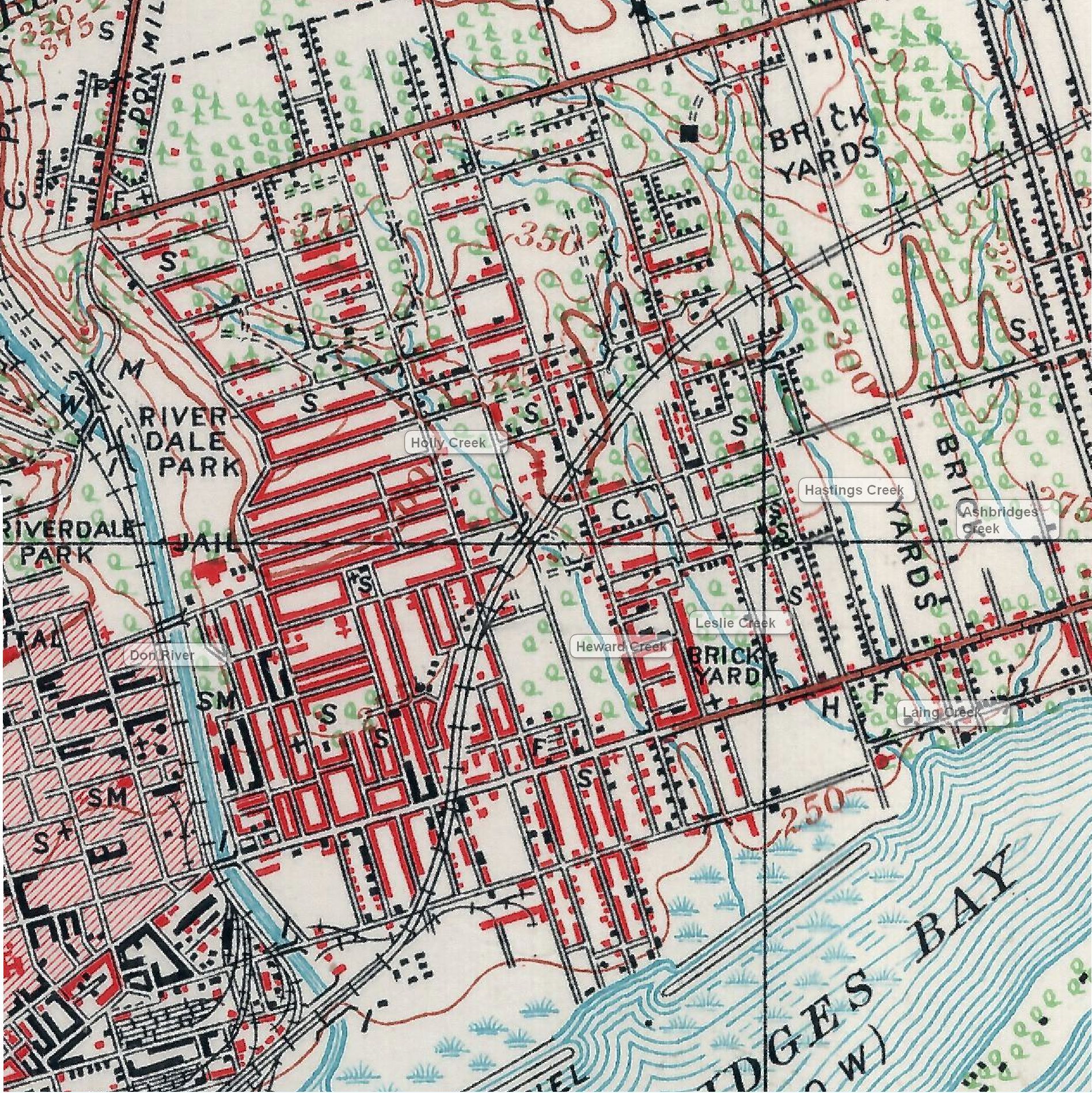
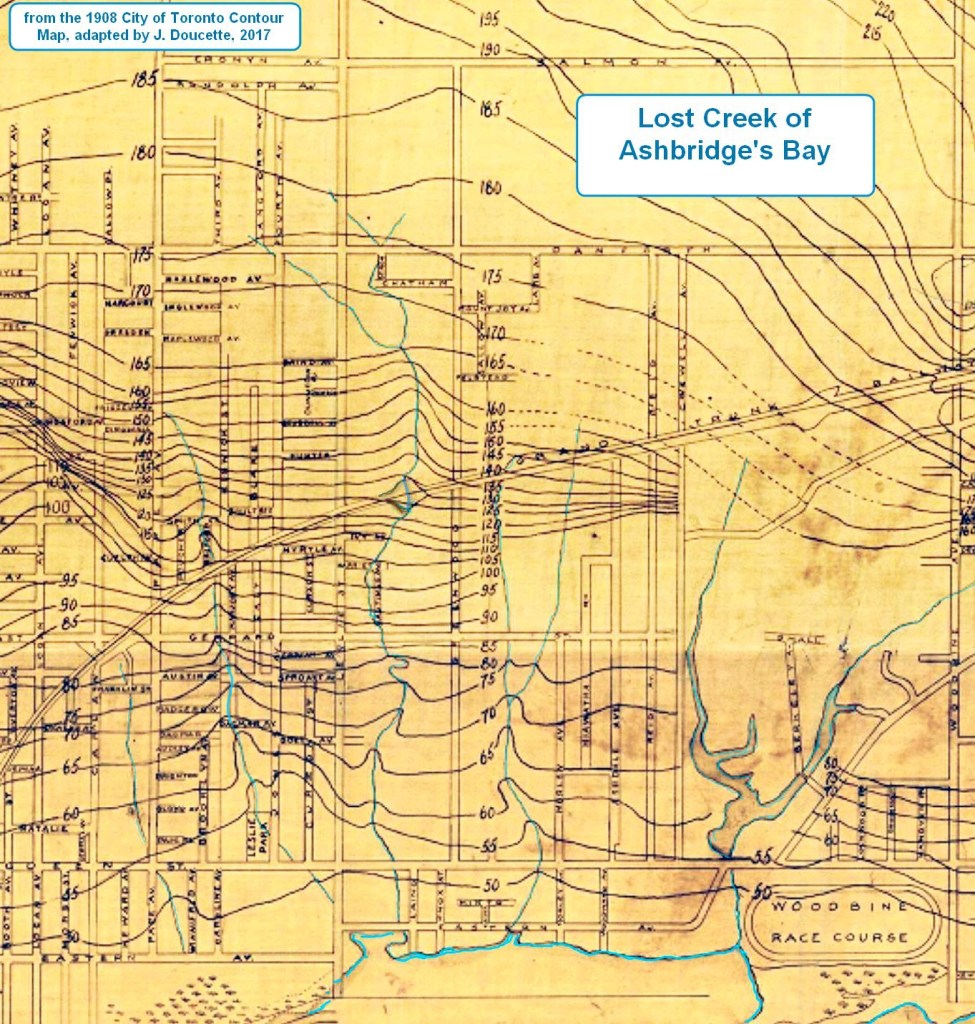
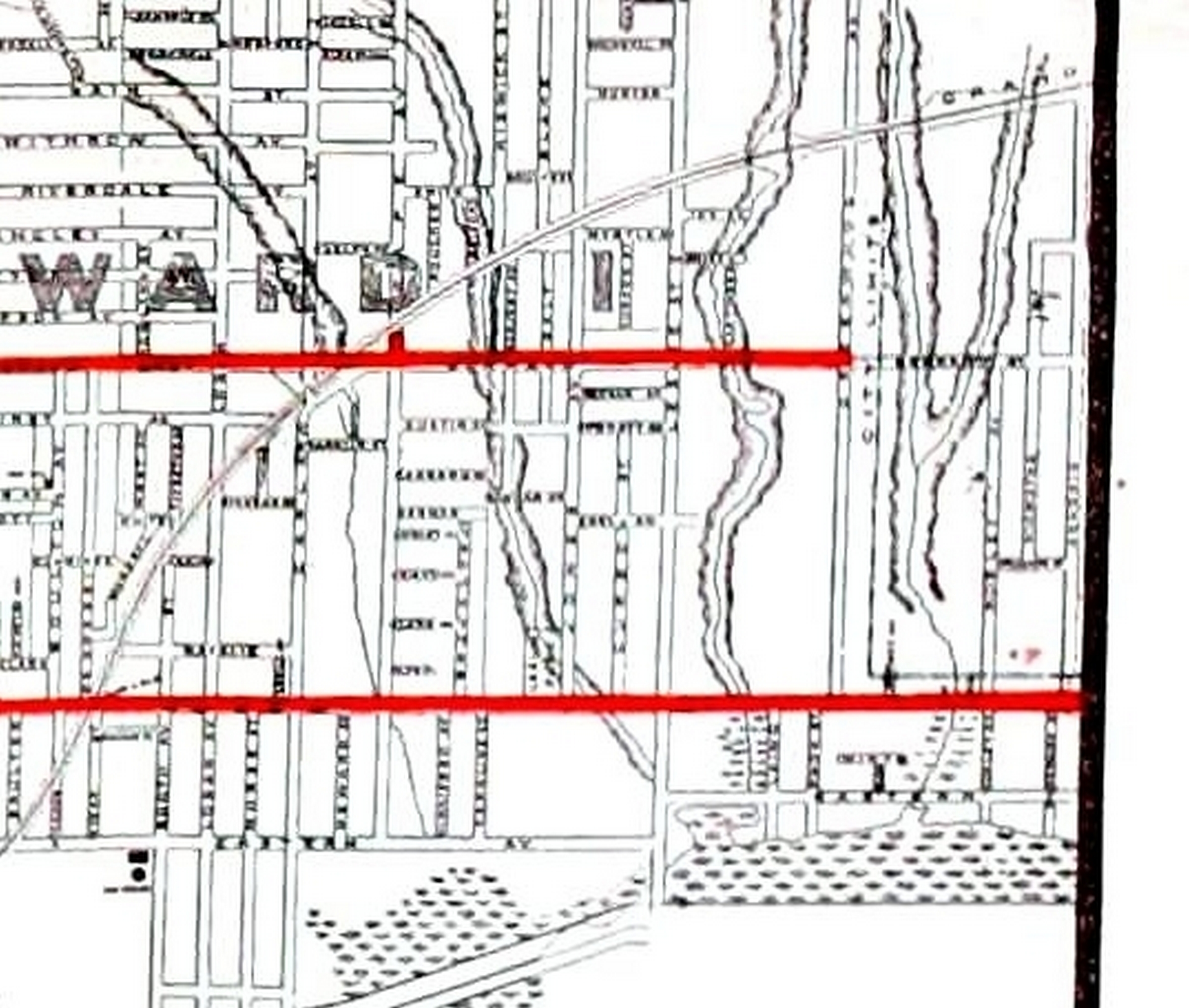
1909 Topographical Map showing Leslieville creeks

Leslie Creek originated in the area of Strathcona Avenue and Eastview Park from springs on the slope of a sandbar from the last Ice Age.

Over ten thousand years ago, the melting ice dumped sand, clay and gravel (“glacial drift”) on southern Ontario. It is about 26 meters thick over most of Toronto.  As the ice melted, a lobe of the glacier filled the basin where Lake Ontario is now. This ice blocked the melt water from draining to the sea down the Saint Lawrence River. The ice was like a plug in a bathtub and a deep, cold melt water lake, Lake Iroquois, formed behind it. This lake was 55 meters (180 feet) deeper than Lake Ontario. All of Leslieville was under water. The Lake Iroquois shore-cliffs form a steep rise or escarpment north of Leslieville.  The shore cliff can be seen clearly along Davenport Road and near Variety Village on Kingston Road. It is the long hill on Yonge Street south of St. Clair Avenue, known as “Gallows Hill”. South of this cliff lies a plain of sand deposited on Lake Iroquois’ bottom. Leslieville sits on the Lake Iroquois Sand Plain.  The Plain, though tilted is still relatively flat, but far from featureless. Great rivers poured off the melting glacier, carrying huge amounts of sand and gravel into the Lake. There wave action and strong east-west offshore currents carried the sand and gravel westward, piling it up in bay-mouth bars. Behind the sandbars at the mouth of what are now the Humber in the west and the Don River in the east, large bays formed.

In the East End, these sand bars form a ridge that stretches from Scarborough, west from the foot of Kennedy Road for about five kilometers (three miles). The sandbar diverted the flow of Taylor Creek westward into the Don. To the south of it more sandbars formed offshore under water, creating the long hill south of Danforth Avenue from Broadview through Leslieville to the Beach and the sand plain of Leslieville. The settlers mined these glacial beaches for sand and gravel. The sandy loam was the basis of Leslieville’s market garden industry. With compost and manure, it was fertile and easy to till, ideal for carrots, potatoes, turnips and other root vegetables.

Onion field, Pape Avenue, Globe, October 16, 1912
Globe, July 26, 1887

Leslie Creek was deeper and faster flowing before settlers deforested the flat, but tilted, sandy plain south of Danforth Avenue. Streams like this cut deep ravines into the loose Lake Iroquois sand plain that made market gardening so lucrative in Leslieville. Erosion exposed clay deposits from an earlier Ice Age, providing the raw material for brickmaking. Some families of market gardeners became brickmakers, like the Logans, while others, like the Papes, remained gardeners, florists and nurserymen.

The flat, tilted Lake Iroquois plain at Pape Avenue looking north to Danforth Avenue, 1907

Part 2: A Skating Rink and Park

According to Elsie Hays, an elderly resident that I interviewed 40 years ago, it was a small brook that ran through an orchard where she used to play with her sister, catching minnows and tadpoles.  It crossed Gerrard where there is a shallow dip in the road to mark it. Entrepreneurs dammed the creek in the late nineteenth century to create Maple Leaf Skating Rink at Pape and Gerrard.

Pape Avenue Junior Soccer team, 1934

Part 3: A Cemetery by a Creek

In 1849 Toronto’s Jewish community opened the first Jewish graveyard west of Montreal on the west bank of Leslie Creek. It must have been an idyllic situation.

Looking south on Pape Avenue from Gerrard towards Austin Avenue, February 19, 1930 On east side of Pape is the entrance to Holy Blossom Cemetery, since replaced. Just south of it was the Holy Blossom funeral chapel.
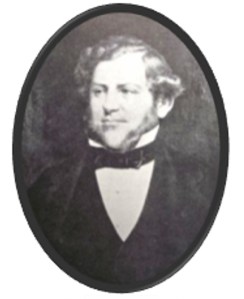
Abraham Nordheimer

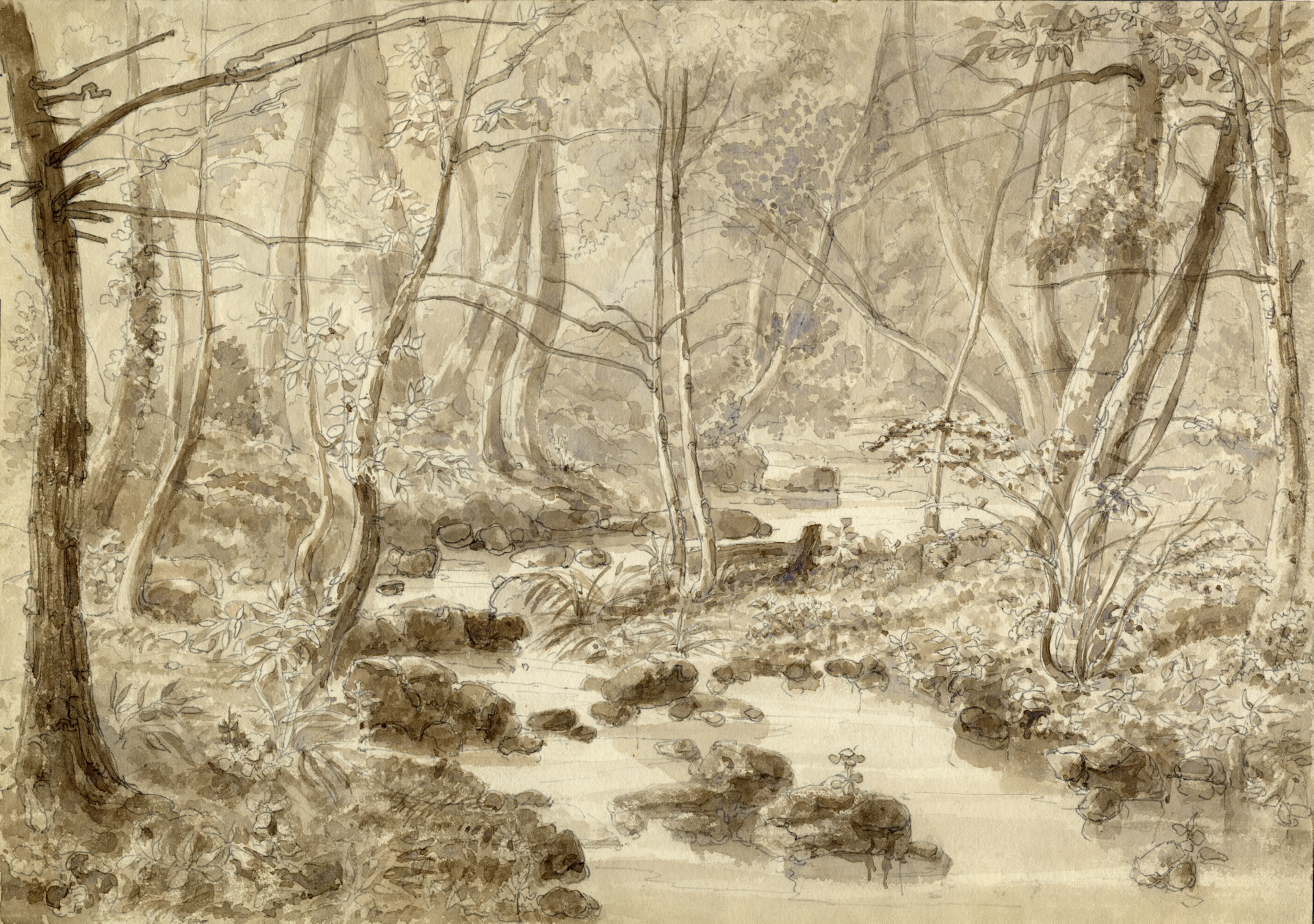
Sir John Robinson, Bart, D.C.L. First Sketch for an Oil Picture. Painted in 1855

There is no synagogue in Leslieville but there has been a definite Jewish presence here from the mid-nineteenth century. In 1847 Judah G. Joseph was an optician and jeweler, with a store at 56 King Street East, Toronto. In 1849 his young son, Samuel, was dying and there was no Jewish cemetery nearer than Buffalo or Montreal in which to bury his boy.  Abraham Nordheimer, a successful piano manufacturer, and Judah Joseph sought land on behalf of the Jewish community for a graveyard.  At the time there were only 35 Jews living in Toronto.

They bought land 60 feet wide and 400 feet deep (about 18 by 12 meters) for £20 through the Chief Justice, John Beverly Robinson. The Robinson family, prominent members of the Family Compact, owned land in the neighborhood. (Part of Pape Avenue was called Robinson Street for some time.) For more about John Beverley Robinson to to: http://www.biographi.ca/en/bio/robinson_john_beverley_9E.html

Christopher Robinson settles near what is now Pape and Queen Street East. From the obituary of Sir John Beverley Robinson, Globe, Feb. 2, 1863
When the City of Toronto annexed Leslieville in 1884, “Robinson Street” became “Pape Avenue” because the City already had a “Robinson Street”, named for John Beverley Robinson’s son, Lukin, a lawyer and real estate developer. Parts of the East End street were also called “Pape’s Lane” and, below Queen Street East, it was known as “Willow Street”. Globe, December 29, 1877

They buried Judah Joseph’s son, Samuel, in 1850, probably near the cemetery gate where the gravestones are all under grass. The grave of Catherine, the wife of Alfred Braham, also buried in 1850, was the earliest Jewish grave in Toronto marked by a tombstone.  After 1930 there were few interments, although the cemetery remained in use through the late 1940’s.

Ad from Browns Toronto City and Home District Directory 1846 to-1847

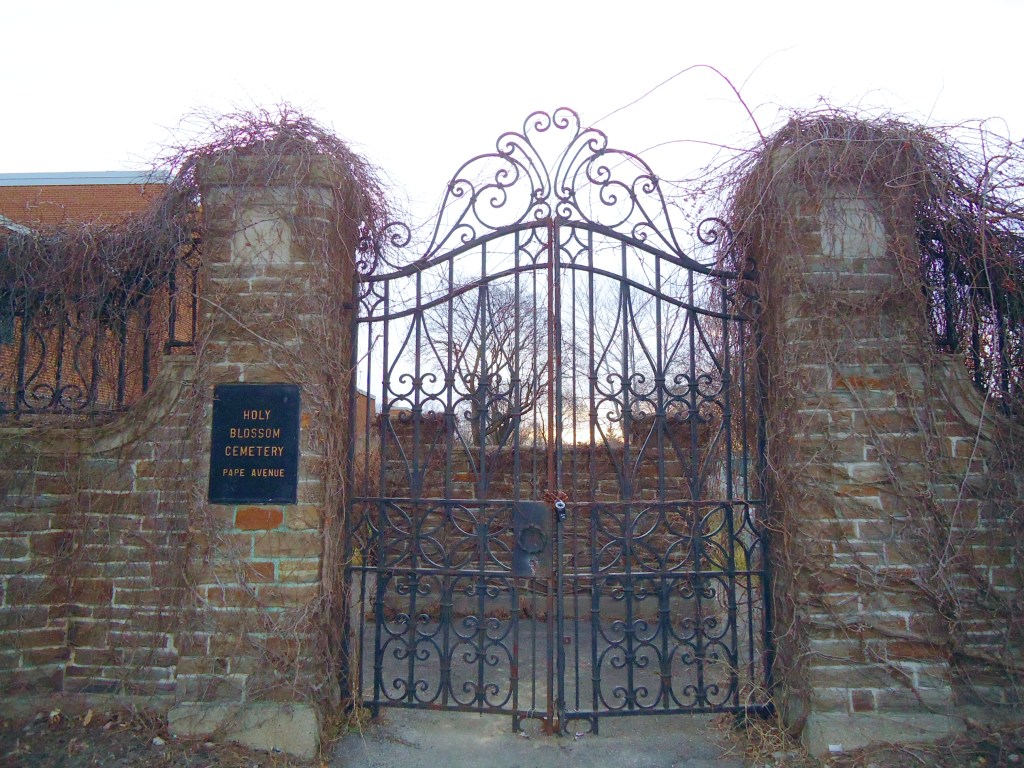
The Pape Avenue Cemetery (now known as the Holy Blossom Cemetery) still lies behind high walls, just south of the Matty Eckler Community Centre. This is the oldest Jewish cemetery in Ontario and indeed the oldest in Canada west of Montreal.  It is inactive and permission is needed from Holy Blossom Temple to enter. Seven years after the cemetery was founded, the Jewish community established the first synagogue in Ontario in rented premises above Coombe’s drug store at Yonge and Richmond streets. It later became Holy Blossom Temple. In 1919 a new Jewish Cemetery on Jones Avenue, just north of Leslieville, was consecrated, fulfilling an old Toronto Jewish proverb: “Live in the west; buried in the east.”

Gates to Holy Blossom Cemetery. Photo by Joanne Doucette.
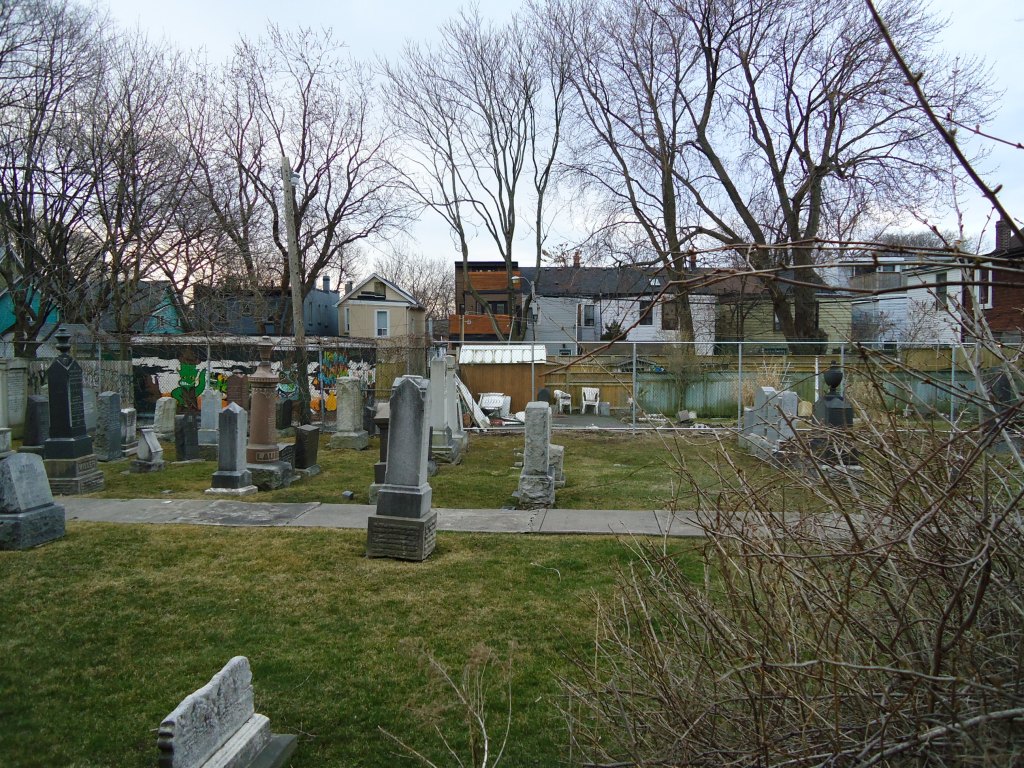
Looking south across the cemetery to the back of the houses on the north side of Austin Avenue. Photo by Joanne Doucette
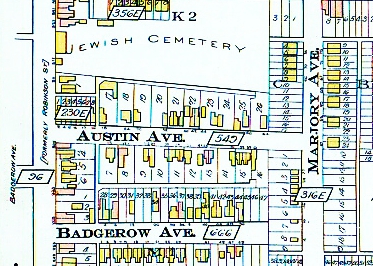
Detail Goads Atlas 1890 Plate 47 showing Austin Avenue before it was extended to Marjory Avenue. Holy Blossom Cemetery stretched from the lane north of Austin Avenue to Gerrard until it was further subdivided and lots sold to the Maple Leaf Skating Rink, and for houses on Gerrard.. The chapel is the red brick building on the east side of Pape Avenue in this map.

Part 4: Leslie Creek: from Austin Avenue to the Bay

South of Austin Avenue, the creek flowed west of Marjory Avenue to diagonally south east to cross Dundas Street at Dagmar. It crossed at 61 Jones Avenue where there was heavy basement flooding. It ran behind the store front block on the north side of Queen Street (George Leslie’s house and selling grounds) and crossed Queen Street just west of his general store at the northwest corner of Queen and Curzon.  It flowed through George Leslie’s nursery to cross Leslie Street and Eastern Avenue to enter Ashbridge’s Bay at the foot of Laing – the Gut. The Gut is where the City of Toronto Works Yard is now.

From west to east, Holly Creek, Leslie Creek, Hastings Creek, Ashbridges Creek and Small’s Pond with Small’s Creek and The Serpentine.

In 1910 city work crews buried Leslie Creek diverting its water into the municipal storm sewer system so that Austin Avenue could be extended. But the creek didn’t die. While water from rain and snow pours into the storm sewers, precipitation also sinks into the soil of gardens, lawns and parks, flowing as groundwater along the course of the old creek. Gone and totally forgotten, wet basements and faulty foundations along its way tell their own story.

Today there’s not much left to see of Leslie Creek, but if you look closely traces of the ravine remain. The dip in the lane way north of Austin Avenue is the old creek bed. If you look into backyards, remnants of the ravine west of Marjory Avenue south of Gerrard. The creek itself can still be heard running underground after a rainfall or in a spring thaw.

Part 5: The Street is Extended

Toronto Star, August 17, 1900
Globe, July 17, 1885
Globe, May 9, 1885
Globe, May 9, 1885

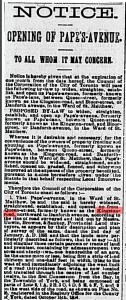
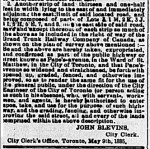
Public infrastructure, which in those days meant sewers, paved streets and sidewalks, was essential to the success of any new subdivision, then and now. George Washington Badgerow believed the East End would become an important and prosperous part of Toronto. Even before he began Subdivision #549 where Austin Avenue is today, he pushed the City of Toronto to improve road access to his subdivision. He succeeded.

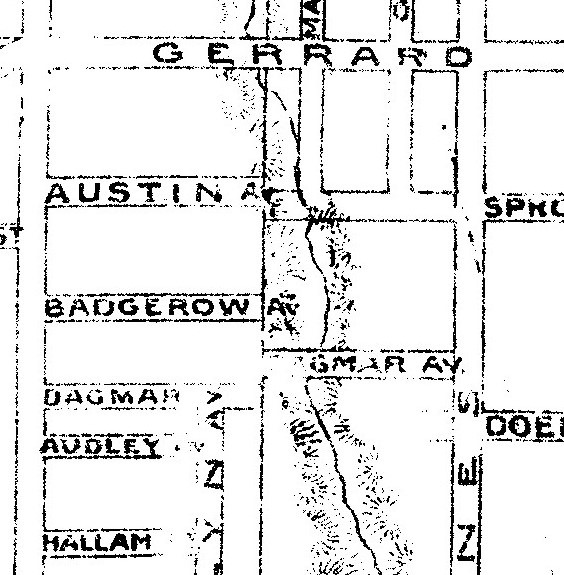
1903 map showing Austin Avenue terminating west of Marjory Avenue
1903 Map showing east end of Leslie Creek and ravine.

Brickmakers deepened and widened the ravine when they dug down to extract clay and sand for bricks. Leslie Creek blocked the extension of Austin Avenue eastward to Marjory until 1910.

Plan of the City of Toronto, 1909, showing different types of pavement

New transportation technology demanded new streets.

Old cedar block pavement Brunswick Avenue north of Harbord Street, November 1, 1899

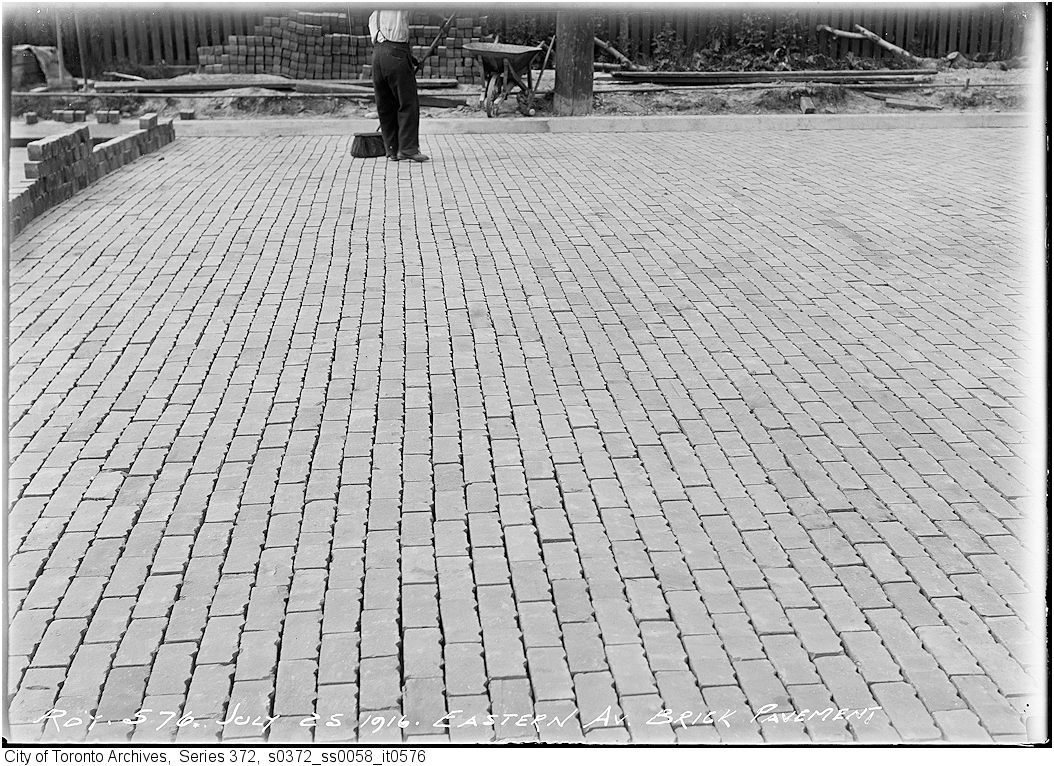
Brick pavement on Eastern Avenue, July 25, 1916
Map of Toronto Railway Company’s streetcar lines, from “Toronto As Seen From the Street Car”, 1894

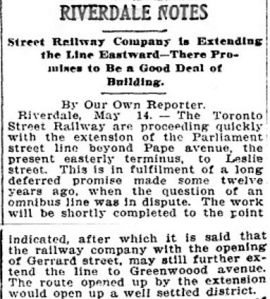
When Austin Avenue was extended in 1910, the area was a streetcar suburb of Toronto. Under heavy pressure from the City of Toronto, the Toronto Street Railway Company extended its Gerrard line east from Pape Avenue to Leslie Street and, after that to Greenwood Avenue, but no further.

. Toronto Star, August 14, 1906

The private streetcar company’s line was extended from Pape to Leslie in 1906 and to Greenwood in 1909 The City of Toronto built its own Civic Car line from Greenwood Avenue to Main Street. In December 1912, the new line opened. Soon after the City built a streetcar line from Broadview to Main along Danforth Avenue. Like Badgerow, others could see a bright future for the East End.

And then people could see that this part of the east-end was being brought very, very near to downtown, and that it was a beautifully wooded stretch of land. The cars discovered Gerrard street. They have taken hundreds of home-site buyers and builders down there. Toronto Sunday World, December 22, 1912

But by the time Austin Avenue reached Marjory Avenue, there were over 2,000 automobiles registered in Canada – a mere handful, but by the outbreak of World War One there were over 50,000. Cars, the new technology, demanded the developed of a different kind of city street, one that could accommodate the wear and tear of mechanized transport.

Car stuck in the mud on Morley Avenue (since renamed Woodfield Road). Photograph taken for the Globe, September 13, 1912

Not everyone was in favour of improving roads. Some rural residents resented Torontonians and their noisy automobiles. In 1903 York County Council considered improving the roads, but:

Councillor Baird  stated that he was very much opposed to paying out money for good roads and then have “the automobile fellow” come out on them from Toronto. He stated that these machines went at a terrific rate, and were very dangerous.” Toronto Star, November 27, 1903

The automobile revolutionized Toronto’s cityscape, transforming the gravel and sand roads of the earlier rural Leslieville and even the more recent “streetcar suburbs” created by the extension of the streetcar system, especially the Civic Car line along Gerrard. It is not coincidence that people in the East End stopped thinking of their community as “Leslieville” around this time.

City crews laying bitulithic pavement on Bain Avenue, looking west from Logan Avenue, October, 1905

Sheet asphalt placed on a concrete base was first used in Paris, France in 1858 and first used in the U.S. in 1870. Thirty years later bitulithic pavements, a mixture of aggregate (crushed rock or gravel) and crude oil, began to be laid in Toronto. At first the binder was produced using naturally occurring crude oil (mostly from Trinidad), but in 1907 manufacturers began producing asphalt binders synthesized from petroleum. By the 1920’s many of Toronto’s streets were paved with asphalt. Portland cement (a mixture of cement, sand and gravel) was also being used in road construction, as a base to support wooden block paving, bricks, cobble stones, granite blocks, etc.

Toronto Star, March 3, 1909
Toronto Star, June 22, 1909

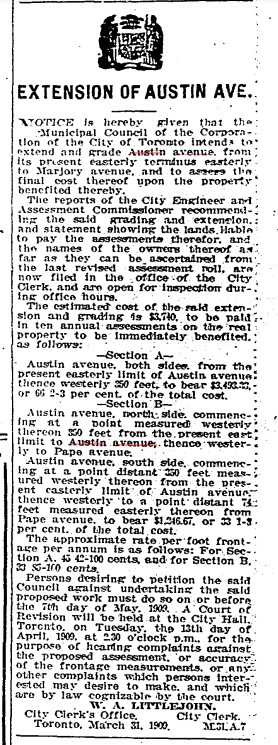
Local improvements could get expensive, especially when streets were extended. The ravine of Leslie Creek cut across the east end of Austin Avenue severing it from Marjory Avenue until 1909. The Russell family of brickmakers mined the banks of Leslie Creek for clay. Marjory Russell is believed to be the source of the name for this local street.

After the City extended Austin Avenue across Leslie Creek ravine, they called for tenders to grade the new section of the street. Globe, June 23, 1909
Toronto Star, October 28, 1909

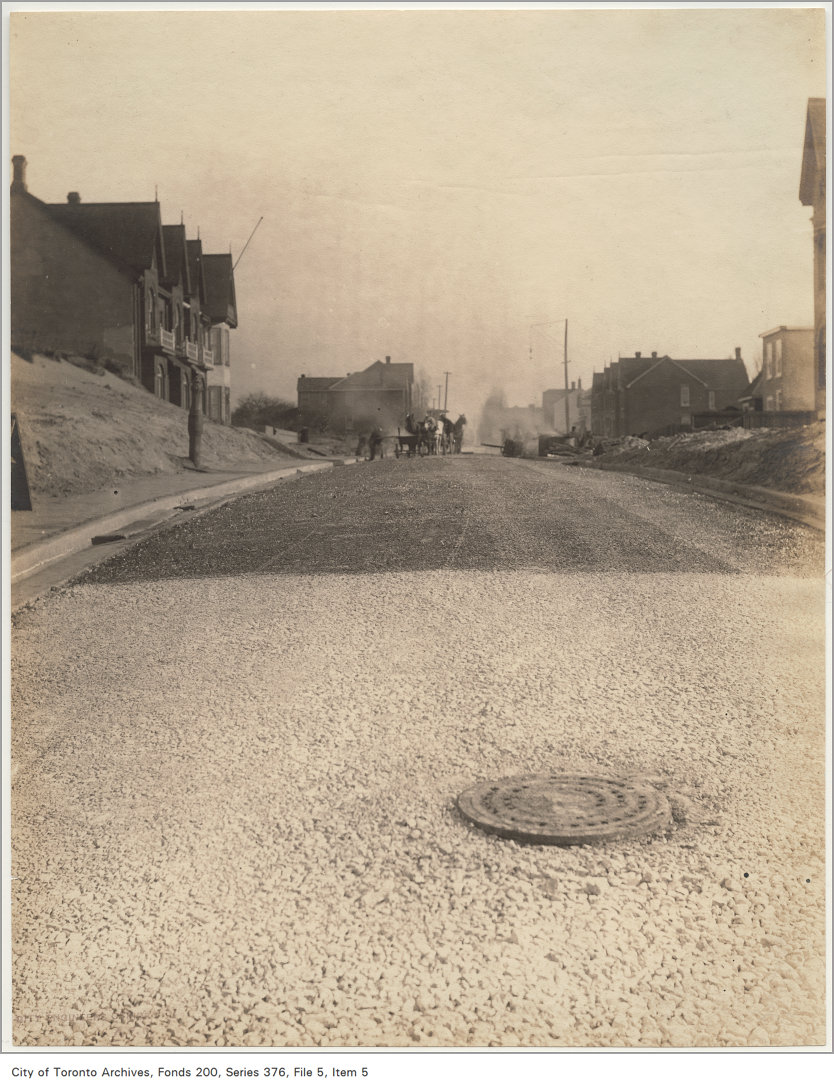
Austin Avenue was paved using new technology, but an old material: asphalt, a mixture of bitumen (crude oil) and aggregate, rolled on to streets hot. As automobiles began to multiply, drivers began to demand better roads and streets. Before asphalt this, the City of Toronto paved its streets with bricks (yes, there really were yellow brick roads), granite or wooden blocks. But the kind of pavement laid down in 1910 on Austin Avenue gave a smoother ride.

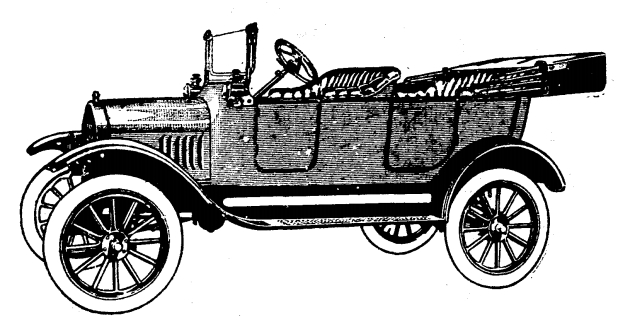
1917 Ford
1910 Map showing extension of Austin Avenue eastward to Marjory Avenue.
Globe, May 11, 1914
Marjory Avenue looking west at Austin Avenue, showing the asphalt paving, concrete curving and cement sidewalk familiar to today’s residents.

A writer in 1716 said, “Tis impossible to be sure of anything but death and taxes.” After the City of Toronto filled in the ravine of Leslie Creek and extended Austin Avenue to Marjory Avenue, property values went up as did tax assessment on Austin Avenue and Marjory Avenue.

Death is still with us and I wonder what the taxes are on theses Austin Avenue houses?

https://torontolife.com/real-estate/sale-of-the-week-39-austin-terrace/

https://www.blogto.com/city/2013/04/house_of_the_week_41_austin_avenue/

http://55austin.com/

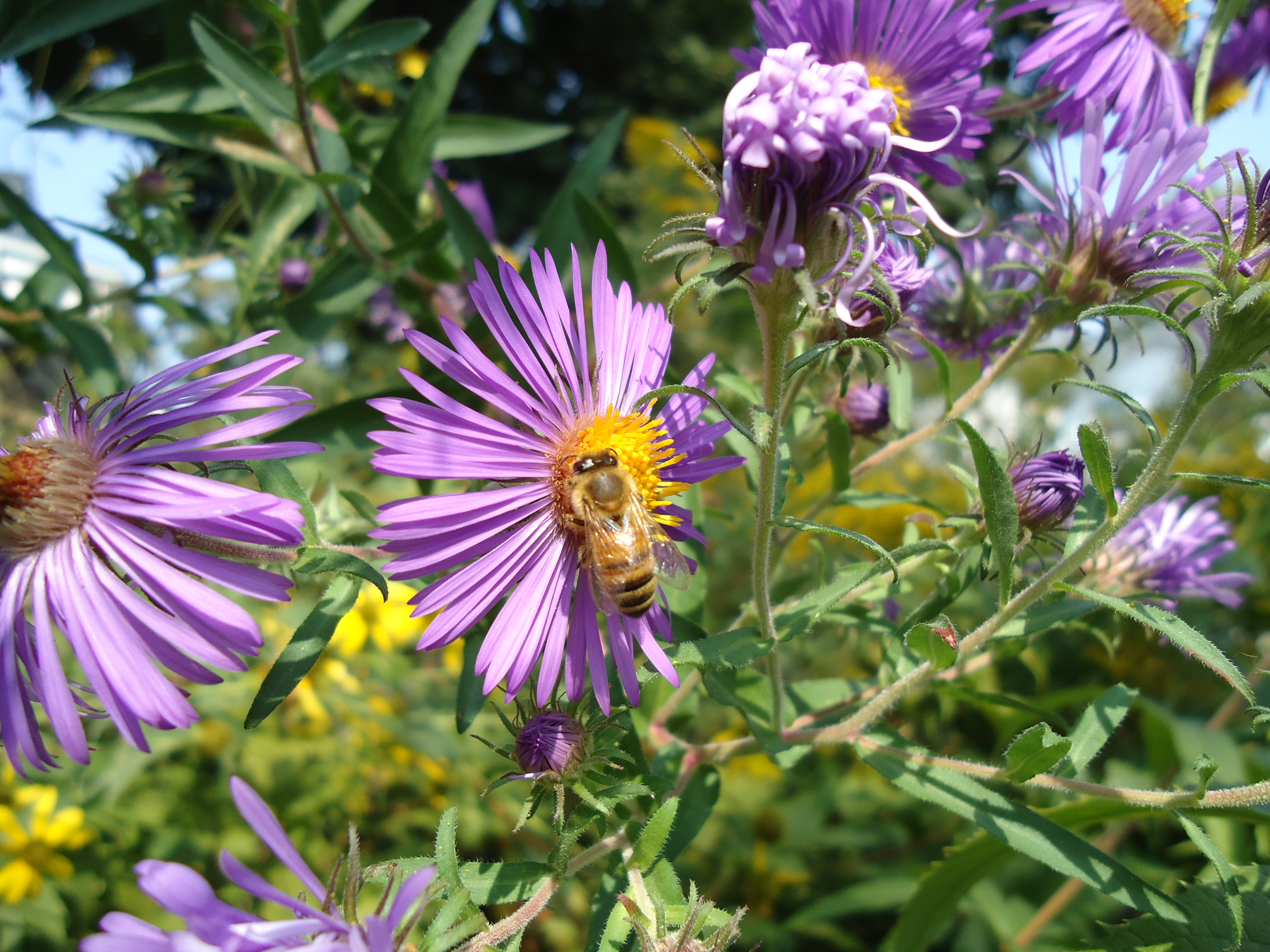
Urban Beekeeping, Austin Avenue, Leslieville, 1912

Bees on AUstin

Perhaps nothing illustrates the value of knowing the background to your life and future than the environmental crises facing us today, including global warming and mass extinction. The bees of 32 Austin Avenue have a story to tell us about remembering the background to our lives.

Collective amnesia is as if we suddenly forgot everything important that ever happened to make us who we are. It is as if we as a society had a massive stroke and could only remember what happened today. Yesterday gone. If this happened to a bee colony, how could they find the flowers with the nectar and pollen needed for survival. The colony would collapse.

What is another name for “the background to your life”? Informally it is our communal memory. More formally it is history, both that written by academic historians in universities and by more everyday folks like me. I’m Joanne Doucette, one of Leslieville’s local historians, and I think that our collective past can help us imagine a better present and certainly a better future.

Let’s take a time machine back to the Green family 32 Austin Avenue in Leslieville in the summer of 1912. Neat homes and gardens line this quiet street and bees buzz from flower to flower long before the City of Toronto considered it necessary to develop a “Pollinator Protection Strategy”. https://www.toronto.ca/wp-content/uploads/2018/05/9676-A1802734_pollinator-protection-strategy-booklet.pdf

Leslieville was founded by market gardeners and many of our streets are named after these families: Pape, Logan, Leslie, Greenwood, etc.

October 23, 1901 Greenwood Avenue looking north. Both sides were lined with apple orchards

George Leslie and the other market gardeners of Leslieville were absolutely dependent on bees, but no doubt took them for granted.

Toronto was home to incredibly communities of pollinators, including honey bees, native bees (many now endangered or threatened), butterflies and moths. For more information about the bees of Toronto: https://www.toronto.ca/wp-content/uploads/2017/08/8eb7-Biodiversity-BeesBook-Division-Planning-And-Development.pdf

Looking over the Steele Briggs nursery at Kent and Queen in the background, just behind the red brick buildings, is the Ashbridge’s nursery.

Although pesticides like Paris green were in use on farms and market gardens, most farms were still essentially organic and agriculture more sustainable.

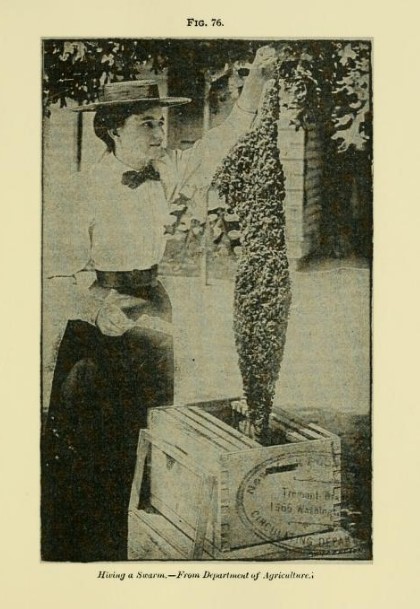
A J Cook, The Bee-Keeper's Guide or Manual of the Apiary 1902 hiving a swarm

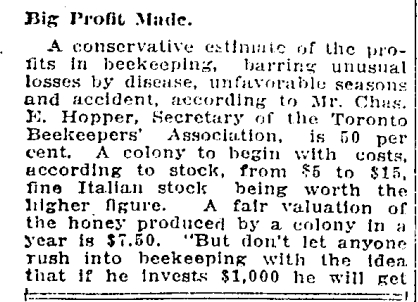
A thriving community of beekeepers, men, women and children, kept hives in their backyards and produced honey for home use and even sale. In 1912 Alfred William Green and his wife Effie Harnden lived at 32 Austin Avenue with their four children, Harold, Bernice, Myrtle and Alton, and thousands of honey bees.

19121102 GL Bee industry1
Globe, November 2, 1912
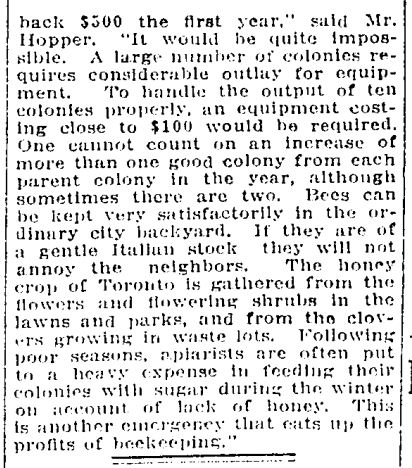
19121102 GL Bee industry2
Globe, November 2, 1912 continued
There were hundreds of urban beekeepers a century ago! For more about urban beekeepers in Toronto go to: http://urbantorontobeekeepers.org/
19121102 GL Bee industry4
Globe, November 2, 1912
19121102 GL Bee industry6
Globe, November 2, 1912
Toronto City Directory, 1912
Gleanings in Bee Culture June 15, 1912 kit1
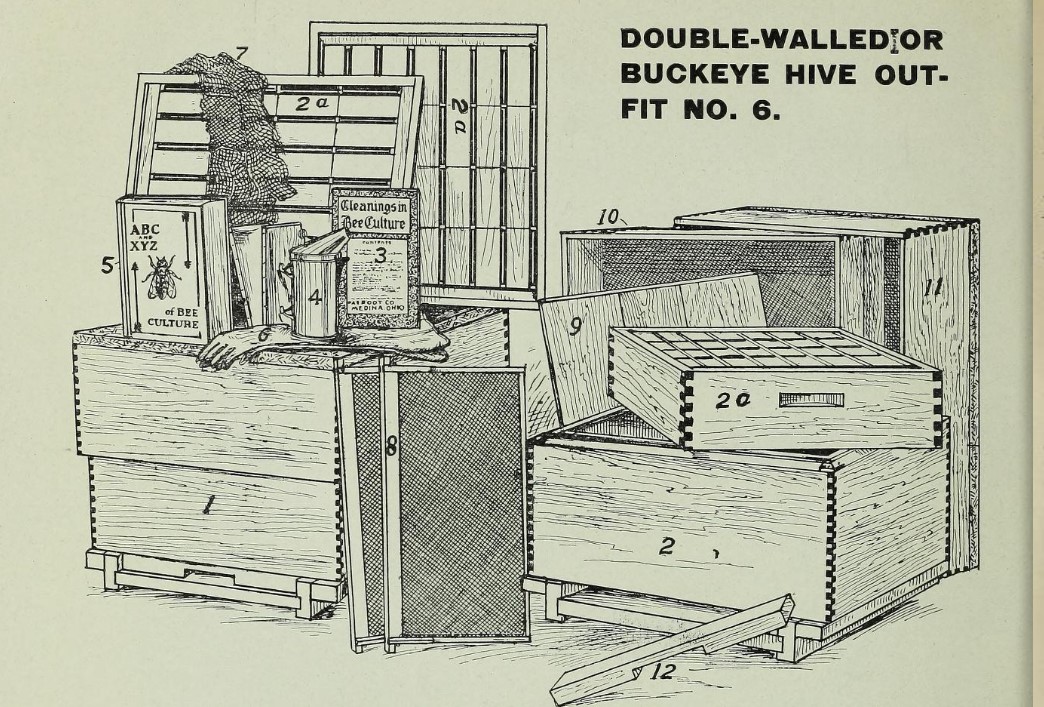
A kit for a beginner, from “Gleanings in Bee Culture”, June 15, 1912 Total Cost $30 US. Similar kits are for sale today for about ten times the price.
Gleanings in Bee Culture June 15, 1912 kit2
Gleanings in Bee Culture June 15, 1912 The items in the kit

In 1912 farming was still largely chemical free and based on small family farms. Bee populations were healthy and beekeeping both a popular urban hobby and a rural business. A beekeeper of 1912 would have had a hard time believing that a century later bees on Austin Avenue would experience more biodiversity than rural bees. Alfred Green, like all beekeepers, would have known that bee keeping is more than some boxes, frames, gloves, head gear and other equipment: it is bee caring. Bees require consideration and in return they give honey and pollinate our gardens and crops.

“The evidence is overwhelming that wild pollinators are declining. Their ranks are being thinned not just by habitat reduction and other familiar agents of impoverishment, but also by the disruption of the delicate “biofabric” of interactions that bind ecosystems together. Humanity, for its own sake, must attend to these pollinators and their countless dependent plant species.” -Edward O. Wilson

In 2019 farming is large scale agri-business, dependent on chemicals and artificial fertilizers, no longer sustainable but a major contributor to a global environmental crisis. Now Toronto, like many cities, is encouraging beekeeping to both stop falling bee populations and encourage local farmers and business.

Today’s city bees are healthier than their country cousins. The urban bees make more honey and have a higher winter survival rate. The city bees of 2019 have access to a wider range of flowers, a more varied diet. They have a stronger immune system and less exposure to toxic chemicals than rural bees.

Colony Collapse Disorder was unknown as were neonicotinoids, the insecticide believed to be behind declining bee populations.

However, now the term “colony collapse” is something even school children worry about.

A J Cook, The Bee-Keeper's Guide or Manual of the Apiary 1902 worker bee
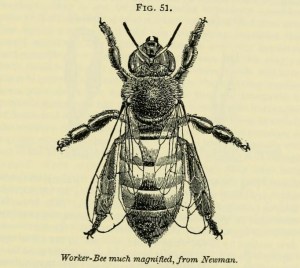
The worker bee, from A. J. Cook, “The Bee-Keeper’s Guide or Manual of the Apiary”, 1902
For more about the different kinds of bees go to: https://www.toronto.ca/wp-content/uploads/2017/08/8eb7-Biodiversity-BeesBook-Division-Planning-And-Development.pdf

“…most industrial farms practice extensive monoculture (miles of the same crop), where there is no alternative forage for any pollinator, native or non-native. Without a variety of food blooming at different times, any insect pollinator in the area will have a short, troubled life.” -Karen E. Bean, beekeeper

R Wilkin, Handbook in Bee Culture, 1871
A honey comb from R. Wilkin, Handbook in Bee Culture, 1871
R Wilkin, Handbook in Bee Culture, 1871a
From R. Wilkin, “Handbook in Bee Culture”, 1871

So for me the value of the background to this little illustrated story from Austin Avenue is not in some dusty type of history that leaves a dry mouth and bored mind but in its power to awaken our imaginations. We reach into our background to move forward to create alternative futures.

“I dreamt—marvelous error—
that I had a beehive
here inside my heart.
And the golden bees
were making white combs
and sweet honey
from my past mistakes.

-Antonio Machado, “Last Night As I Was Sleeping”

Some bee-friendly plants still common in Leslieville today

A bee-friendly Leslieville area garden, 2019

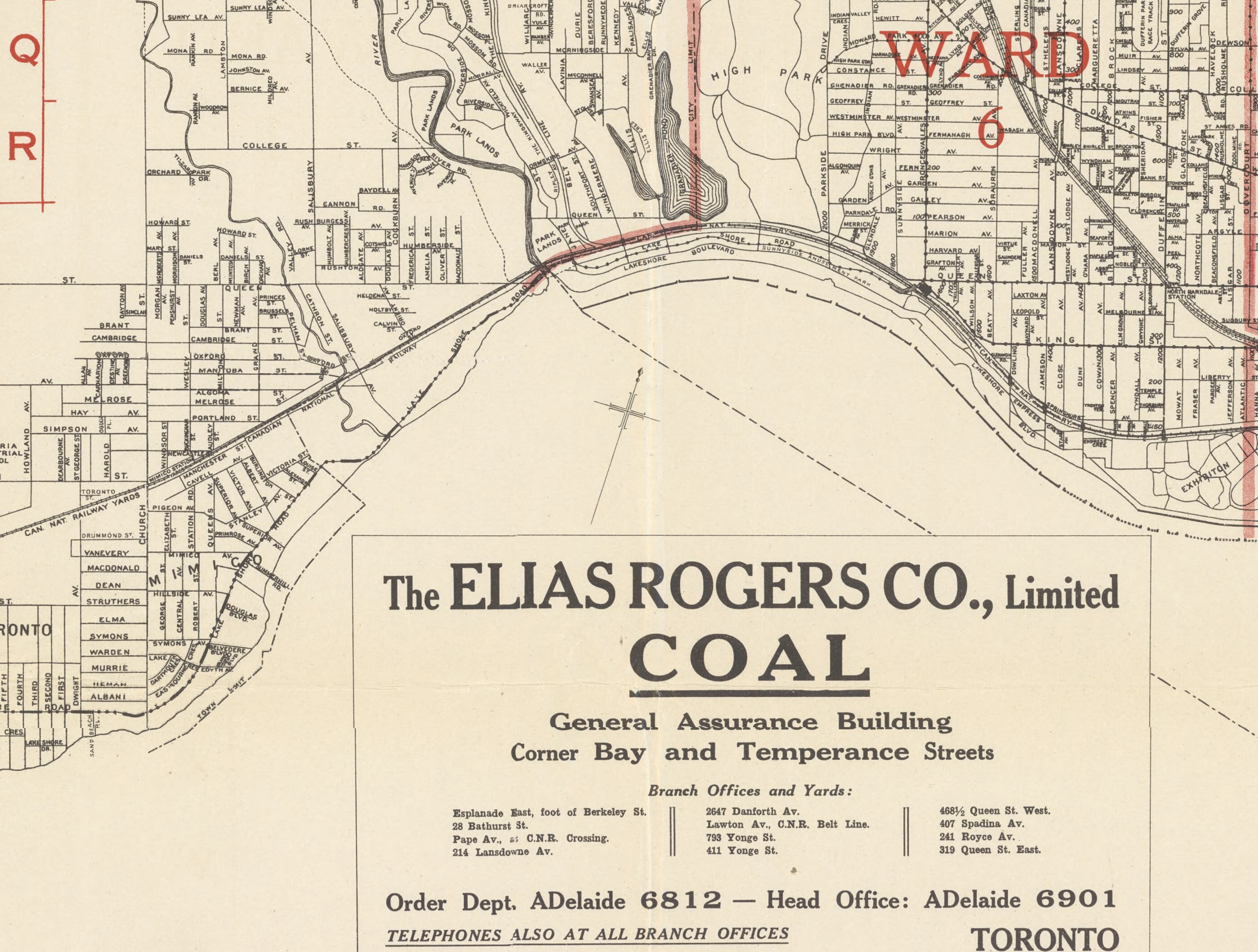
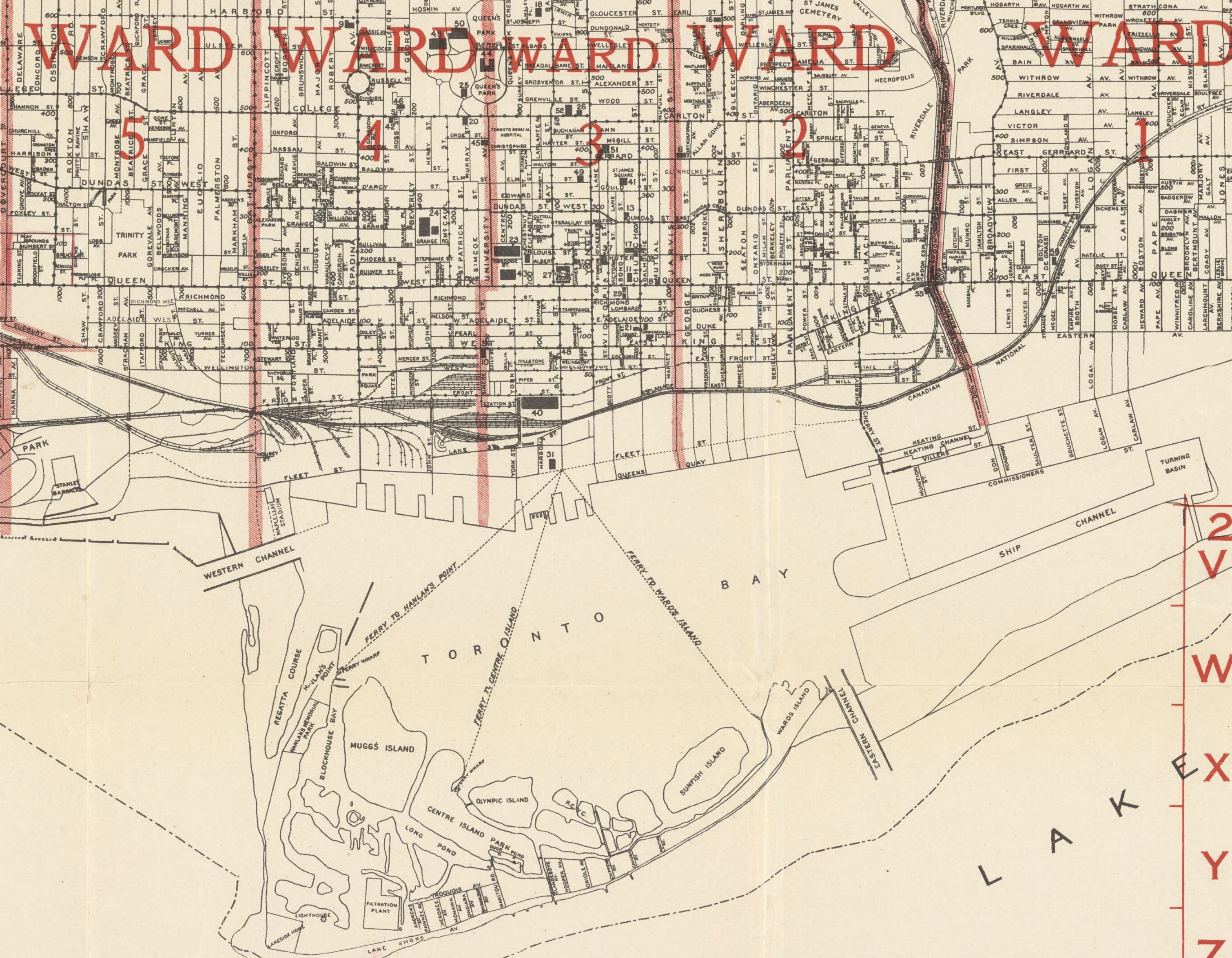
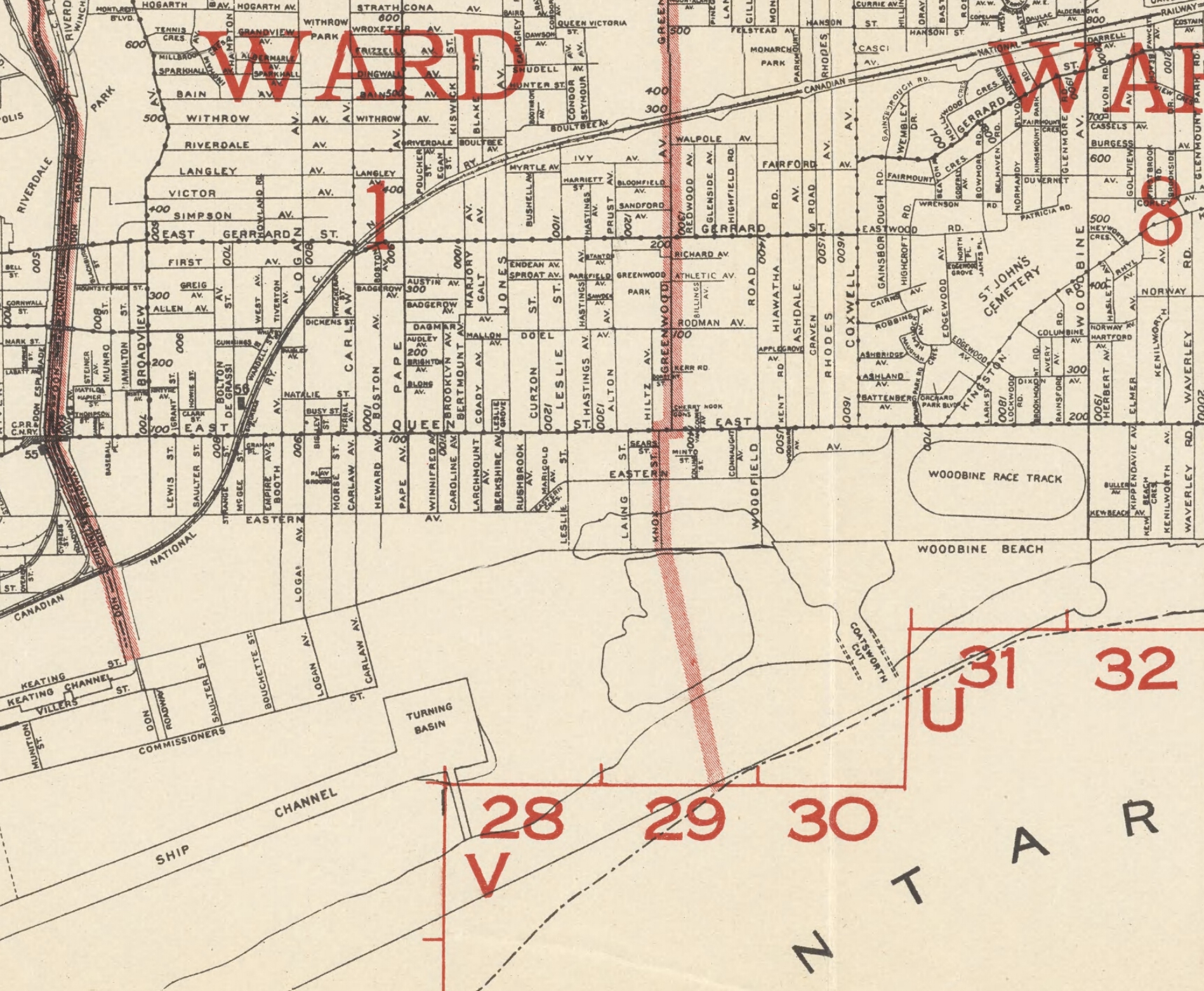
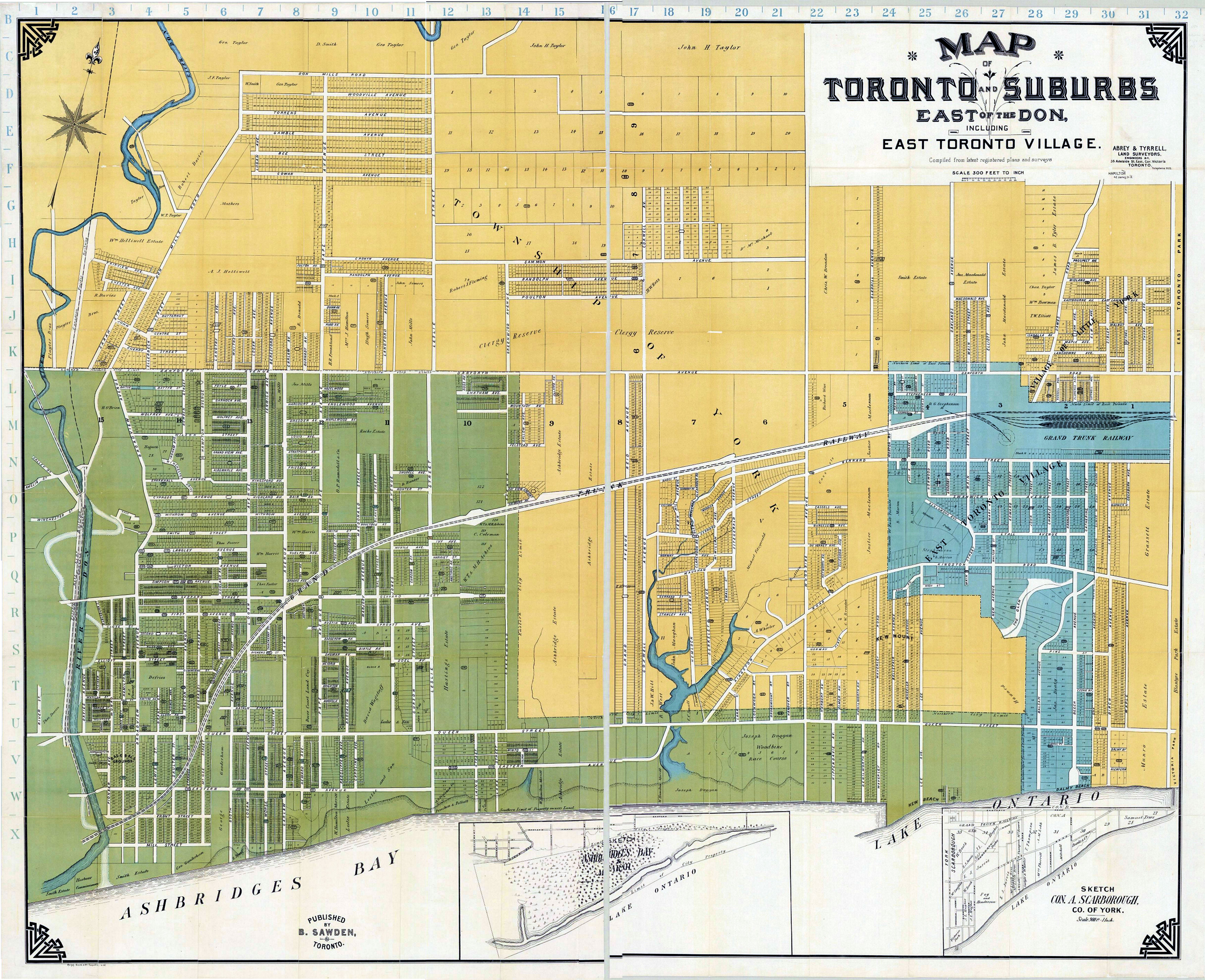
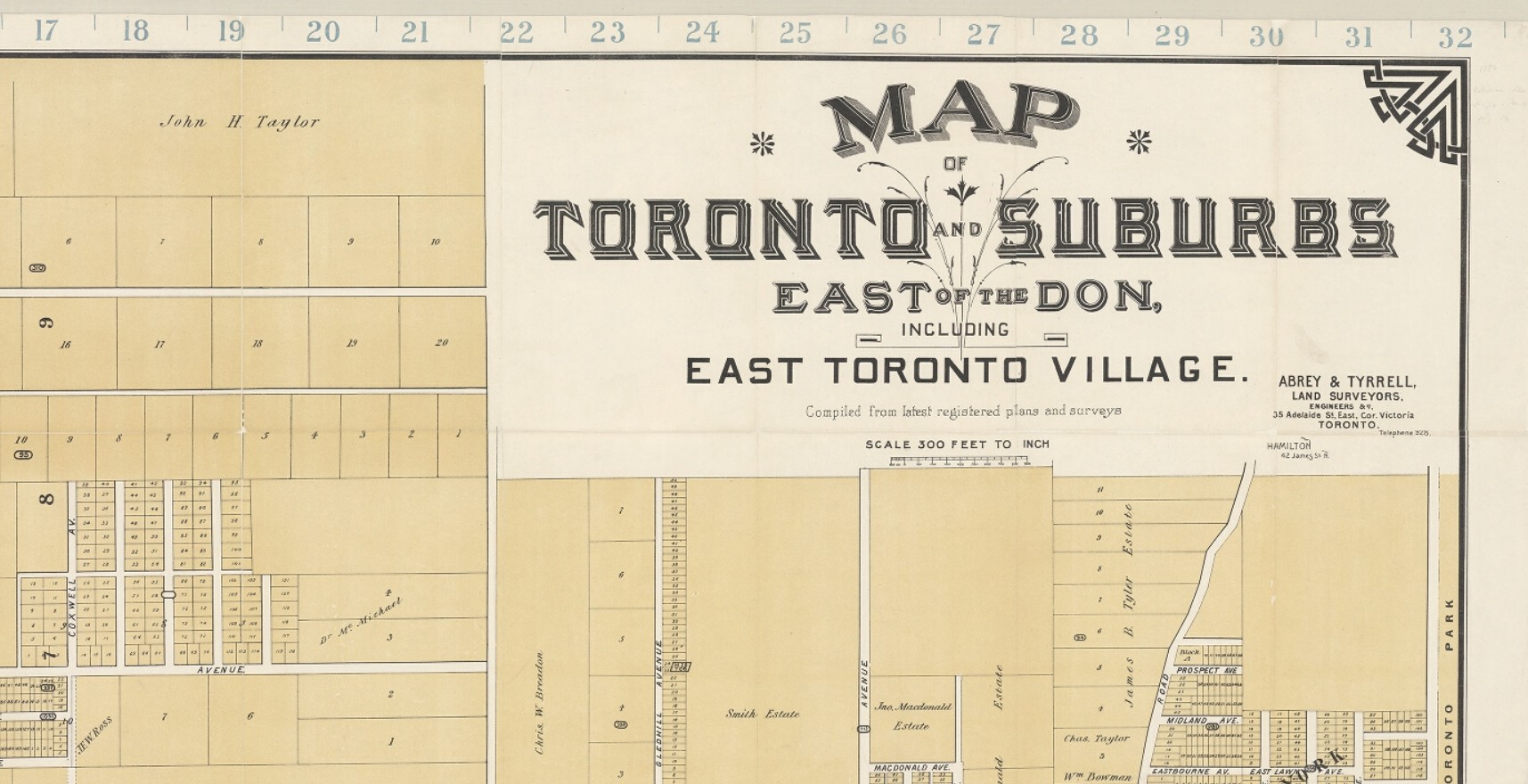
A map of what was and what might be, 1908 Abrey and Tyrell Map

1908 Abrey and Tyrell Map
1908 Abrey and Tyrell Map in full. Sections are included (below) to make the map and the information on it more accessible.
Map of Toronto, 1908 info
I particularly love this is beautiful and detailed map, but it needs to be looked at with care since it is a map of plans and surveys, some of which were never built!

This slideshow requires JavaScript.

From the Don River to Greenwood and from East York to Ashbridge's Bay
From the Don River to Greenwood and from East York to Ashbridge’s Bay
Greenwood to Coxwell, East York to Ashbridge's Bay
Greenwood to Coxwell, East York to Ashbridge’s Bay
East
From Coxwell to the boundary with Scarborough. Blue indicates the Village of East Toronto — an independent and separate municipality with its own town hall, services and council.
a
north of the Danforth include part of East York and the area known as Doncaster.
b
The northern part of East Toronto VIllage and the land occupied by the Toronto Golf Club. This has been surveyed and a subdivision planned, but that plan never came to fruition and many of the streets were never built, at least as configured on this map. Note the large Grand Trunk Railway yard and roundhouse. The area between East Toronto Village and the City of Toronto was called “Midway”.
c
From Ashbridge’s Bay and Lake Ontario to Kingston Road, including Small’s Pond (left), Glen Stewart Ravine (called “The Glen” on the map), and the village of Norway. Like Leslieville and Don Mount, Norway was a postal village and was not incorporated as a municipality, unlike the Village of East Toronto.
From Coxwell Avenue to Victoria Park, including the Woodbine Race Track, Kew Beach, and Balmy Beach.

Some Leslieville Street Names

Leslieville Historical Society's avatarLeslieville Historical Society

1860 Tremaine's Map of the County of York, Canada West From Tremaine’s Map of the County of York, 1860

It is sometimes difficult to trace the origins of street names. Clearly most Leslieville streets were named after families who lived here or after the builders who put up the houses on the street. Only a few, such as Eastern Avenue, are more or less self-explanatory. Moreover, street names changed over time. Doel became Dundas; Kingston Road became Queen Street, etc. Street names were changed because citizens requested it (as with Erie Terrace with became Craven Road) or because amalgamation with the City of Toronto led to confusing duplication of street names. A number of streets in the newly annexed areas had the same names as streets in the old City of Toronto so those streets were renamed.

Street naming went through fads and suffered at the whim of politicians. In 1905, the City of Toronto’s Street Naming Sub-Committee (all aldermen) wanted all new streets…

View original post 2,653 more words

Riverdale Collegiate

by Joanne Doucette

A ghostly Riverdale Collegiate stands behind an orchard. Workers with pick and shovel fill in the Devil’s Hole or Devil’s Hollow, a ravine cut by Hastings Creek and widened and deepened by brickmakers. Nearby Harriet’s Hill shows how deep the hole really was and even the bottom of the gully there has been filled in with brickyard waste — broken bricks and cinders. Riverdale Collegiate itself was built of those deep red bricks from the local brickyards.

1910 Devils Hollow labelled
1910 map with my labels. 

There is an urban legend that Myrtle, Ivy and Harriet Streets were named after local women (true) who argued so much that they could never meet so the streets don’t meet (not true). The deep ravine called “the Devil’s Hollow” had more to do with keeping the streets from meeting. The women were all members of local brickmaking families who actually seemed to have got along quite well.


5
This is likely along Hasting’s Creek near Riverdale Collegiate. Note the orchard at the top of the bank. The Clay Worker, November, 1906.

Slide 22
The area was still quite rural in 1907 when Riverdale Collegiate began as can be seen in this photo of Pape Avenue looking north from about the railroad tracks.

Slide 23b
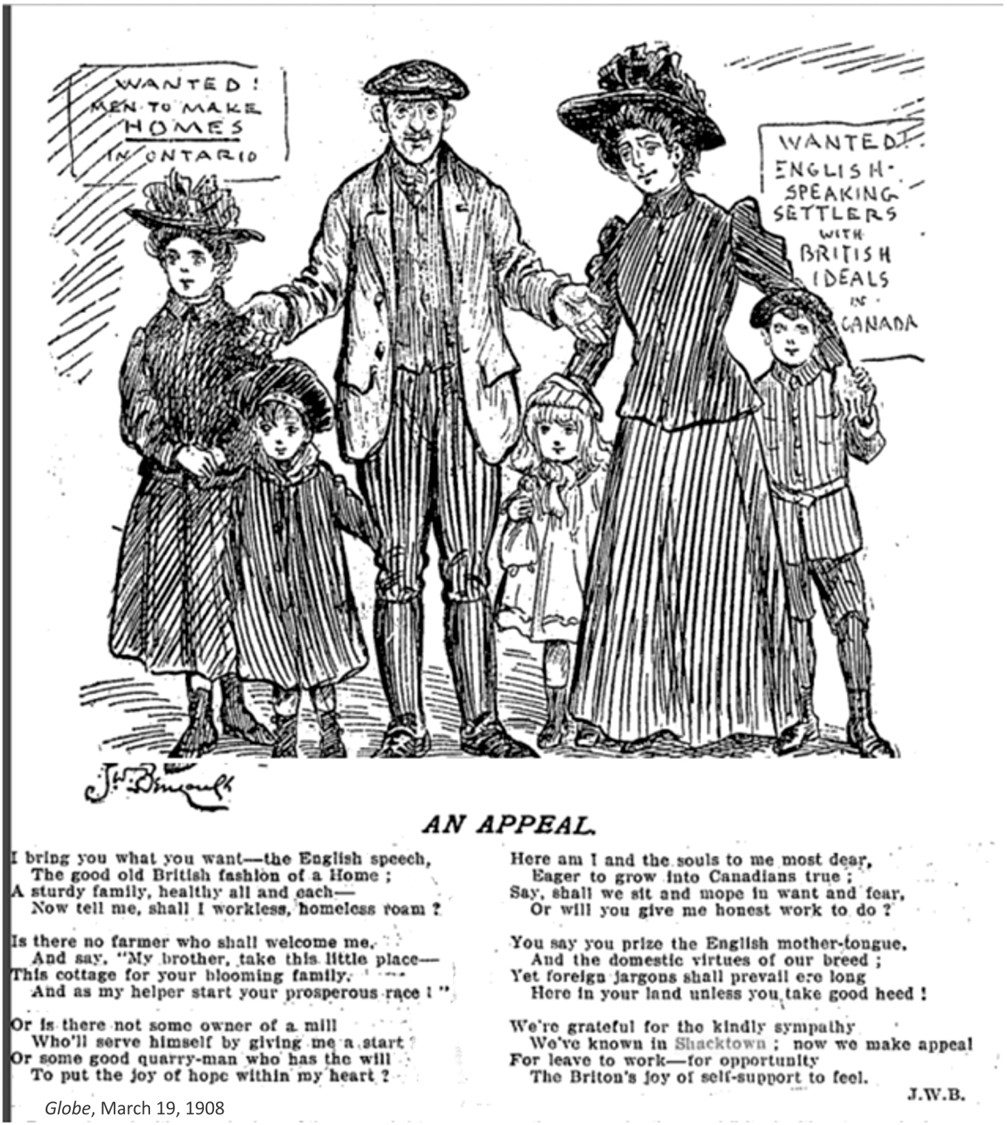
A cartoon appealing for British immigrants to come to Toronto. From the Globe, March 19, 1908. 

Canada’s immigration policy was openly racist and specifically sought white Scottish, Irish and English immigrants to counter the feared “Yellow Peril” — immigration from China and, to a lesser degree, Japan. This is clearly and, none to subtly, reflected in the poem below. John Wilson Bengough (1851-1923) was one of Canada’s leading cartoonists.

Slide 23a

British immigrants crossing the “Bridge of Tears” over the railway tracks at Union Station around 1911. It was called this because here people said goodbye to loved ones or cried because they had left everything they had to gamble on a new start in a new country. Everything they own is in their hands.

Most came in family groups like this. Mother has baby in her arms. Dad is at the back. Two teens carry the luggage and grandmother is at the back carrying another child. The grinning child on the right reflects the hope they had, but others don’t look so enthralled with Toronto.

Slide 24

At the same time that a Shacktown was growing outside the city, families like the Andersons built brick and brick-fronted houses like these west of Greenwood Avenue. The City of Toronto imposed stricter building requirements due to the danger of fire. The so-called “Fire Limits” required brick construction at least on the street facade and fire resistant cladding on the other walls. Much of that cladding was Insulbrick, a kind of asphalt impregnated with asbestos. There is still a lot of that material around, often covered with newer aluminum siding.

The Andersons, professional builders from Scotland, preferred to build solid brick, sturdy houses, like these three. Many of those still stand today near Riverdale Collegiate. (Photos courtesy of Guy Anderson)

Slide 25

After 1905 a Shacktown developed east of Greenwood Avenue on land that was still outside of the limits of the City of Toronto. A flood of impoverished British immigrants arrived here to start new lives only to find that while jobs were available (at least at first), there was no housing for them. So they bought lots at around $5 to $10 a foot of frontage and scrounged bits of lumber, old crates, tarpaper, tin and whatever could use to create their own homes. These are on Coxwell Avenue.

Slide 26
City of Toronto Building Construction Dates City of Toronto Works and Emergency Services, Technical Services, Survey and Mapping Services, Mapping Services. Produced by Patricia Morphet, September 2003 This map is on line at http://oldtorontomaps.blogspot.com/2014/06/contemporary-maps-with-historical.html

Slide 28
From Goad’s Atlas, 1913, Plate 100, showing Riverdale Collegiate. Curzon Street was later renamed Bushell Avenue north of Gerrard. Bushell may have been named after a brickmaker named Bushell who was killed in World War One. After that bloodbath the City of Toronto renamed a number of small streets after particularly courageous men who died. Another such street is Dibble near Eastern Avenue and McGee.

Skating on Hastings Creek The Devil's Hollow

December 22, 1919 Boys playing hockey on Hastings Creek. Hastings Creek crossed the Danforth just east of Jones and cut a ravine at Ravina Crescent in “The Pocket” and another gully, known as the “Devil’s Hollow” between Jones & Greenwood.

The creek continued south through the Hastings’ farm (Hastings Avenue to Alton Avenue) and across where Greenwood Park is to enter Ashbridge’s Bay between Leslie Street and Laing Street. The City filled the ravine in a number of times and finally buried the creek in the sewer system in the early 1920’s.

A staff member at the East End Garden Centre recalled when her grandfather caught fish in this pond. Others have told me of their grandparents tobogganing down the hill or skating on the pond.

Slide 29

Cattle and pigs were driven along roads leading into Leslieville from very early in the 19th century. The men and boys who managed the cattle en route were called “drovers”. Later they were brought in by train. When they reached Leslieville the animals were let loose to graze on the nutritious meadow grasses along Ashbridge’s Bay.

Some were even fed on the leftovers from the Gooderham Worts Distillery. Then they were slaughtered by butchers in the many abattoirs that were feature of Leslieville’s economy. Of the cattle that were fed on whisky mash, it is said that they died happy.

Slide 30

This is looking west along Jones Avenue just north of Riverdale Collegiate. Heavy industry lined the track, including a pork packinghouse on the west side of Jones where pigs where slaughtered. The stench was incredible especially on hot days, making nearby houses and the high school even more uncomfortable in the days before air conditioning,

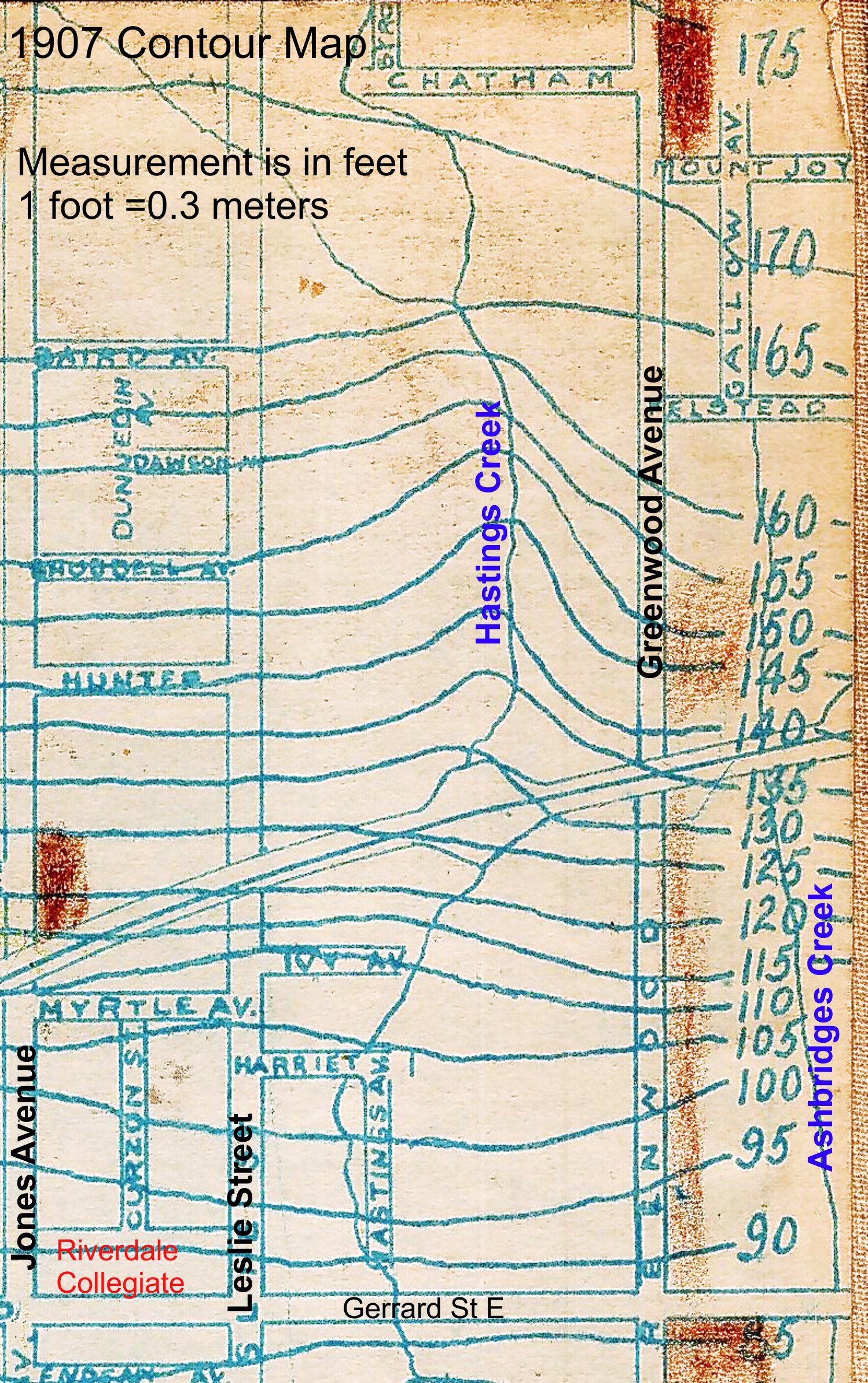
Contour Map 1908 Hastings Creek labelled
This map was published in 1908 and is based on surveys done in 1907.

Lazeby 1921 TTC close up topo map Leslieville labelled
Hastings Creek has now been put underground as part of the sewer system. The penciled in line just east of Leslie Street may indicate the path of the sewer. By this time the creek was heavily polluted with industrial and human effluent. But public health was coming into its own by the 1920’s and chlorination of drinking water, immunizations against infectious diseases, pasteurization of milk, and the invention of new drugs like penicillin began to revolutionize society in ways that we often don’t recognize today. Nonetheless, the teenagers of Riverdale paid a heavy price in the First World War and Great Flu pandemic that followed. I hope the short history of the Riverdale Collegiate site that I have written will help all of us appreciate young people more through understanding the area that they grew up in.

Slide 31
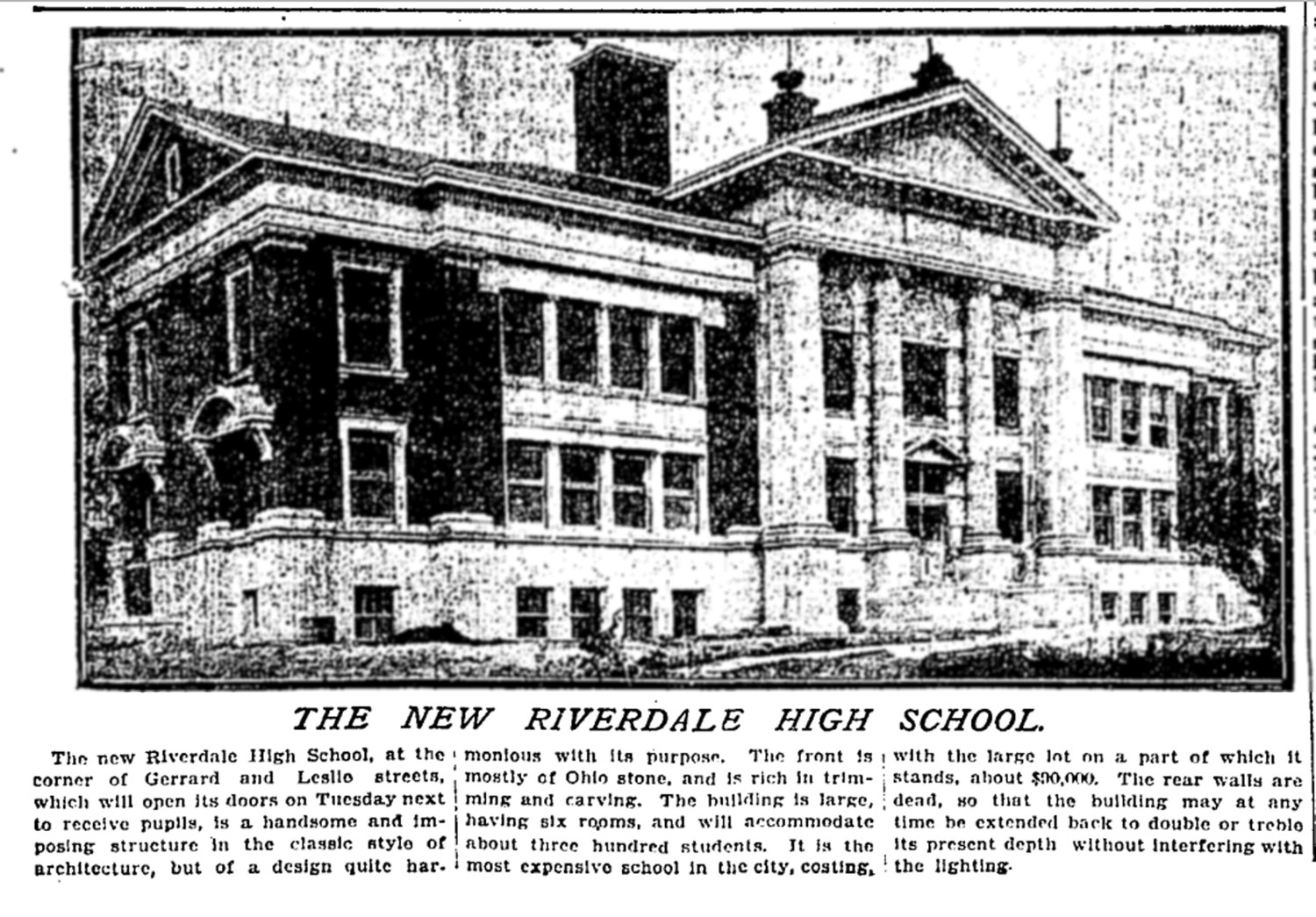
Globe, Sat., Aug. 31, 1907 On the former exterior south wall, now inside an atrium, a 1965 Toronto Board of Education plaque. This is what it says: “In co-operation with the Riverdale Business Men’s Association, the Toronto Board of Education persisted in building a school on Gerrard Street, named Riverdale Collegiate Institute. The original school, consisting of a principal’s office, library, auditorium, four classrooms and two science rooms, was occupied in 1907.”  Contrary to some sources such as Wikipedia, Riverdale Collegiate Institute was first called Riverdale High School NOT Riverdale Technical School. Riverdale Technical School, founded in 1919 on Greenwood Avenue north of Danforth Avenue was renamed Danforth Technical School.

Slide 32
Colourized postcard, 1907

Slide 33
Photo from The Report of the Dept of Education 1910 By the second and third years, classes had to be held in the cloak rooms. The first addition was completed in 1910 and consisted of the assembly hall and the eight classrooms to the north and south of it.

Slide 34
Photo from Report of the Dept. of Education, 1914. Additions were built in 1914, 1922, and 1924, in accordance with the architect’s original plan for the expansion of the school.

Slide 35
Architect’s blueprint showing planned extension to Riverdale Collegiate. City of Toronto Archives.

Slide 36
Postcard of Riverdale Collegiate after 1924 when additions were added to enlarge the school further. This is likely from an architect’s drawing prepared for that extension to the school.

Riverdale_CI_From_Jones_(Phone)
CC BY 2.5, https://commons.wikimedia.org/w/index.php?curid=1201756

Riverdale_CI_Crest
THE END

On this place: Riverdale Collegiate…

Slide 1 Devil's Hollow 1919
Welcome to this presentation which was given at Riverdale Collegiate on May 1, 2019.

Did you ever wonder what was here in days gone by? Who lived here? What buildings stood here? Why did they build here?

This picture shows Riverdale Collegiate on the far hill on December 22, 1919. We are looking from Prust Ave. Landfill with large concrete rubble fills the ravine in the immediate foreground. The new Hastings Avenue lies in the mid-ground and just west of it, hidden from sight, is Hastings Creek. On the slope immediately east of Leslie Street  is an orchard with an apple storage barn (cold storage).

Slide 2

Lucius O’Brien, Among the Islands of Georgian Bay, watercolour, 1886. This painting depicts Anishnaabe families similar to the Mississauga people whose traditional territory included the site of Riverdale Collegiate. The Mississauga are a group within the larger Anishnaabe (also known as Chippewa or Ojibway people).

When the first white settlers came to the area around Jones and Gerrard the Kichigo family of Mississaugas helped them adapt to life here, welcoming them and sharing food and medicine. Many native people still live in Leslieville.


For more about the Mississauga of the New Credit First Nation go to: http://www.newcreditfirstnation2015.com/community-profile/


Slide 3

Lieut. Governor John Graves Simcoe granted large parcels of land to people who supported the government of Upper Canada. Most of these did not actually settle on the land but held it as an investment, hoping to subdivide it later for sale. Riverdale Collegiate lies in Lot #11 which was granted to United Empire Loyalist Benjamin Mosely. (Mosely Street is named for him.) The writer of this article, Joanne Doucette, is herself a United Empire Loyalist being a direct descendant of Capt. Matthew Hawley of Connecticut.


For more about United Empire Loyalists go to http://www.uelac.org/

George Leslie by John McPherson Ross ca 1907
George Leslie attributed to John McPherson Ross ca 1907.

George Leslie attributed to John McPherson Ross ca 1907. George Leslie (1804-1893) was the founder of the small community that grew up around the corners of Leslie Street (named for him) and Queen Street East (then known as Kingston Road).

Leslie was a market gardener whose Toronto Nurseries became the largest tree-growing business in Canada in the 19th century. He was a public school trustee and a strong advocate for free education for everyone. His market garden was between Queen Street and Ashbridge’s Bay (south of Eastern Avenue) and Leslie Street and Caroline Avenue (named after his first wife Caroline Davis).

His home was at the northeast corner of Queen and Jones and Leslie Grove Park is the northern part of his arboretum and site of his greenhouses.

Below 1868 Gehle, Fawkes & Hassard: Reconnaissance Sketches of Toronto Area.

Slide 4b

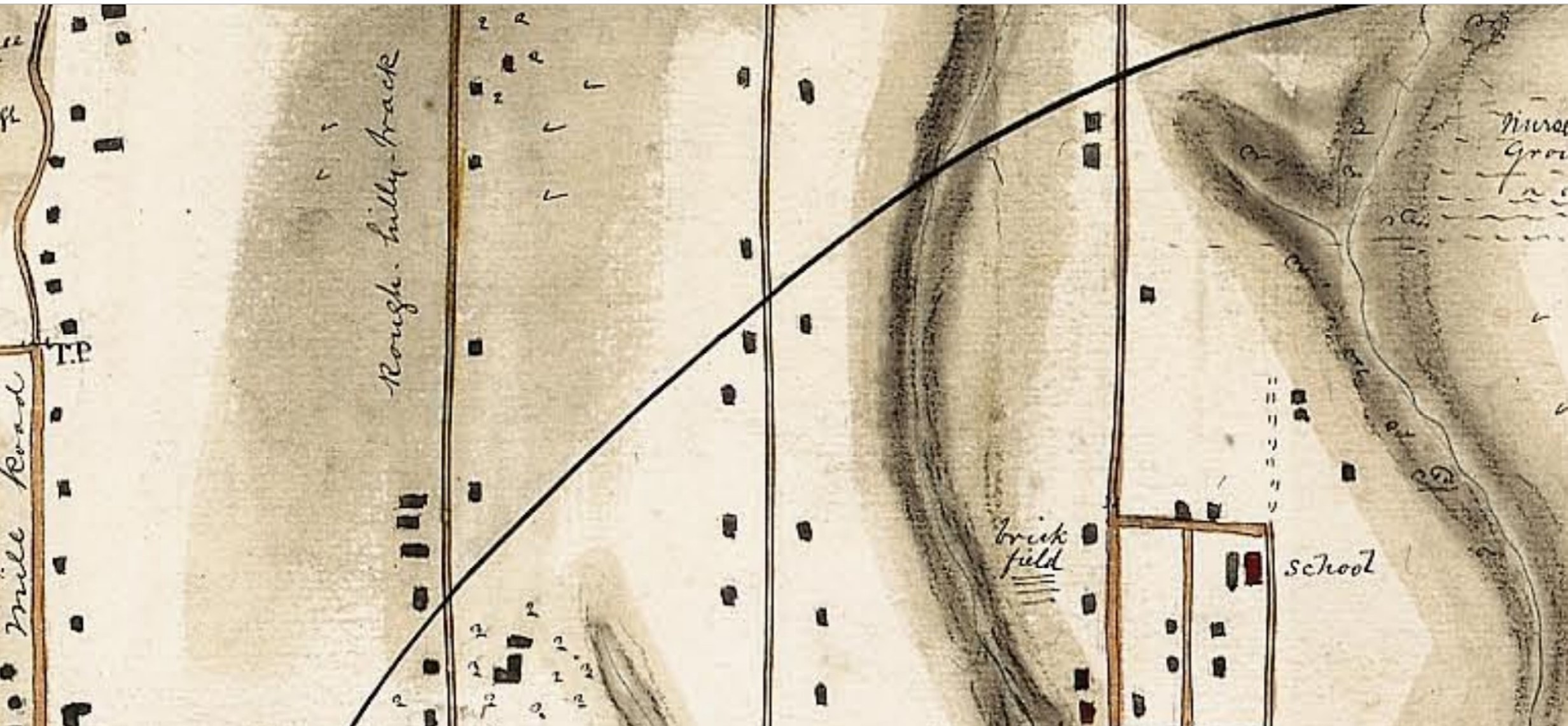
This map was prepared by British army officers in order to secure Toronto in case the Fenians attacked the city. The curved line across the map is what is now the GO Train line (CNR) but was then the Grand Trunk Railway line, the first rail connection between Montreal and Toronto.

The note “brickfield” is just west of what is now Jones Avenue. Gerrard Street doesn’t exist yet but a faint line of dashes just below “Nursery Grounds” on the right of the map marks where the street will be in the future. The school marked on the map is the Leslie Street school still on that location today. The north-south street west of Jones is Pape Avenue and to the west of that is Logan Avenue. Mill Road is now Broadview Avenue. It was originally an indigenous trail.

The creek immediately to the east of Riverdale College (forked creek on the map) was Hastings Creek flowing through the Nathaniel Hastings farm. The other creek on the map was Leslie Creek and it began in springs just south of Danforth Avenue. Both creeks entered Ashbridge’s Bay where the Loblaws parking lot is at Eastern Avenue and Leslie Street.

Rembler Paul (1832-1916) was George Leslie’s brother-in-law, married to Elizabeth Davis (1831-1914). Rembler Paul was an English veterinarian, horse dealer and real estate agent. Gerrard Street East was originally called “Rembler’s Way” or “Rambler’s Way” after Rembler Paul. 

Slide 5b
Elizabeth Davis

George Leslie’s first wife, Caroline Davis (1820-1852), and her sister were the daughters of one of Toronto’s first police officers. (Both loved animals and are buried in a tomb on a mountain top in British Columbia along with the family cat.) 


for more about Rembler Paul and Elizabeth Davis:

http://www.kelownadailycourier.ca/life/article_f00e57a2-24cf-11e4-bc09-001a4bcf6878.html


Slide 5a
Rembler Paul

Leslieville showing Gerrard Street East (Late Ramblers Rd.) at top of map. Detail from Goads Atlas 1890 Plate 47

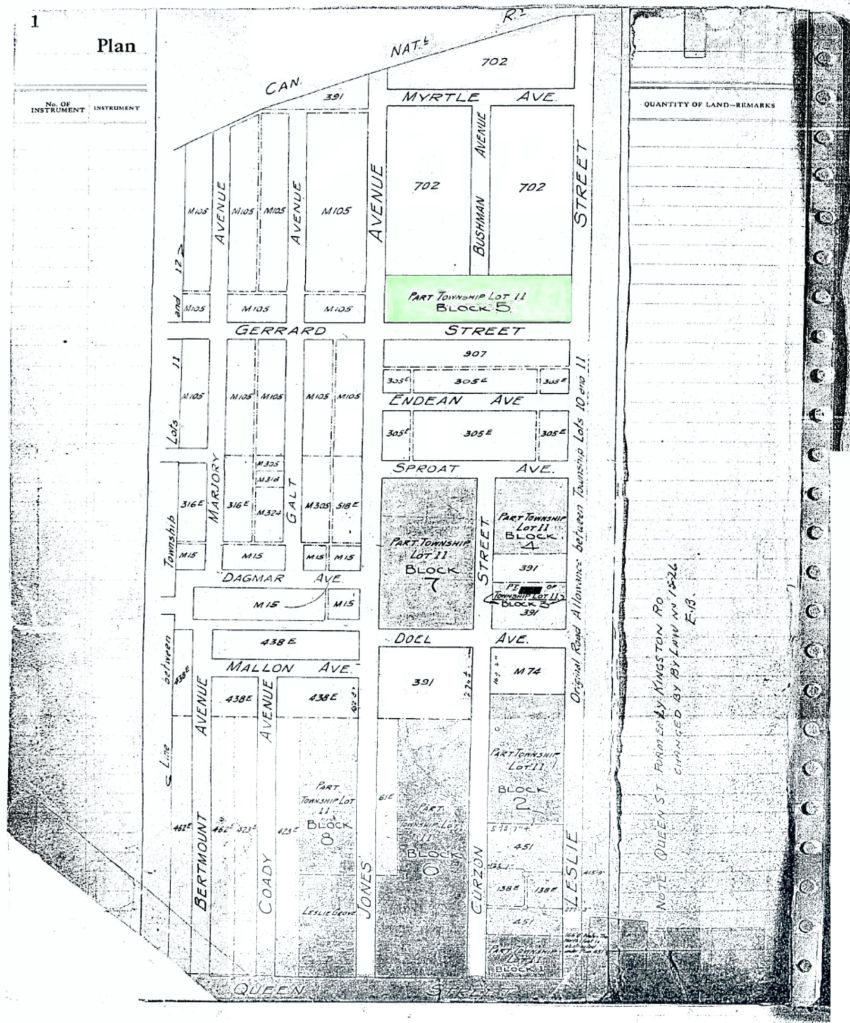
Property owners from the first settlers to the Toronto Board of Education.

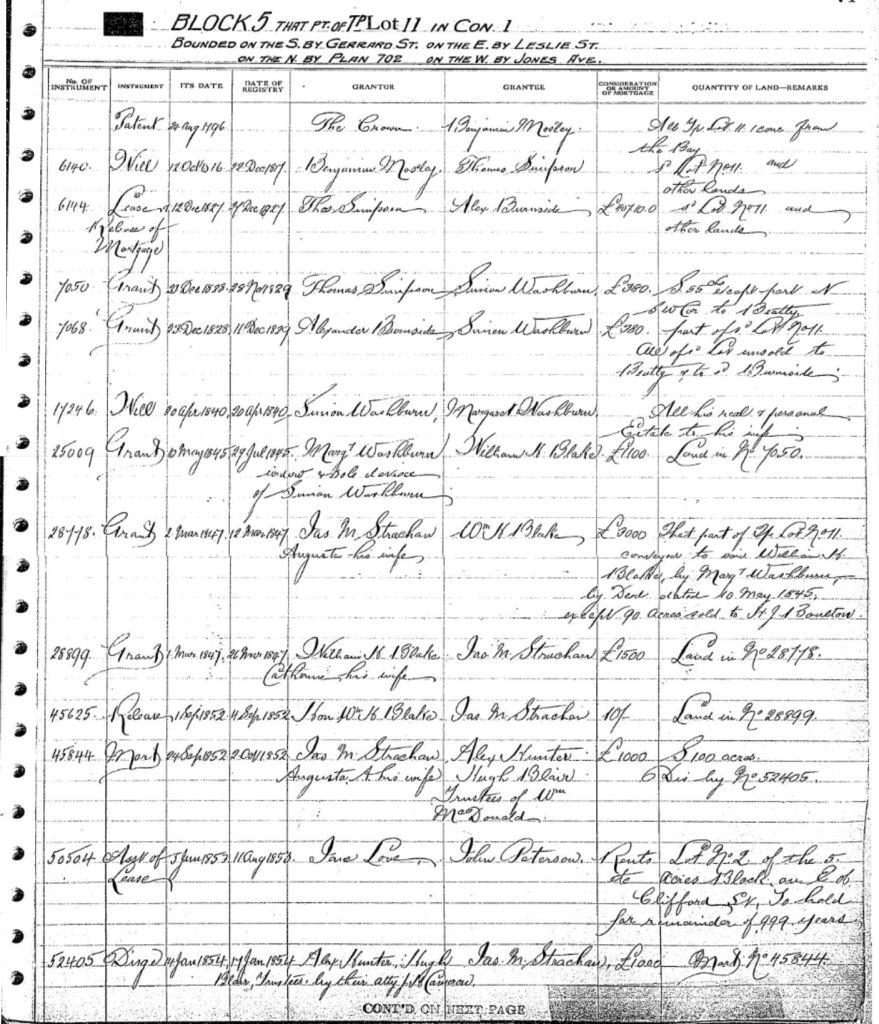
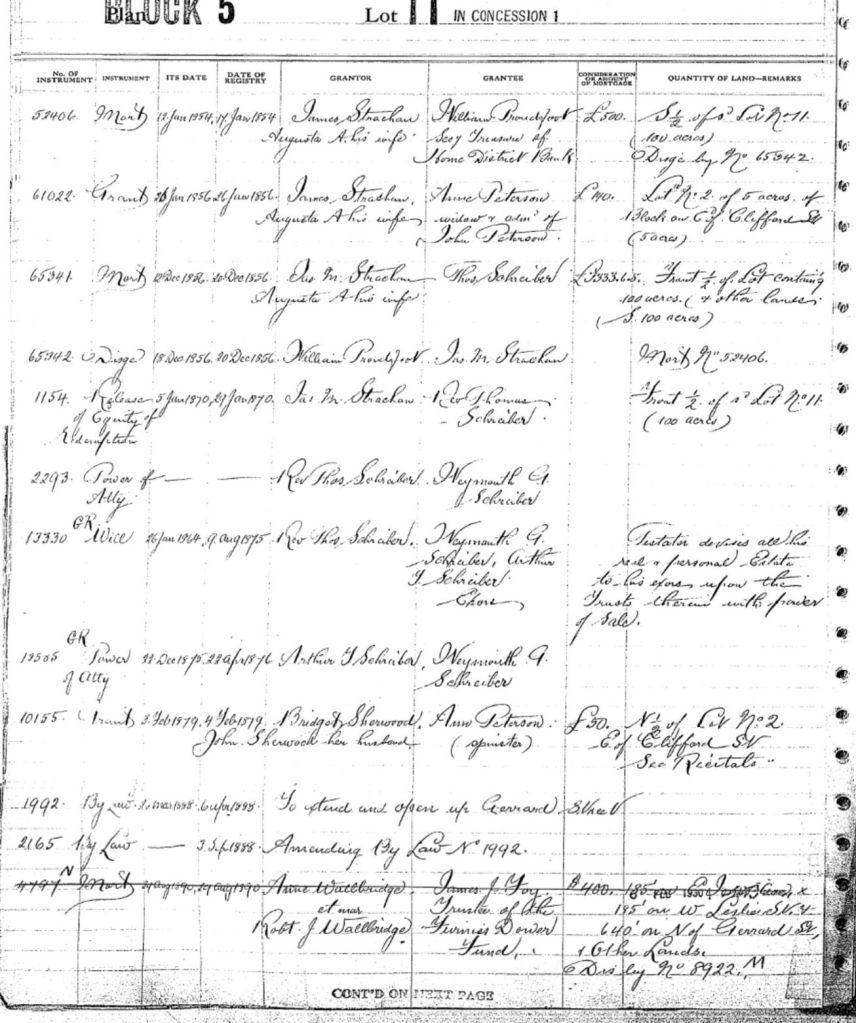
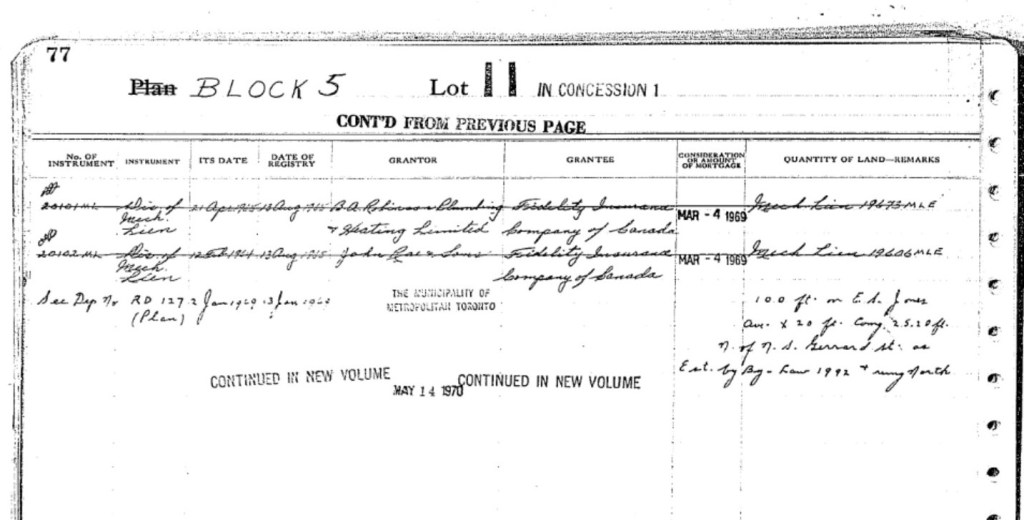
Source: Book 489 Block 5 Lot 11 Concession 1


The first settlers on the site of Riverdale Collegiate — from Benjamin Mosely to James M Strachan (real estate agent)

From 1854 to 1890

1898 to the Board of Education, purchased for Riverdale High School

40 of Book 489 Block 5 Lot 11 Concession 1
Samuel Gerrard (1767-1857) was a fur trader, business man, financier and the second president of the Bank of Montreal. Gerrard Street was named for him.


For more about Samuel Gerrard go to: http://www.biographi.ca/en/bio/gerrard_samuel_8E.html

Jones Avenue was first called Clifford Street after a well-known local family. It was renamed after John Jones (1843-1918) who was born in Glamorganshire, Wales, and became a sailor, coming to Canada in 1850. While he eventually became a city alderman, and Works Commissioner, he was a jack-of-all-trades: market gardener, brickmaker, real estate developer, community activist and He was lodge master of Leslieville’s L.O.L. No. 215 for seven years. L.O.L. means “Loyal Orange Lodge”.


For more about John Jones see
https://books.google.ca/books?id=0QgxUAAx8kQC&pg=PA322&lpg=PA322&dq=%22John+Jones%22+Toronto+alderman&source=bl&ots=CEjGavmWK7&sig=ACfU3U13M4j-3f1xJtgL52b2IRpgBL05Bg&hl=en&sa=X&ved=2ahUKEwjjkJjutYDiAhVLR60KHdBWAcQQ6AEwA3oECAYQAQ#v=onepage&q=%22John%20Jones%22%20Toronto%20alderman&f=false

Four of these photographs are from the Globe, September 18, 1909  and show the area as it developed in the latter half of the 19th century. The three main industries were market gardening and small farms (hay stacks upper left), livestock (man driving cow lower left), and brick making, as well as sand and gravel extraction lower right). That is why I named my history of the area: Leslieville: Pigs, Flowers and Bricks. Sheep are grazing at the northeast corner of Greenwood and Gerrard in the photo top right!


To read or download free of charge my book, Leslieville: Pigs, Flowers and Bricks go to:
https://archive.org/details/PigsFlowersAndBricksFeb32017/page/n1


However, the gentleman with the beard in the lower middle photo was an unusual and intriguing member of Leslieville’s rural industrial economy.

Joseph Simpson (c. 1825-1898), a Jewish American immigrant, began a successful woolen mill in Leslieville, buying up large expanses of land to graze sheep. He was originally from South Carolina and had joined the 1849 gold rush to California where he made his fortune not digging gold, but selling underwear to the miners. 

Unwilling to fight in the Civil War, he came north to Leslieville and began a knitting mill at Coxwell and Queen. In 1872 he moved downtown and built a new knitting mill, now Berkeley Castle, at Berkeley and Front Streets, to produce high quality woolen underwear.

He grazed his sheep under the trees in Leslieville’s orchards including those where Riverdale Collegiate is today. Sheep acted as effective lawn mowers, cutting the grass short, fertilizing the soil, and removing the undergrowth that housed and sheltered the pests that attack apples. His fine merino sheep grew fat and happy while the apples grew large and shiny and orchard owners and wool merchant made money.

Joseph Simpson was one of the founders of the Canadian Manufacturers’ Association.

Mr. Joseph Simpson was always an active member of the Jewish community, especially in its younger days, and throughout his life subscribed liberally to all Jewish charities. He also took a keen interest in civic and municipal affairs & never hesitated to combat any measures which he believed not thoroughly intended for the welfare and prosperity of the city of his adoption. He was often pressed by his numerous friends to enter public life, but he never consented. He was a very prominent and active member of the National Club, R.C.Y.C. shareholder, and member of the Athletic Club, and at the time of his death was one of the oldest members of the Board of Trade.”

“The Outstanding Personalities of Toronto Jewry During the 19th Century” From The Jewish Times, 1912 (as reprinted in The Jewish Standard, 1934) by S. J. Birnbaum

Sheep, small flock on hillside, November 8, 1926.

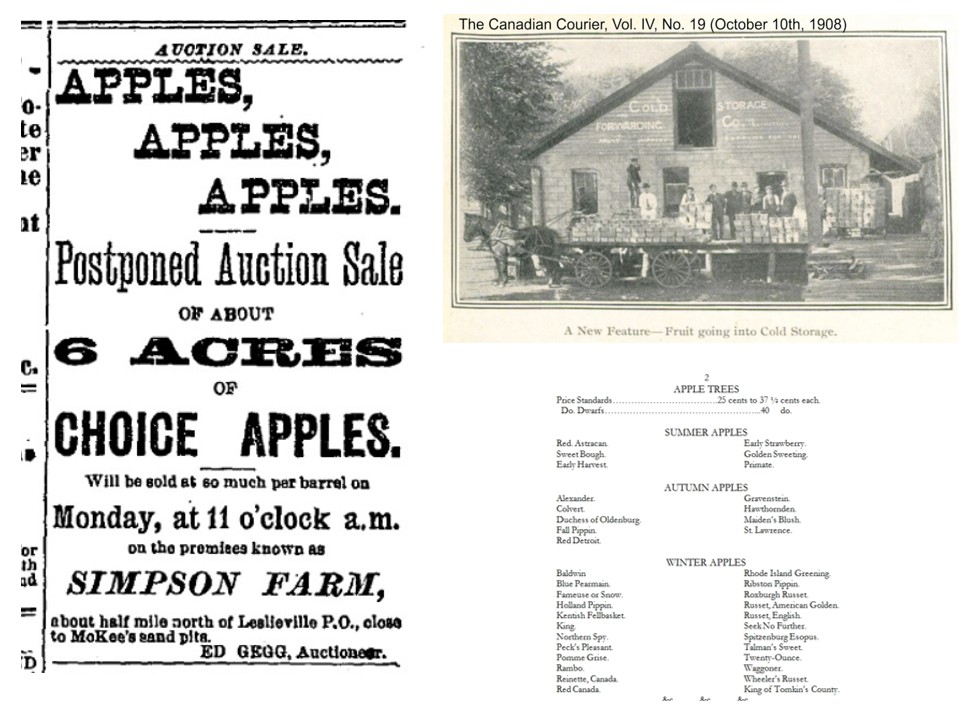
Ad, Apples, Apples, Apples from the Toronto World, October 12, 1885. An apple storage shed, 1908. A listing of some of the many varieties of apples available in the 19th century (from Toronto Nurseries catalogue)

A nineteenth century illustration of a now rare variety of apple, “Seek No Further”. US Dept of Agriculture Pomological Watercolor Collection Rare and Special Collections, National Agricultural Library A man picking apples, Ontario.

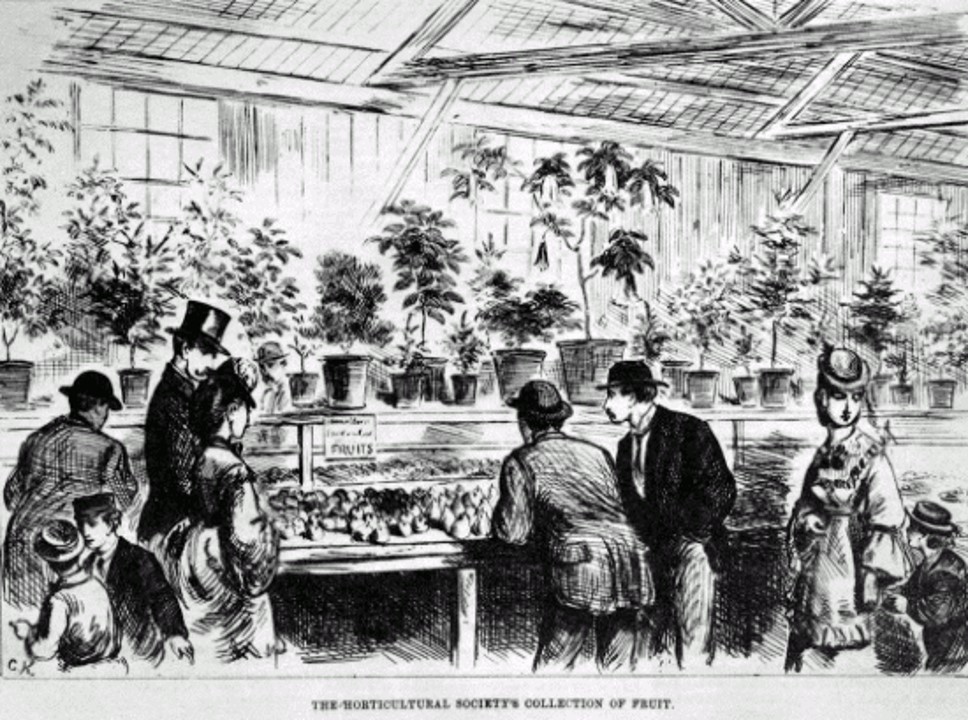
The 1840’s were a golden age of greenhouses. For the first time, technology was available to make large sheets of plate glass and iron frames. Steam engines heated these “crystal palace”. The greenhouses and their crops amazed people. For the first time, fruits and vegetables became available and affordable for the middle classes year round.

In 1851 the great glass structure, the Crystal Palace, designed by Joseph Paxton as the centerpiece of the first Great Exhibition, was opened. Paxton was knighted for his efforts. This is Toronto’s very own Crystal Palace (Crystal Palace, 1871. Exhibition Place & CNE Archives).

Market gardeners near to Jones and Gerrard, 1890 City of Toronto Directory. For more about Timothy Lynch (highlighted in orange) read on!


To be continued…