
MUD ROADS AND PLANK SIDEWALKS: LESLIEVILLE 1880 By Sam Herbert I would be useless to search for Leslieville on any map of to-day. It simply is not there. A Directory for the year 1871 gives it the following description: Leslieville, a thriving village on the Kingston Road, Township and County of York, named after GeorgeContinue reading “MUD ROADS AND PLANK SIDEWALKS: LESLIEVILLE 1880 Part 1”
Author Archives: Leslieville Historical Society
East End Sports Timeline

1848 The first regatta took place on Toronto bay in 1848.[1] 1880 It has been arranged that H.D. Wise, of Leslieville, will contest with Charles Annis, on Orillia Bay, a three mile race with a turn…for $100; the race to come off on August 25th. [2]1880 It has been arranged that H.D. Wise, of Leslieville,Continue reading “East End Sports Timeline”
Decoding City Directories to find out more about your home, your street, your city

Ever wondered who lived where your home is long, long ago? Well, I can give you some idea because I have directories from the early twentieth century and the nineteenth century. But there are no street addresses in the earlier directories. Look at this example from 1866 for Leslieville. I think you’d agree that thereContinue reading “Decoding City Directories to find out more about your home, your street, your city”
Riverdale Gardens & the Edwardian Dream Home

We think of the Edwardian period as the time when King Edward VII, Victoria’s son reigned. That is the period from 1901 to 1910. For Riverdale Gardens, this is the period when Albert Wagstaff and others opened brick yards along Greenwood near the railway tracks. William Prust, Riverdale Garden’s founder, retired from his positions inContinue reading “Riverdale Gardens & the Edwardian Dream Home”
PART II: Ivy Avenue between a Devil and an Angel

If there is an angel or a saint in the story of Riverdale Gardens it is William Prust, the creator of that quiet enclave dissected by Sandford and Bloomfield, and bounded by Gerrard on the south, Ivy on the north, Prust on the west and Greenwood on the east. William Prust was born on OctoberContinue reading “PART II: Ivy Avenue between a Devil and an Angel”
A New History of Leslieville
Source: A New History of Leslieville
Ivy Avenue: before it was the boundary between Heaven and Hell

How did Ivy Avenue come to be the boundary between a kind of local heaven and a very local hell? Well, it’s a long story, but I always like starting about 12,000 years ago — perhaps the local historian’s equivalent of “once upon a time”. In that long ago time, the ice from the lastContinue reading “Ivy Avenue: before it was the boundary between Heaven and Hell”
Ulster Stadium: Home of the Red Handers

Behind the decaying Ulster Arms between Greenwood and Coxwell Avenues, lies a neat few streets. Blocky houses, called “four squares” and post-War bungalows line Hertle and Highfield, making this enclave unique. Most of the houses in the surrounding neighbourhood are 25 to 30 years older, having been built between 1912 and 1930. But that isContinue reading “Ulster Stadium: Home of the Red Handers”
A Lost Street: Applegrove Avenune
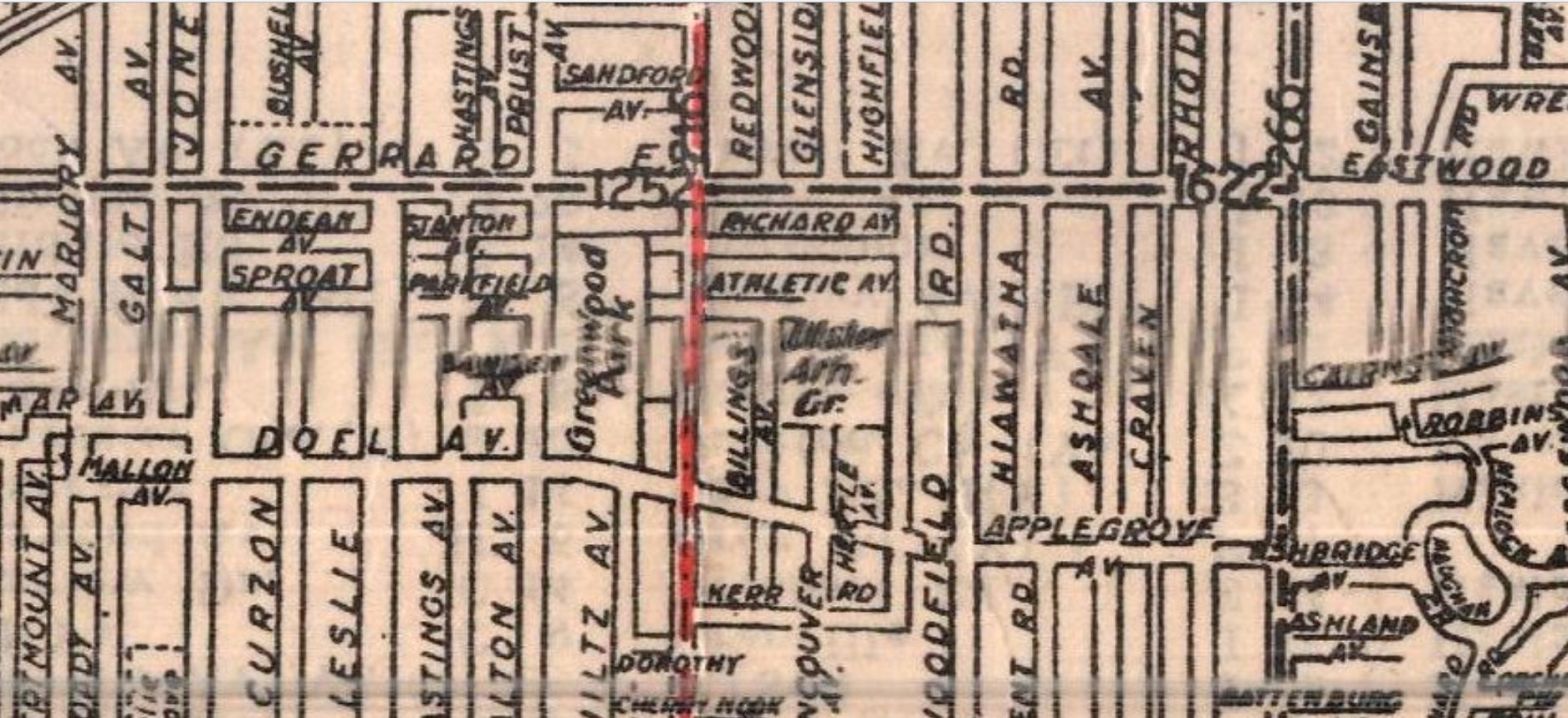
What happened? How can a street be lost? Let’s go back to the beginning, around 1909 when Applegrove Avenue was a short street running from Morley Avenue, now Woodfield Road, to Ashdale Avenue — a mere two blocks. It ran through the Ashbridge’s large apple orchard, giving an obvious reason for the street name. ApplegroveContinue reading “A Lost Street: Applegrove Avenune”
Some Leslieville Street Names
It is sometimes difficult to trace the origins of street names. Clearly most Leslieville streets were named after families who lived here or after the builders who put up the houses on the street. Only a few, such as Eastern Avenue, are more or less self-explanatory. Moreover, street names changed over time. Doel became Dundas; KingstonContinue reading “Some Leslieville Street Names”
 Leslieville Historical Society