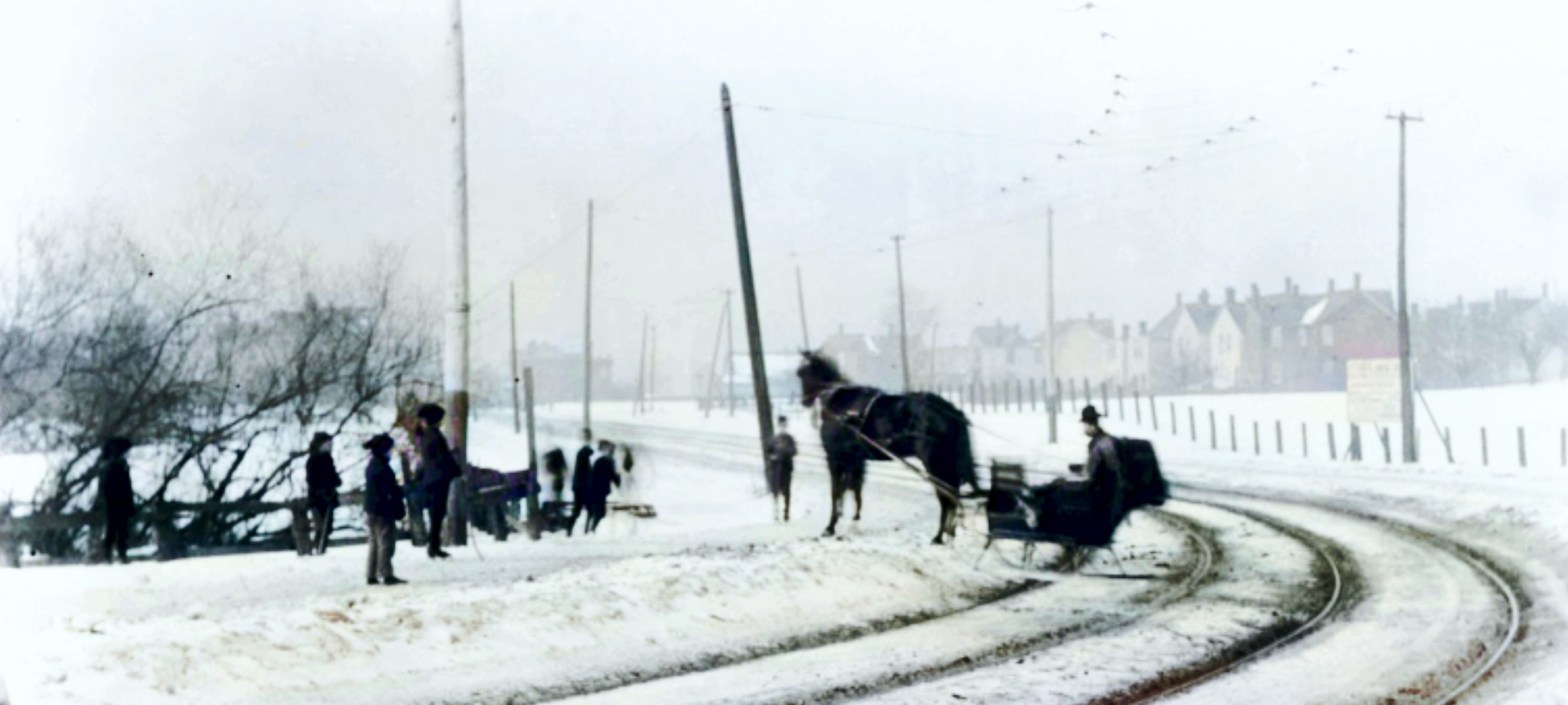
By Joanne Doucette

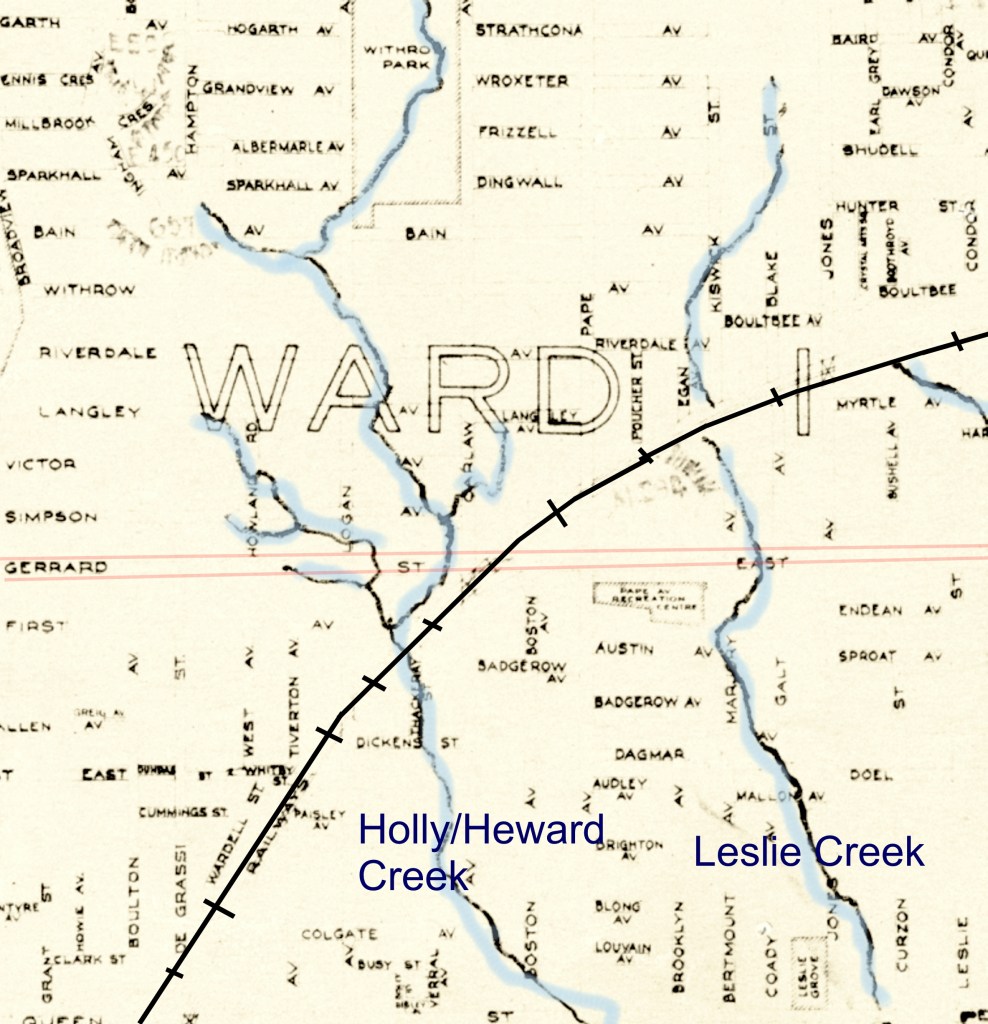
I hope you enjoy this short photo essay. For scholars, students and the curious, a detailed time line of Heward/Holly Creek showing the development of Carlaw Avenue follows. It is from original sources which are credited.





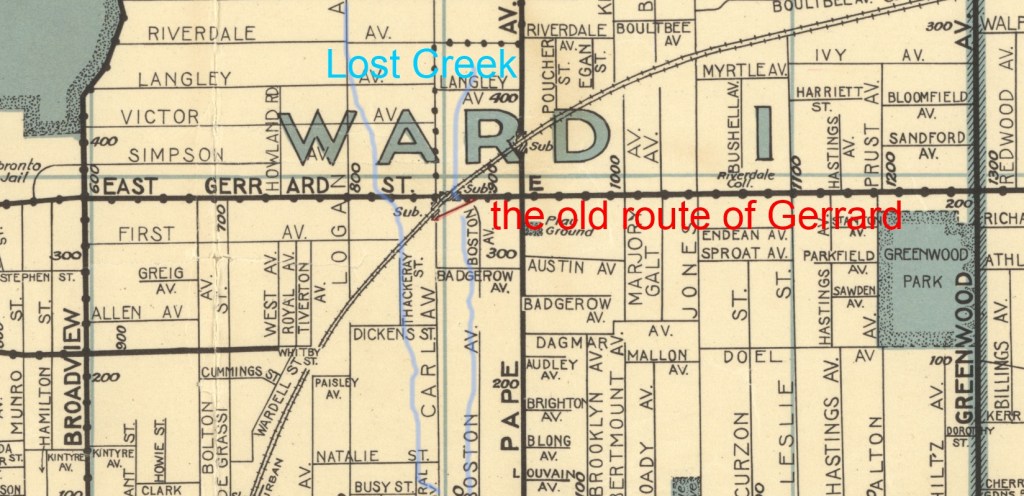


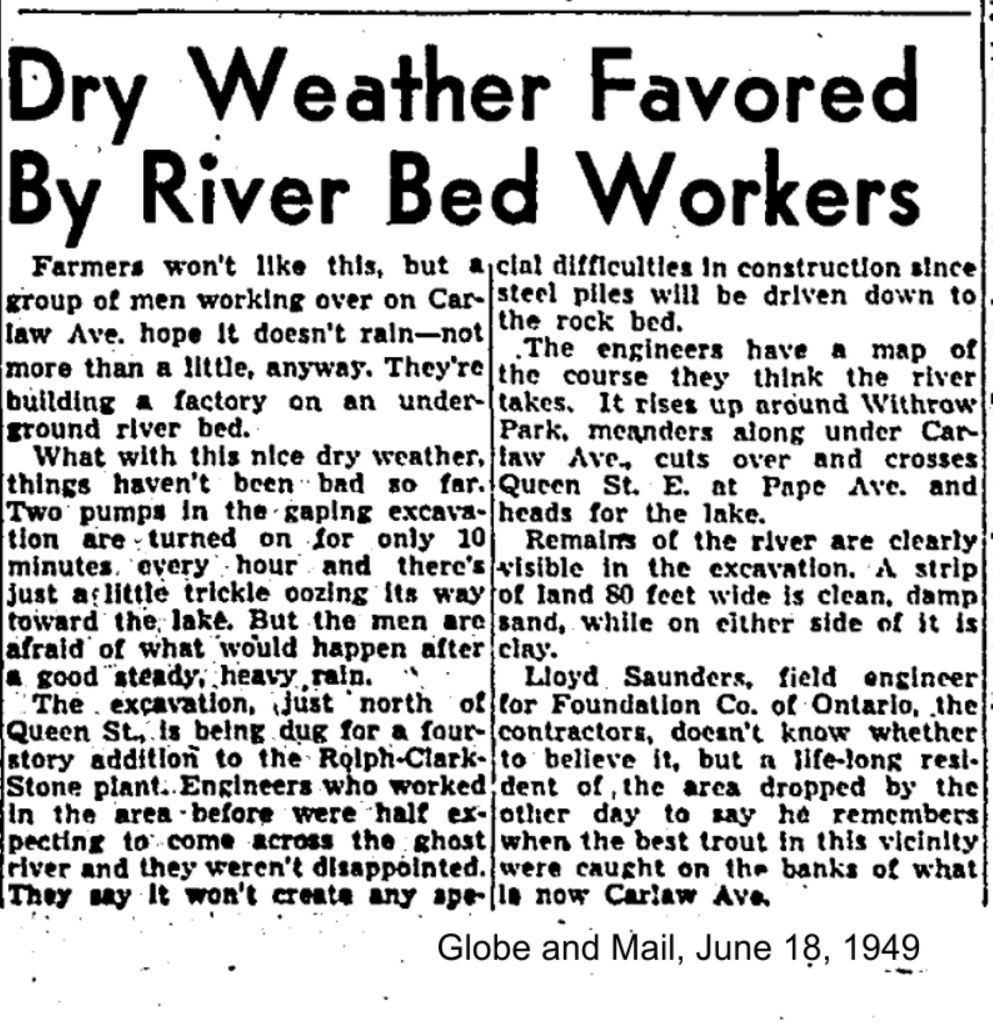

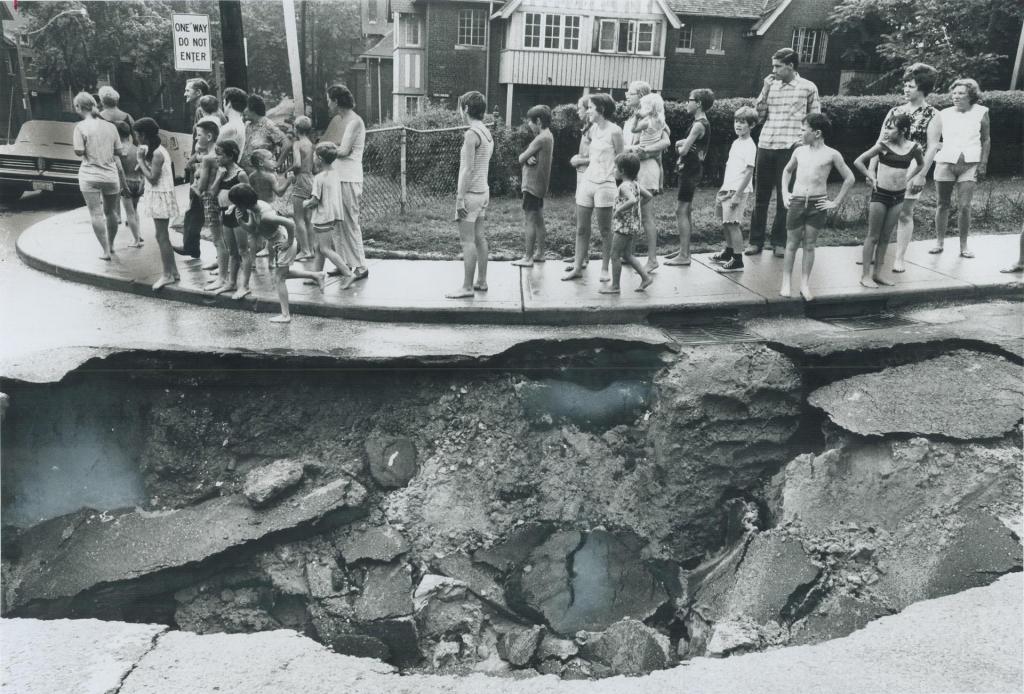
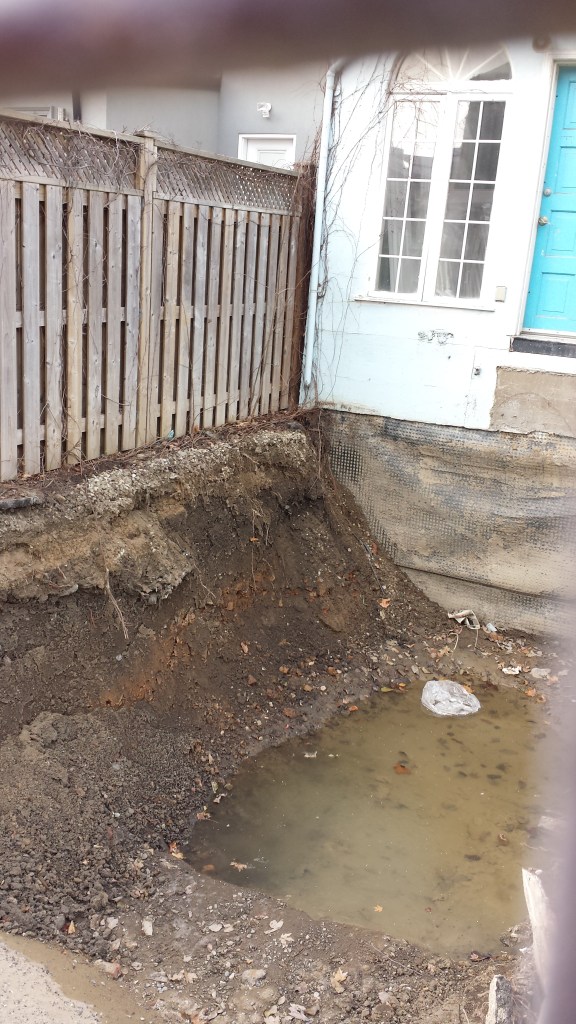


Time Line
1874
Motion that “the new street running from King-street southward to the lake, west of Robinson-street, and being between the properties formerly known as the “Heward and Gorrie” property, below the Don Bridge, in St. Lawrence Ward, be named “Carlaw avenue:’ and that the City Engineer be directed to put up proper signboards with the name of the said streets thereon. Carried. Globe Oct 6 1874
1876
Ald. Withrow introduced a bill to change some street names. “…the changes made had been necessitated, either to avoid confusion or to oblige the people. Gorrie-street was changed to Carlaw-street.” Globe Dec 12 1876
1881
“A NEW SUBURB Everything now seems in ship-shape on Carlaw-avenue for the mammoth sale of lots on the Queen’s birthday. The opening of the avenue through to the bay, full width, and the recent tree-planting, gives a handsome effect to the property, and the enterprise of the proprietors will no doubt be rewarded.” Globe May 20 1881
HOMES FOR EVERYBODY at the GREAT AUCTION SALE OF CITY LOTS CARLAW-AVENUE. ON MAY 24. CHOICE AND CHEAP, HANDY AND HEALTHY. FREE LUNCH ON THE GROUNDS. SALE AT ELEVEN. Take the King Street cars to the Don Bridge. Geo. D. Morse & Co. James Banks. Auctioneer. Globe May 23 1881
In order that the locality may look its best on the 24th both men and horses are being employed in the work of grading Carlaw-avenue. Globe May 23 1881
1882
Ald. Davies said he had been waited upon by some of his constituents asking him to use his influence to have water put on Carlaw-avenue, and he would move that a main be put on Carlaw-avenue and a hydrant put in at the corner of that avenue, opposite the Presbyterian Church. Globe June 20 1882
LESLIEVILLE NOT SATISFIED The inhabitants from the Don Bridge to Duggan’s corner complain that, although they contribute $15,000 to the city treasury annually, all they get in the shape of benefit is thirty lamps, a few hundred yards of sidewalks, and city water as far as the Crossing. There is no drainage whatever. Globe March 23 1882
1883
The work of laying the six-inch water main on the Kingston-road, between the railway crossing and Willow-street, has been completed. Globe April 18 1883
1884
Ald. DEFOE introduced a bill to provide for the extension of Gerrard street in St. Matthew’s ward. It passed to a second reading. Toronto Daily Mail Oct 21 1884
GERRARD STREET EXTENSION AND IMPROVEMENTS. – In May last the city Engineer recommended the extension of Gerrard street from its present eastern terminus at Logan’s line to the present eastern terminus of the city at Greenwood’s line. He recommended that the property along the line of the proposed extension should be assessed for the cost, except the cost of the subway to be constructed under the railway tracks. He suggested that the committee should decide whether the cost should be contributed by the city generally or be assessed on the property to be benefitted by the construction of the work. Since that time some misapprehension seems to have existed with regard to the matter. Some of the people seem to be under the impression that the section of the street west of the present eastern terminus as far as Mill road will be assessed for the cost of the whole extension. This is not the intention. The intention is to assess property to be benefited along the line of the extension. It was also feared by many that the cost of the work of raising the Gerrard street bridge and roadway as far as the gaol would be included in the cost of the other work, but this is not the case, as they are separate undertakings. The Engineer will report more fully on the matter at the next meeting of the Board of Works in order that a decision may be come to as to the levying of the cost of the projected subway under the railway tracks east of Logan’s line. The cost of the subway will be about $8,000 or $10,000. The people of that section contend that, as the people generally will use the subway in order to avoid the railway crossing on the Kingston road, it is only fair the city should pay for it in addition to the cost of the Gerrard street bridge, on the same principle on which the city raised Yonge street at the Tannery hollow, in St. Paul’s ward, and raised the gully on Bloor street west. Toronto Daily Mail, Nov. 22, 1884
Messrs. Leslie & Son have taken down the old wooden fence in front of their lawn and home garden, and replaced it by a wire fastened to light posts. This improvement will be very much appreciated by pedestrians and others travelling Queen-street East during the summer months. Other changes have also been made in this locality. The two great trees which have stood sentry, grim as Gog and Magog, for so many years past at the top of Willow-street, have been laid low by the woodman’s axe. The one that obstructed the sidewalk on Queen-street was of gigantic size, and in its removal another old landmark has gone. Globe Nov 13 1885
NOTICE Construction of Permanent Roadways Notice is hereby given that the Council of the Corporation of the city of Toronto will in pursuance of the provisions of the Consolidated Municipal Act pass by-laws for the construction of permanent roadways on the following named streets, and for assessing and levying the cost thereof on the real property benefitted thereby, unless the majority of the owners of such real property representing at least one-half in value thereof, petition the said Council of the Corporation of the city of Toronto against such assessment, within one month after the last publication of this notice, which will be on the 24th of May, 1884: — A cedar and gravel roadway on Carlaw avenue, from Eastern avenue to the bay. A cedar block roadway on Huron street, from St. Patrick street to College street. A stone block roadway on Front street, from Church to Yonge street. ROBT. RODDY, City Clerk. Toronto, May 16, 1884. Toronto Daily Mail, May 17, 1884
1885
PROPOSED SMALL POX HOSPITAL. The sub-Committee of the Markets and Health Committee, appointed to visit the two pieces of land spoken of as a suitable site for a smallpox hospital, met at the City Hall Saturday afternoon. There were present, Ald. Allen (Chairman), Carlisle, and Jones, as well as the City Solicitor, City Commissioner, and Ald. Smith. They proceeded to inspect the property owned by the city on the banks of the Don, just beyond Taylor’s bridge. This property, which is now leased to the Walton estate as a brickyard, would make a very suitable site, situated as it on a hill. However, it is looked upon as a piece of the Eastern Park (on the gaol farm), and the sub-Committee thought it was a question whether the site should be used for the purpose of erecting a smallpox hospital thereon. The sub-Committee then visited the site formerly before the local Board of health as a suitable place. This is a piece of land near the foot of Willow-street, on the opposite side of Ashbridge’s bay. It is proposed to dredge a cut across this next of land, as to allow a wash and change of water in Ashbridge’s bay. If this was done a bridge would have to be constructed across the bay at Willow-street. Mr. Coatsworth was instructed to prepare a statement showing the estimated cost of the bridge as well as a roadway required to be constructed, together with the conditions upon which the city could get possession of the property on the Don from the Walton estate. The local board of Health will, in all probability, report to the Council at its next meeting. Globe Nov 9 1885
QUEEN-STREET EAST. Within the recollection of the oldest resident the streets of this locality were not known to be in such a disgraceful condition as they are at the present time. The Kingston-road, or Queen-street east, is literally a river of mud. Since annexation to the city nothing has been done to put or keep the road in repair. It was torn up last winter for the construction of the sewer, and it has remained just as the contractors left it until the recent rains, which have broken it all up. The road is full of holes, which cannot be seen in consequence of their being filled with mud. The tramway is, if possible, in a worse condition than the rest of the road. While it keeps the water from running off on the south side, in consequence of the height of the rails above the level of the road, the space between the rails is over ankle deep, with water thickened with clay, and the car horses splash this mixture on the fronts of the stores at the roadside, and any goods that many be exposed for sale. When this was a country road the mud was scraped off after seasons of rain, and patched with broken stone at least twice a year, but since it has been controlled by the city not an ounce of mud has been removed nor a toise of stone placed on its whole length. The other streets leading north and south, except McGee-street, which has recently been block-paved, show similar signs of neglect, so that the whole neighbourhood is in a pretty pickle. Even on McGee-street the sidewalk has not been replaced. On Carlaw-avenue South heaps of sand have been dumped in all manner of positions on the roadway, so that it is almost impossible to traverse it without coming to grief, and there are no lamps to lighten the darkness of this thoroughfare. It is not safe to life and limb to travel these roads. Globe Nov 10 1885
1886
“Carlaw-avenue property owners are agitating for the immediate extension of that street to the bay.” Globe June 1 1886
1887
Board of Works New Works to be Carried Out – Scarcity of Lumber for Sidewalks The Board of Works held its regular meeting yesterday, those present being Ald. Carlyle (chairman), Jones, Shaw, Woods, Fleming, Carlyle, Morrison and Barton. Several residents on Carlaw avenue complained that the sewer on that thoroughfare is a mere surface drain. The chairman suggested that it was six feet deep, but suggested that the matter be referred to the engineer. Mr. Blong stated that a street east of the Don was known in different sections as Blong street, Logan avenue and Sparkhall’s lane. He asked that the street be called Blong all through, but was informed that such a change could only be made by the count Judge. Mr. Leslie was granted permission to dedicate to the city a sixty-foot street in St. Matthew’s Ward. Logan Avenue Globe Nov 2 1887
1888
Carlaw Avenue cut through to Danforth 1888 as reported in the Globe Globe Sept 12 1899
Carlaw Avenue was planned to cut through from Queen Street to Danforth Avenue. With the construction water mains and sewers laid. Later the land along Carlaw was divided into building lots. Globe Sept 12 1899, Globe Oct 9 1899
Contracts were awarded for 18 inch tile sewers on Ashbridge’s Bay including Booth Ave and Carlaw Ave Globe June 27 1888
NOTICE TO CONTRACTORS Tenders will be received by registered post, addressed to the Chairman of the Committee on Works up to 2 o’clock p.m. of the 10TH DAY OF JULY, 1888, for the construction of the following works, viz: Carlaw avenue and Gerrard street subway…. Cedar block pavements… Logan avenue, Queen street to Gerrard street: in re Carlaw avenue and Gerrard street subway. The contract will be let in two lump sums. One for masonry and excavation , and one for the steel superstructure…Wm. Carlyle, Chairman Committee on Works, Committee Room, Toronto, June 16, 1888. Globe June 27 1888
NOTICE TO CONTRACTORS. The plans and specifications for the Gerrard street and Carlaw avenue subways are now ready and can be obtained at the City Engineer’s Office, the tenders for which will come in July 10th. C Sproatt, City Engineer. Globe July 7 1888
On recommendation of the city engineer it was decided that the following sewers should be constructed: — On Heward street, from Queen to Eastern avenue; on Eastern avenue, from a connection with the above sewer to a connection with the Morse street sewer; on Carlaw avenue, from Queen street to Eastern avenue…Globe March 21 1888
Other by-laws adopted were as follows: — …To extend and establish and open up Carlaw avenue from its present northern terminus at Queen street northerly to Danforth avenue, in the Ward of St. Matthew. In reference to this latter by-law, Mayor Clarke spoke against the custom of accepting new streets unless the land was dedicated to the city. He contended that those whose property was benefited should be prepared to offer the land. Globe Nov 6 1888
The contract for Carlaw avenue bridge was awarded as follows: — Excavation, Harrison & Duncan at $3,499; masonry, to same arm at $13,196.70; steel superstructure, Dominion Bridge Company, at $5,920; lumber decking, Dominion Bridge Company, $279.18, making the total cost of construction $21,894 [unclear]. Globe July 11 1888
1889
“Mr Phillips, of Pape avenue, drew the attention of the Association to the fact that the residents of that thoroughfare south of Queen Street were anxious that the small creek running through their property and emptying into the marsh should be drained into a sewer, commencing at Queen street, which will improve the health of the locality. This will be brought before the proper authorities.” Globe Aug 8 1889
“The delay in the construction of Gerrard street subway and extension of Carlaw avenue was then discussed, and a Special Committee, composed of Messrs. J.K. Leslie, D. Hunter, N. Mills and G.S. Macdonald, was appointed to wait on the Council regarding this matter.
”Orders have been issued to the contractors to proceed with the Carlaw avenue subway…” Globe, Aug. 16, 1889
Indignant East Enders The falling rain did not cool the indignation of a mass meeting of East Enders held last evening in Poulton’s Hall. The failure of the city authorities to attend to the many grievances of the citizens in this portion of the city was severely commented on, and a resolution was carried expressing disapproval of the action of the Board of Works in not proceeding with the opening up of Carlaw avenue and the construction of the Gerrard street subway, and appelating a deputation to wait upon the Committee of Works and urge upon them the great necessity of proceeding at once with this work. Globe May 31 1889
1890
1890- 1891 JENNINGS, William Tyndale, b. 19 May 1869, Toronto, Ontario; d. 24 October 1906, Lansing, Michigan. … the eastern entrance to Toronto; and the wharves west of Yonge Street. As Toronto city engineer (1891-2) he recognized his department and was responsible for the Sherbourne Street Bridge; Carlaw Avenue, and King Street subways (the latter from Charles Sproatt’s plans), and the Toronto Island Ferry slips. …During his final years, he was consulting engineer to the Electrical Development Company and the Toronto and Niagara Power Company, and in 1906 was preparing a report for the federal government on the Louise Basin at Quebec. A member of the Institution of Civil Engineers of Great Britain and the American Society of Civil Engineers, Jennings was a charter member of the Canadian Society of Civil Engineers (1887), and elected president in 1899. An advocate of scientific engineering education, he also supported the enactment of restrictive engineering licensing laws to raise the status of engineering. The Canadian Engineer reported that Jennings’s remarkable career was practically the “history of Civil Engineering in the Dominion.” Rod Millard, Biographical Dictionary of Canadian Engineers http://history.uwo.ca/cdn eng/jennings.html
Ashbridge’s Bay Reclamation Reports W. T. Jennings, 1890 and E. H. Keating, 1892 accessed 2015 at: openlibrary.org
City Engineer Jennings has made a great improvement in the old state of things, but with all due respect to him it looks as if he will have his hands full in the next decade dealing with the Trunk sewer scheme, the Esplanade problem, and the thorough repairing of the streets of Toronto, not to speak of the innumerable smaller issues which all help to distract the attention of the works department to the detriment of more important matters. The ratepayers of Toronto are to be asked next January to vote on the two questions: “Shall the city improve Ashbridge’s Bay itself? or, Shall the work be given to a syndicate under a similar plan to that proposed by Beavis & Co.?” Yea to the first means, if the past is any criterion by which to judge the future, delay and probably nothing done. Engineer Jennings himself reports that the work of reclamation cannot be done under $4,500,000, and where in the present financial muddle is the city to raise this amount? When it is considered that funds have to be provided for the taking over of the street car system, the extension of the parks system and numerous other almost equally necessary works, the question must naturally arise to the possibility of raising the amount required for Ashbridge’s Bay reclamation. Toronto World, Dec. 17, 1890
Contracts for sewers were awarded as follows: …Carlaw avenue, $29,458, to J. Farley…Globe May 21 1890
The Court of Revision forwarded a minute of the last meeting referring back to the Board of Works the recommendation as to the extension of Carlaw avenue, some of the inhabitants of same having objected to be [sic] assessed for the work. The board referred the matter back again to the Court of Revision, pointing out that it was the duty of that body to remedy the assessment if unequal. Globe Aug 28 1890
The Toronto, Can., Sewerage Scheme. City Engineer Jennings, of Toronto, Can., has submitted a comprehensive report on the Toronto trunk sewer scheme, agreeing, in the main, with that handed in by Messrs. Hering and Gray. The total approximated cost of construction, as determined by Mr. Jennings, will be $1,632,533, exceeding the estimate of Messrs. Hering and Gray by $261,490. Accompanying the report are tables showing the length, dimensions, capacity and cost of the proposed system of sewers, also the maximum population and area which they will serve. There is also a plan giving the course of the sewers recommended. Henry C. Meyer, ed., Engineering and Building Record and the Sanitary Engineer, Volume 22.1890
1891
…to warrant the use of asphalt rather than another set of blocks, and the concrete foundation will then be suitable for the asphalt as for stone or wood. Regarding macadam, the report reads: “it is to be hoped that the great mileage of this class of pavement now existing in the centre of our city, will be rapidly reduced by the immediate introduction of a modern class of roadway.” Nearly 18 miles of brick and pipe sewers were finished in 1890, including several large trunk sewers, which have been in progress for over a year. The construction of a crematory for garbage and night soil is strongly recommended. The report contains the plans of Mr. Jennings for the complete sewerage of the city, which do not differ from those recommended by Messrs. Hering and Gray a few years ago, except as regards the position of the outfall sewer, which is to discharge further from the city. The estimated expense of the system is $1,632,000. Edward J. Mehren, Henry Coddington Meyer, Charles Frederick Vingate, John M. Goodell, editors. The Engineering Record, Building Record and Sanitary Engineer, Vol. 24, 1891, 286.
A sewer was built from Carlaw Avenue to Danforth Avenue. It was of brick. The contractor was J. Farley. Report of the City Engineer 1891
EXTENSION OF SEWERS INTO ASHBRIDGE’S BAY Owing to the low stage of the water in the lake this summer, the sewers emptying into this bay created a nuisance to the residents living in the vicinity. To relieve them it was decided to extend the sewers on Carlaw, Booth, Morse and Logan Avenues. The existing line of tile pipe was extended in a blank box a few inches larger that the pipe, built on piles, and the space filled in with concrete. The cost of the work amounted to $949.00; the cost per yard ranging from $.470 to $5.20. Report of the City of the City Engineer 1891.
TORONTO’S CITY ENGINEER TORONTO, CAN., is fortunate in having for a City Engineer a man not only of great capacity and experience but of sufficient force of character to refuse to serve the city unless he can conduct his office and employ his subordinates without the interference of members of the Common Council. It is also fortunate in having daily papers who sustain such an engineer without opening their columns for every frivolous criticism instigated by disappointed schemers. It appears than when Mr. W.T. Jennings was induced to accept the position of City Engineer, he took it only on condition that he was to have full power to engage, dismiss, and fix the compensation of all officers and members of his department, the Council to make the gross appropriation which he was to apportion, claiming he would not be responsible for results unless this concession was acceded to. On the strength of a promise made by the Mayor and influential men in the Council that a suitable ordinance would be passed conceding these points, Mr. Jennings assumed the duties of City Engineer, and the city has had the benefit of his valuable services in the meantime. The by-law, however, was not passed. The smaller politicians in the Council, and certain interests which considered themselves antagonized by Mr. Jennings’ recommendations in the interests of the city at large, have thus far prevented the adoption of the ordinance. The press of Toronto are condemning the action of these men, testifying to the ability of Mr. Jennings, and urging him to recede from his position, in order that work may not be delayed and laborers thrown out of employment. Whatever force there may be to these appeals, however, now is the time for Mr. Jennings to be firm in the stand he has taken. He is setting a good example to engineers in America, and the fight had better be now, so far as the city of Toronto is concerned, than later. The class of people that are opposing will only be emboldened by any weakening. It reminds us of a very similar experience that the city of Chicago had with the late lamented E.S. Chesbrough, with this difference, however, that when Mr. Chesbrough found that they were trying to force employees on him that he did not need, and would not be responsible for, he resigned, and when the politicians backed down, and begged him to resume his duties, he declined to do, and thereafter would assume only the duties of a consulting engineer. Since Toronto has discovered an engineer to serve it intelligently, and with the firmness to resist the interference of schemers, it will do well to retain him, and concede the point that is important to the success of his administration.
1893
A sewer on Queen Street East, for the carrying off of storm water to relieve this district, has been constructed, and I trust that now this sewer is built, it will do away with the constant flooding of cellars in this section of the City after heavy rain storms….All the sewers emptying into Ashbridge’s Bay have been extended southerly towards the line of the proposed channel. Report of the City Engineer 1893, 13.
1896
Mr. John Taylor got a reduction from $9 to $8 per foot on 549 feet of low land on Morse street, west side, south of Eastern avenue. On Carlaw avenue 450 feet on low lying land was reduced from $7 to $5 per foot, and on Logan avenue 320 feet were reduced from $8 to $4 per foot. Globe June 18 1896
1899
Queen Street Culverts During the year a 4-ft. brick, arch culvert has been built to take the place of three 18-in. pipes across Queen Street, at Pape Avenue, which were found crushed. Report of the City Engineer 1899
1902
In 1902 Alfred R. Clarke moved his tannery from beside the Don River to 633 Eastern Avenue. “A story circulated that, while Clarke was supervising raising the flag (to celebrate the end of construction) from his new building’s roof, all Toronto’s church bells rang and factory whistles shrieked. Though Clarke knew he was a prominent figure in Toronto’s business world, he was, none the less, gratified with the City’s response to his new tannery’s opening. When he got back to his office he found that the celebrations were for the end of the Boer War, not to welcome the new tannery.”[1]
Suing the City. Benson Papperwell and Mrs. Papperwell of the corner of Pape avenue and Radcliffe street have appealed to the courts for an injunction restraining the city from draining sewage on their property. They also claim damages for wrongful entry and the construction of a drain at that point. Globe Oct 11 1902
1903
$25,022.89 was spent by the City of Toronto on the Gerrard St. bridge and subway, re: Carlaw Ave. extension Toronto Star, Nov. 4, 1903
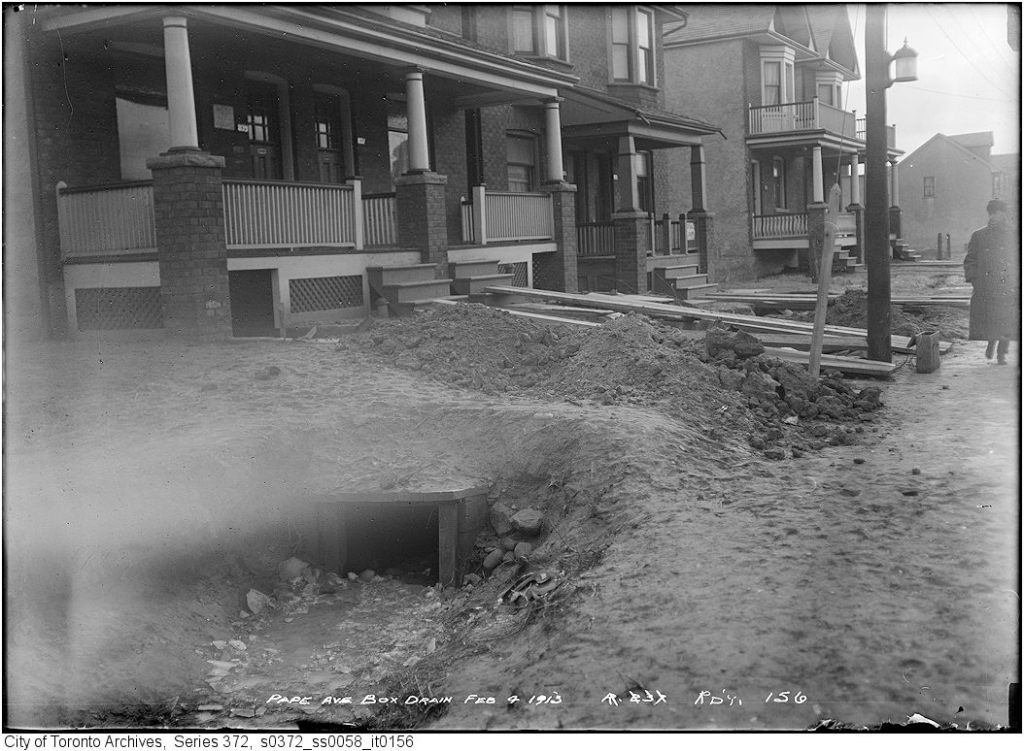
PAPE AVENUE SEWER EXTENSION A box drain 14 inches by 14 inches in size and 1,074 feet in length was built to extend the Pape Avenue sewer from Eastern Avenue to Keating’s Channel, the former outlet in the marsh, a short distance east of Pape Avenue, having caused a great deal of annoyance to residents in the district. Report of the City Engineer 1903, 62, 64.
RADCLIFFE STREET SEWER The tile pipe sewer on Radcliffe Street, between Queen Street and Eastern Avenue, is being raised and connected with the Eastern Avenue sewer at Caroline Avenue. Formerly this sewer emptied into the creek a short distance west of Radcliffe Avenue, and was likely to cause a nuisance as soon as Radcliffe Avenue became built up. The raising of this sewer will be completed early in January 1904. Report of the City Engineer 1903. 64.
1904
Robert Anderson of Toronto sued the City for damages for $1,500 for injuries sustained through the alleged non-repair of Carlaw avenue. Toronto Star June 13, 1904
Site for Varnish Works. The Standard varnish works of New York, London and Chicago, who sometime ago were refused by Council a permit to locate a factory north of the Dundas street bridges, are now asking to be allowed to erect works north of the Grand Trunk tracks between Carlaw and Pape avenues. The Board of Control have recommended that the application be granted, and the matter will be considered by Council today. Globe June 27 1904
The railway subway at Gerrard and Carlaw avenue was flooded in a heavy rain storm. 1.91 inches fell. Toronto Star Sept. 25, 1904
1905
Street names were changed because citizens requested it or because the City wanted to clear up any confusion. The City Street Naming Sub-Committee wanted all new streets running east and west to be called avenues and all north south streets to be called streets. It wanted to do away with place and square. This did not work out. A number of streets in the newly annexed areas had the same names as streets in the City of Toronto.[2] The Board of Works recommended a number of street names be changed, including Garden place changed to Pape place and Russell Place to Bisley Street. Radcliffe avenue was changed to Winnifred avenue.[3]
1906
“No Claim On Land. City Solicitor’s Opinion on Application of Mr. Russell. City Solicitor Chisholm informed the Board of Control to-day that Mr. Russell had no claim against the city for the redemption of the Carlaw avenue property formerly owned by him, and four years ago acquired by the city for arrears of taxes. The statute validating all sales of lands for taxes has since been passed.” Toronto Star Oct. 30, 1906
“John Russell is completing six new houses on Queen street, immediately to the east of Carlaw avenue.” Toronto Star, April 6, 1906
“John Russell Sues John Russell has begun his action at Osgoode Hall to have declared null and void the transfer of lands formerly owned by him, to the city for arrears of taxes. The land comprises about four acres on Carlaw avenue. The deed whereby the city took it over is dated October, 1902.” Toronto Star Dec. 21, 1906
One of the concerns about the Clarke and Clarke tannery was that the sewage system “would not be sufficient to carry off the sewage from the factory and many damage suits would result.” proposed Carlaw Ave Globe, Oct. 9, 1906 C. C. Leathers Inc. is a modern descendant of the A.R. Clarke & Co. Ltd. Tannery. The company’s sales division became Lackawanna Leather in 1984 and changed its name to C. C. Leathers Inc. in 1992. C. C. Leathers Inc. is still a privately-owned Canadian company, with a showroom and warehouse at 388 Carlaw Avenue. The company imports and distributes quality upholstery leathers.[4]
P.J. Brown, M.D., two and one-half-storey brick residence, north-west corner of Queen street and Carlaw Avenue, $9,000. [Building Permit] Globe, Dec. 25, 1906
Riverdale residents objected to the new Clarke and Clarke tannery proposed for Queen and Carlaw. The tannery, on Carlaw, would be next door to Dr. Brown’s new house at Queen and Carlaw. “I have invested $15,000 there, the savings of a lifetime,” he said [Dr. Brown]. “No one can tell me that there will be no odor from hides in pickle.” Toronto Star Sept. 26, 1906
The Board of Control rejected the Clarke and Clarke plan to build a tannery on Carlaw Avenue and then changed their mind to allow it. Toronto Star Oct. 9, 1906
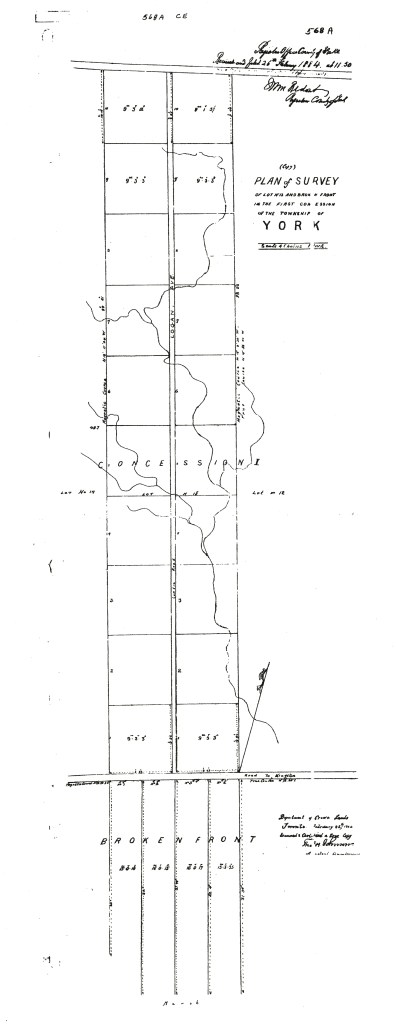
Trustee’s Sale of Valuable Freehold Situate on Logan and Carlaw Avenues, in the City of Toronto. Offers will be received by the undersigned up to the 4th day of June, 1906, for the purchase – in one or several parcels – of that valuable tract of city property lying between Logan and Carlaw avenue, situate a short distance north of Queen street, known as lot No. 2, plan 568A, on the east side of Logan avenue, containing about nine acres. This property has a frontage upon Logan and Carlaw avenue each of about 600 feet. The depth between these streets is about 656 feet. This property, which has been in the possession of the Brooke estate for upwards of 80 years, and is now for the first time offered for sale, affords an exceptional opportunity to builders, manufacturers, and others. Terms – The purchase money to be payable in cash on completion of purchase or at the purchaser’s option 50 per cent thereof may remain outstanding on mortgage on the land with interest at 5 per cent. Cassels, Brock, Kelley and Falconbridge. 19 Wellington St. West Toronto. Dated 18th May, 1906. Toronto Star May 19, 1906
1907
There was a call for tenders to pave Carlaw Avenue from Queen Street to Gerrard Street. Toronto Star June 11, 1907
“Clear the Titles. Toronto’s application to validate the city’s sales of lands seized for taxes was favorably reported on. This clause was inserted in the city’s bill as the result of the litigation in connection with the Russell property, on Carlaw avenue. The clause will affect all sales except such as were in litigation previous to March 22.” Toronto Star March 22, 1907
”Homes For The People” One Hundred and Fifty Houses for Workmen in the Riverdale District. Provided the city does not insist on placing all the district bounded by Danforth, Broadview, Riverdale and Carlaw avenues in the brick limits, 150 workmen’s houses will be built within that area as quickly as it is possible to proceed with the work. Some time ago Mr. Fred H. Ross of Adelaide street east purchased for $40,000 the homestead of the late E.A. Macdonald, and now this property, with some other lots secured since, has been taken over by a syndicate organized by Mr. Ross and Mr. J. J. Walsh, and on these lands the houses will be erected. The Board of Control will be asked to allow houses with brick cased fronts, roughcast extensions and all modern conveniences to be erected on these lands.” Globe, June 5, 1907
“John Russell Gets Assessment Cut Court of Revision Reduces Valuation Placed on Property in Carlaw Avenue. Mr. John Russell, who won his suit against the city regarding tax sale property on Carlaw Ave., appeared before the Court of Revision to-day and obtained a decrease of $100 per acre in an assessment of $800 on his Carlaw Ave. property. The Court also reduced the assessment on the property of James Richardson, in the same neighborhood, from $800 to $700 per acre. Fifteen acres, or 1,500, are represented in those reductions.” Toronto Star June 3, 1907
“The Mills Tax Sale Dr. Goldwin Smith Had Bought Land for Model Cottages. In October, 1902, Dr. Goldwin Smith bought at a tax sale lands on Carlaw and Pape avenues and vicinity, part of the Mills estate, for presentation to a company or association that would erect workingmen’s houses, and today the executors of the Mills estate began action against the city and Dr. Smith to set aside the deed. Dr. Smith bought about forty lots in all, and his object was to help solve the housing problem.” Toronto Star, March 22, 1907
In 1907 the Wrigley Building 245 Carlaw Avenue was built. It was converted into 79 “hard loft” units in 1998.
Phillips Mfg. Co. Ltd. (mouldings) In 1905, Cobban Mfg. became Phillips Manufacturing Co. and in 1907 the firm bought the Carlaw building for $16,733.00. In 1908 Phillips moved to 258 Carlaw Ave. Later the company name was change to Phillips Toronto Limited and produced mainly picture frames.
The Canadian Pacific Railway filed plans at the Registry Office for their projected lines to enter Toronto from the east. A main line would run south of the Woodbine Race Track along the landfill over Ashbridge’s Bay to the Don River. “At a point about 600 ft. west of Leslie avenue a branch turns north and runs north-westerly in a diagonal direction, crossing Eastern avenue just west of Winnifred street, Pape avenue just south of Queen, and Queen just west of Pape avenue, then runs up between Carlaw and Pape avenues crossing the G.T.R. at Gerrard, then northwesterly between Logan and Carlaw avenue, crossing the former at Withrow, then turning almost west, crossing Bain street, Sparkhall avenue, and Broadview just north of the jail.” CPR wants to build rail line Carlaw Ave through Riverdale Toronto Star Jan. 15, 1907
1908
“City Wins The Tax Sale Case Mr. Russell Cannot Redeem the Lands in Carlaw Avenue, Riverdale. Council Welcomes news There are Other Cases pending, and It Means a Great Deal to Toronto. Toronto’s legal agents in London, England, this morning cabled the City Legal Department that the Privy Council had sustained the corporation of Toronto’s appeal in the Russell vs. Toronto case. This decision is an important one from the city’s standpoint, and the Mayor and Controllers, upon hearing of the decision, expressed themselves as delighted with the result of the city’s appeal. Some years ago the city purchased at a tax sale some eleven acres of land on the east side of Carlaw avenue, just north of Queen street, previously owned by ex-Ald. John Russell. In the early part of last year, the city sold to A. R. Clarke and Co., leather goods manufacturers, a portion of the land, but Mr. Russell took action before Mr. Justice McMahon to set aside the sale on the ground of irregularities and improper descriptions. Judge MacMahon [sic] set aside the sale, and decided that Mr. Russell could redeem the property upon the payment of the arrears of taxes. The city appealed to the Court of Appeal, but the judgment was sustained. The next move of the city was to appeal to the Privy Council, and there the city was victorious. The importance of the judgment can be better understood when it is known that about a dozen other actions to prevent the city disposing of land purchased at tax sales are pending, but have not been forced to an issue pending the decision of the Privy Council in the Russell case. Mr. C. P. Shepley, K.C., represented the city before the Privy Council.” Toronto Star July 30, 1908
GTR accident. Shunting locomotive breaks away and plows through the wall of Phillips Mfg Carlaw Ave Toronto Star, Oct. 23, 1908
Permit issued to A. A. Barthelmes to build a 3-storey concrete factory, near Gerrard st., on Carlaw ave., $19,000. Toronto Star, June 26, 1908
1909
Dovercourt Land Building and Savings open subdivision on Boston Avenue. according to an article in the Globe June 20 1914
Summer 1909 Boston Avenue graded from Queen street to appoint 1,381 feet north. Globe July 21 1909
1910
Fall 1910 The City of Toronto decided “to make an extension of Boston avenue, connecting two sections by about 700 feet of road. The cost will be about $22,000, and the city is to pay half.” Globe Oct 15 1910
Kent McClain ad for a foreman. They made showcases. 181 Carlaw Avenue Toronto Star Dec. 12, 1910
1911 – 1912
Construction of sewers along Carlaw Avenue, Gerrard and Boston Avenue. Major interceptor sewer along the line of what is now Dundas Street. Creek diverted into sewer and direction of creek changed to run north into sewer.
1911
STREET IS SEWERED BUT WITHOUT WATER And Has No Fire Protection—Peculiar Situation in Boston Ave. A STREET IN RIVERDALE Boston Ave. bids fair to become famous. It boasts a sewer which is absolutely dry, and a series of dwelling houses which cannot legally be given water services. It has no fire protection. This peculiar state of affairs is an echo of the well-remembered Russell case, in which Toronto, by fighting to the Privy Council, secured possession of certain lands for non-payment of taxes. The parcel which has caused the present trouble is situate on Carlaw Avenue, and extends back to Boston Avenue, which was opened up by a land company. In fact the whole of one side of Boston Avenue is city property, and railway siding is to run down it to serve factories which will locate on the Carlaw frontage, and secrete their water from that street. On the other side of Boston Avenue there are not enough houses, and never will be, to guarantee a ten per cent revenue on the cost of a water main. A civic official, who was sent out to investigate so reported. Cannot Give Guarantee. The regulations require that water mains cannot be laid until there is a guarantee of ten per cent revenue. this the residents obviously cannot furnish, and their only alternative is to get water by paying, besides usual water rates, a sum sufficient to provide interest and sinking fund on the cost of the main, a tax which would be unduly burdensome. When told of this they declared they would appeal to the controllers, and a deputation visited the City Hall this morning. The Engineer is recommending that the City Solicitor endeavor to find a way out of the dilemma. Until some arrangement is made, the houses are without fire protection. In ignorance of the difficulty in securing water, the property owners had a sewer installed. As they cannot use the conveniences in their houses, the sewer is dry. Toronto Star June 2, 1911
1911
The Court of Revision approved the extension of Boston avenue. Globe, Jan 18, 1911
For the congested part of the City, in the vicinity of Queen Street and Carlaw Avenue to the north, a contract for a relief sewer on Carlaw Avenue, from the bay to Gerrard Street, has been awarded to Jennings & Ross, contracting firm, and work will start on this very shortly. City Engineer’s Report 1911, 317
1912
“John Russell, a pioneer in the east end of the city, the oldest brickmaker in Toronto, and father of Joseph Russell, ex-M.P., died Sunday from heart trouble, at his home, 165 Wellesley street. Mr. Russell, who was born in County Mongahan, Ireland, Feb. 11, 1837, came to Toronto in 1849; having lived here ever since. Mr. Russell’s wife, who was Mary Smith, died ten years ago. There are eight daughters: Mrs. Edwin McPherson, Winnipeg; Mrs. J.J. Walsh, Monrovia, California; Mrs. Ardagh Cundle, Great Falls, Montana; Mrs. James Aikins, Toronto; Mrs. H.I. Armstrong, Toronto, and three unmarried daughters living at home. For seven years, from 1898, Mr. Russell was in the City Council as alderman for Ward One. He owned about one hundred acres on Queen street, and was at one time almost the heaviest property holder in the ward. Mr. Russell gained fame five years ago in a fight with the city over a tax sale. The fight he carried upward through the Canadian courts, winning almost every time, right to the Imperial Privy Council, where he lost, rather fortunately for the city, for a victory on Mr. Russell’s part would have decided innumerable similar cases at great cost to the city. The fight concerned a large tract of land that included the greater part of Carlaw avenue. This land Mr. Russell once owned, but he allowed the taxes to lapse during a long period of hard times. The city took over the land. When it became valuable, Mr. Russell demanded it back, on the ground that there was some technical error in the city’s advertising of the seizure. Although this land to-day is immensely valuable, Mr. Russell’s other real estate ventures and business enterprises were so successful that he is understood to have died worth nearly a million.” Toronto Star Sept. 9, 1912
“The Board of Control decided this morning not to sell the Carlaw avenue-Boston avenue block, north of Queen street, to the Grand Trunk Railway for a freight-yard. This recommendation goes to the City Council. “It is an outrage to those workingmen who have their all invested in their homes in that district,” said Controller Church. “I think it will help rather than hurt your properties,” said Mayor Geary to the big deputation of residents who opposed the G.T.R. application. “If you do, Mr. Mayor, buy my house and take a chance,” offered J. B. Robinson, of 204 Pape avenue. “I wouldn’t sell it for less than $3,500, but if you put that freight yard there it will not be worth more than $2,500.” The controllers thought the new yard should be south of Queen street.” Toronto Star Mar. 27, 1912
“A by-law was passed to set aside property on Gerrard street and Carlaw avenue for the use of the Hydro-Electric Commission as a site for a transformer station. The sum of $1,360 will be charged against the commission.” Hydro transformer stn to be built Carlaw Toronto Star July 23, 1912
”Mr. Justice MacMahon reserved judgement yesterday in the suit of ex-Ald. John Russell against the city over eight acres of land on Carlaw avenue, sold for taxes.” Carlaw Ave Toronto Star Jan. 5, 1912
Barthelmes sold their factory site Carlaw to Roden Bros. It was 165 feet by 400 feet and sold for $25,000. Toronto Star Dec. 17, 1912
Homeowners objected to the sale of 450 feet of land on Carlaw to the GTR. They feared their property values would fall. Toronto Star Feb. 20, 1912
Large Building On Property Which Grand Trunk Wanted Structure Covering Nearly Two Acres to Be Erected by Rolph & Clark on Carlaw Avenue, North of Queen Street. A two-story building covering nearly two acres of ground is to be erected by Rolph & Clark, Limited, on the west side of Carlaw avenue, just north of Queen street, The building permit will be applied for to-day, and the estimated cost is $75,000. The site was purchased from the city, and it was this deal which took Mr. G.R. Geary, ex-Mayor, and a deputation of manufacturers and members of the Riverdale Businessmen’s Association to Ottawa to oppose the Grand Trunk Railway in expropriation proceedings before the Dominion Railway Board late in September. The total frontage of the lot is 400 feet, and the Rolph & Clark Company paid the city $100 a foot for it. Rolph & Clark have sold their three-story building on Simcoe street and will vacate the premises as soon as their new building is ready for occupancy next spring. Riverdale Businessmen opposed GTR Carlaw Ave Globe, Nov. 19, 1912
March 1912 Council asked the Board of Control to reconsider ale of the property on Carlaw Avenue. “The purchase of 400 feet of the city’s property on Carlaw avenue by the G.T.R. is strongly opposed by workmen residing in the locality, who fear that the yard will seriously injure their property.” GTR Freight Yard opposed Toronto Star March 5, 1912
Property Sold The board decided to accept Rolph & Clark’s offer of $100 a foot for a piece of land 273 by 400 belonging to the city on Carlaw-ave., just north of Queen St. The company will begin work immediately on the erection of a building to cost $150,000. They expect to employ 325 men, and to pay $200,000 per year in wages. Toronto World July 3 1912
RODEN BROS LTD – Toronto, Ontario, Canada Founded in 1891 by Thomas and Frank Roden. The firm became Roden Bros Ltd in the 1910s and was purchased by Birks in the 1950s. http://www.silvercollection.it/AMERICANSILVERMARKSRDUE.html
Sept 11 1912 GTR drops plan for freight yard. “Civic property in Carlaw avenue, north of Queen street, will not become a freight yard for the G.R.R., nor will that portion recently sold to the Rolph and Clark Company be used for other than industrial purposes.” The City of Toronto had refused to sell the land to the GTR. The railway asked permission to expropriate but withdrew their case. Toronto Star Sept. 19, 1912
The City of Toronto decided to apply to the Dominion railway Board for an order to prevent the Grand trunk Railway Company shunting trains, to the annoyance of residents of Boston Avenue between the hours of 10 p.m. and 8 a.m. Globe Nov 22 1912
The renowned Roden Brothers Silversmith Company originally opened shop in Montreal, Canada 1879 where it flourished in its creativity of silver design in sterling objects and jewelry. In addition they became expert glass cutters in Canadian Brilliant Period Cut Glass. Their success prevailed and eventually they moved shops to London and Toronto, Ontario in 1900. http://www.passionforthepastantiques.com/store/products/item/categories/semi-precious/products/roden-bros-amethyst-marcasite-ster-earrings-c-1900-10/?tt_products%5Bbegin_at%5D=10&cHash=d6dc57942c8031ea192c00c4b258b5f7
The GTR announced its plans to build a $100,000 freight yard “on a portion of the Russell property east of Carlaw avenue, on the north side of Queen street, which property the city acquired by tax sale. It is composed in all eight acres.” [The Russell property was 11 acres total.] One acre of the southern part was sold to Kent-Mclain Co. The O’Keefe Brewing Co., Limited bought the northerly 550 feet from the siding cross Carlaw avenue into the property. The GTR secured an option on the O’Keefe land. Toronto Star Feb. 16, 1912
1913
“Great month,” said Norman C. McEachren, of W.N. McEachren & Sons. “January was exceptionally brisk. Our lot sales totalled $190,000, and were confined to the Gerrard and Danforth districts. A sweeping wave of house construction down here is certain this spring. In fact it’s already on the way. The market is on a most solid footing. Builders and people who want to build houses for themselves have plenty of ready money. First payments are going to be larger than ever. The way the older portions of the city, sections thought to be completely built up, are getting more and more congested is strikingly shown by the addition of rooms recommended by the public school inspectors. Glance thru the list and you’ll see that some of the heaviest demands are made by districts settled ten or fifteen years ago. In the older sections there can be only one reason for the new needs and that is the growing custom of living two families in one house.”[5]
A new telephone exchange opened to serve the area between the Don and Greenwood avenue. The prefix was Gerrard. The telephone exchange was on Logan just north of Gerrard. It had a capacity for 10,000 telephones.[6]
Building Permits …George Nicholson, one pair and one detached 2-storey brick dwellings, near Badgerow on Boston, $3,500. Toronto Star May 30 1913
The re-numbering of houses on the south side of Wroxeter avenue, and both sides of Badgerow avenue and Beech avenue was ordered. Toronto Star Sept 30, 1913
1914
“$65,000 Carlaw Avenue Addition. The City Architect issued a permit to-day for an additional two storeys to the factory of Wm. Wrigley and company on Carlaw avenue. Estimated cost, $65,000. Toronto Star Dec 30 1914
LARGE GUM FACTORY TO BE BUILT AT ONCE FAMOUS WRIGLEY SPEARMINT TO BE MANUFACTURED IN TORONTO The largest and finest chewing gum factory in the British Empire will be built by Wm. Wrigley, Fr., Company, Ltd., manufacturers of the famous Wrigley’s Spearmint, on Carlaw avenue, next to Rolph & Clark’s splendid plant.” …”The building is to be an all-steel, concrete and brick structure of the best known pattern, four stories in height, with quarter-cut oak trim.” …Excavating is now in process.” Globe, Aug. 12, 1914
Open New Street. The Works Commissioner has recommended the opening of a street from Badgerow avenue to Dagmar avenue in Ward One, at an estimated cost of $2,500. Toronto Star Feb 26 1914
Today’s Permits. Total Issued by City Architect Comes to $103,500. …Ex-Ald. R.M. Yeomans, four pair 2-storey brick dwellings at the south-east corner of Boston and Badgerow streets, to cost $15,000…Toronto Star May 14 1914
1915
“Tenders Wanted Tenders will be received addressed to Chairman Toronto Electric Commissioners, 226 Yonge Street, Until noon, Thursday, April 8th, for the excavating and removing to dump approximately 3,500 cubic yards of earth, preliminary to erecting a building at southeast corner of Carlaw Avenue and Gerrard Street.” Globe April 3 1915
Call for tenders for a new $65,000 power station at the corner of Gerrard and Carlaw. “The building will be of steel and brick construction with a cement foundation.” Globe May 8, 1915
Tenders Wanted Tenders for the building of a substation at the corner of Carlaw avenue and Gerrard streets, addressed to the chairman of the Toronto Electric Commissioners, will be received until noon, Thursday, May 13. Toronto World, April 28, 1915
Tenders Wanted Tenders will be received, addressed to Chairman Toronto Electric Commissioners, 226 Yonge street, until noon, Thursday April 8th, for the excavating and removing to dump approximately 3500 cubic yards of earth, preliminary to erecting a building at southeast corner of Carlaw avenue and Gerrard street. Details will be furnished upon application to Toronto Hydro-Electric System Office, 15 Wilton avenue. The lowest or any tender not necessarily accepted. Toronto World, April 1, 1915
The Board of Works decided to spend $1,038 to round the corner of Gerrard and Carlaw avenue. Globe, Feb. 13, 1915
1916
369 CARLAW AV The Toronto Hydroelectric System; 1916; 1924 addition to south; 1929 addition to east of property -adopted by City Council on May 6 and 7, 1991 Heritage Designation
Ad for Rolph Clark Stone 1916 in Two Years of War as Viewed from Ottawa; Ad for Roden Bros 1916 in Two Years of War as Viewed from Ottawa
1917
AD A Hydro Kitchen – Solid Comfort Toronto Hydro Shop Branch Store Corner Gerrard Street and Carlaw Avenue Phone Gerrard 761 Globe July 17, 1917
Harness Cutters The T Eaton Co. Limited 235 Carlaw Ave Globe, Dec. 12, 1917
Rolph-Clark-Stone Limited built its new building at 201 Carlaw Avenue. It was first recorded in the tax assessment rolls in 1916. Rolph-Clark-Stone Limited was “one of Canada’s largest graphic arts companies.”[7]
Wrigleys ad WRIGLEY’S The Pass Word to pleasure, for the fighters abroad and works at home Toronto Star September 4 1917
1918
Assessment Factory 357 Carlaw Avenue Frank Stanley’s assessment was cut from $15,000 to $13,500 an acre. His property had a frontage of 150 feet by 400 in depth. Toronto Star Aug 7 1918
The Jefferson Glass Factory at 388 Carlaw Avenue was destroyed by a spectacular fire. 200 employees were thrown out of work. “The building was situated one hundred feet in the rear of Carlaw avenue, just north of Gerrard street. It was a two-story building, with sheet metal walls.” Globe April 1 1918
1919
AD Maids may Quit but your Hydro Vacuum cleaner stays on the job Toronto Hydro Shop Branch: Gerrard and Carlaw Toronto Star April 22 1919
1921
AD Give Your Hens Needed Energy Pratt Food 330 Carlaw Ave Globe, Dec. 2, 1921
CARLAW AVENUE 1921 City Directory Carlaw Ave East Side 3-15 Fuller Stanbury Co., pork packers George H. Hatt & Son, tallow, rear John Fox, tallow manufacturer 21-23 E. Myatt & Co. iron works 101 Samuel Cohen Veterans Rag & Waste 105 ½ Peerless Rubber Co. 181-199 Kent-McClain, Ltd., showcases 201-213 Rolph, Clark, Stone Ltd., lithographers 235-245 Wm Wrigley Jr Co. Ltd. Gum makers A. D. Shoup Co. Ltd., paper boxes British American Wax Paper Co. Ltd. 235-245 Dunlop Tire Rubber Goods Co storage T. Eaton Co. Factory 319 George Le Monte & Son, Ltd. Paper manufacturers 325 Connell Anthracite Mining Co. Ltd. 345 Roden Bros. Ltd., silversmiths 347- 353 Flexible Shaft Co. Ltd. Stanley Piano Co., piano manufacturers Toronto Hydro Electric System East End Station GTR Bridge Carlaw Ave West Side 2 H.B. Johnston & Co., patent leather manufacturer 200 Hyman Chaikoff then Queen Street intersects 208 Poulton Bros. machinists 210 Henry B. Boulton, carriage maker 254 Palmolive Company of Canada Ltd. 258 – 326 Phillips Manufacturing Co. Ltd., mouldings 328 Pratt Food Company of Canada Ltd. 330 The Canadian B. K. Morton Co. Ltd. 346 Frederick G. Harold, coal 388 Jefferson Glass Co. Ltd. Gerrard St. intersects
1922
AD Wrigley building rentals Globe, Sept. 19, 1922
Ad Wrigley Building to rent Globe, April 19, 1922
1923
Ground floor of the William Wrigley building was leased to Wrigley building leased to Dyment Limited, lithographers. Globe, Jan. 15, 1923
Sturgeons Ltd., manufacturers of painters’ specialties, purchased 330 Carlaw Avenue. “The property is in the centre of a district which has only become industrial property in the past few years by the establishment of a number of the city’s larger factory buildings in the vicinity. It has a frontage of 80 feet on Carlaw avenue and runs back 300 feet to a railway siding.” “The Carlaw avenue district, in which the property is located, has not always been an industrial district. in the growth of the city, however, industries have established themselves there owing to its vicinity to the Grand Trunk main line. At the present time that section of the avenue lying south of the tracks and north of Queen street is in a peculiar position. On almost every side there are flourishing residential streets. South of Queen street, the property is almost solely residential, and north of the railway main line there are only one or two industrial buildings group closely round the line. Carlaw avenue itself, however, has been built up with several factories for the greater part of its length between Queen and Gerrard streets, and the few vacant sites available are all being held for future industrial building. On the parallel streets to the east and west conditions are similar to those north and south. By a curious chance this small section of one street has been given over to industry.” Globe, Jan. 6, 1923
1926
Diamond State Fibre Co 235 Carlaw Ave made “Celeron Silent Timing Gears” “Enjoy the pleasure and advantage of an absolutely silent motor.” Globe April 2, 1926
Carlaw Avenue 1926 Large Industrial Plants (see 1926 City Directory)
1927
ADDe Forest Crosley Radio Globe Sept. 10, 1927
Fire International Varnish 317 Carlaw Ave Damage of $1,500. Globe Oct. 31, 1927
1928
East End Residents Urge Improvements Straightening of Carlaw and Gerrard Especially Stressed …The Riverdale Ratepayers’ Association called on council to straighten out Carlaw Avenue and Gerrard. Globe Oct. 10, 1928
1930
De Forest Crosley Radio Company Ltd. in the Engineering and Electrical Building 245 Carlaw Avenue Globe Aug. 26, 1930
Fire damaged a building owned by the National Trust Company and occupied by the Veribest Aluminum Company of Canada; the Flexible Shaft Company; and the Piano Repair Company. Jan. 6, 1930
The CNR advertised tenders for Gerrard Street and Carlaw Avenue Subways on April 10, 1930 Globe April 19, 1930
1931
The new subway at Gerrard Street East and Carlaw Avenue eliminated the jog on Gerrard Street. The old subway structure was removed. The work was completed in 1931. Second subway Gerrard Carlaw Globe Nov 10 1931
1932
AD THE A.D. SHOUP CO. LIMITED, MANUFACTURERS OF PAPER BOXES 235 Carlaw Ave.Globe May 27, 1932
1935
AD KENT-MCLAIN MOVING SALE 181 CARLAW AVE.Globe Jan. 16, 1935
2009
Ad for Printing Factory Lofts “East-enders your time has come. Don’t wait to move last. With a flood of interest, beautiful architecture and a stellar location, the east end of the city has quietly made the transformation from aging to edgy and from shabby to chic. In this Queen East location, the up and coming community of Leslieville is emerging as an attractive place to live, where residents have it all and Beaverbrook has designed an unbelievable loft condominium.” Construction was to start later that year. September 2009 condolifemag.com
[1] http://www.firstportcredit.com/pages/410/410_51_history.html
[2] Toronto Star Wednesday, April 5, 1905
[3] Toronto Star Wednesday June 14, 1905
[4] http://www.contractleathers.com/C_C_Leathers_Inc_About.html
[5] Toronto World, February 2, 1913.
[6] Globe Monday April 28, 1913
[7] http://www.toronto.ca/legdocs/mmis/2007/te/bgrd/backgroundfile-1048.pdf
 Leslieville Historical Society