
MISS WESTON IS CHAMPION
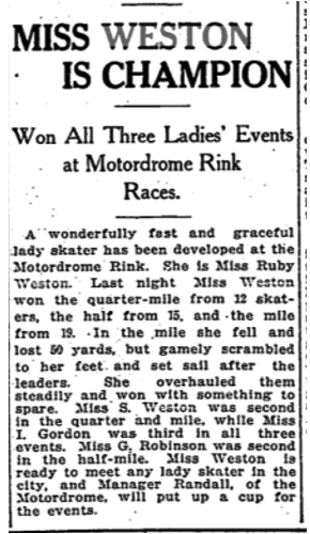
Won All Three Ladies’ Events at Motordrome Rink Races. A wonderfully fast and graceful lady skater has been developed at the Motordrome Rink. She is Miss Ruby Weston. last night Miss Weston won the quarter-mile from 12 skaters, the half from 15, and the mile from 19. In the mile she fell and lost 50 yards, but gamely scrambled to her feet and set sail after the leaders. She overhauled them steadily and won with something to spare. Miss. S. Weston was second in the quarter and mile, while Miss I. Gordon was third in all three events. Miss G. Robinson was second in the half-mile. Miss Weston is ready to meet any lady skater in the city, and Mange Randall, of the Motordrome, will put up a cup for the events.” Toronto Star, January 29, 1915
Over half Leslieville’s land surface was once brickfield. This industry, more than any other, shaped the land here. Once a property had been subjected to the digging, blasting, scraping & general mayhem of brickmaking it was heavily cratered, bare of all vegetation, with a hard clay surface. It was “as bald as a brickyard”, as the oldtimers used to say. The clay pits they left behind are still with us today, disguised as subdivisions, parks, schoolyards and even Gerrard Square! John Price’s shale pit on Greenwood Avenue is now the site of a housing complex and secondary school. Felstead Park is the site of the Logan brickyard. Greenwood Park is the site of the Russell and Morley brickyards. Another became Harper’s Dump, the main municipal waste disposal site for Toronto. It later became the TTC yards on Greenwood. Many others, large and small, remain. One was the site of the Motordrome, Canada’s first board motorcycle racetrack. Another was the site of the Ulster Stadium where the soccer greats of the 1920s and 30s played “the beautiful game” against local teams.
“Only known motordrome outside of United States” Rob Semmeling, Racing Circuits Factbook accessed Aug. 1, 2015 at http://www.wegcircuits.nl/RacingCircuitsFactbook.pdf
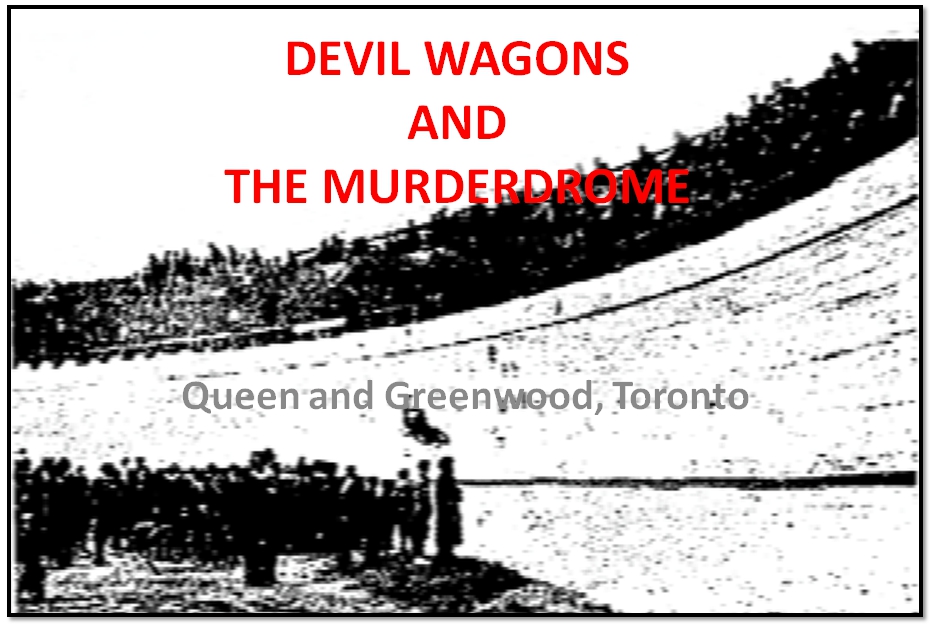
Board track racing was popular during the 1910s & 1920s. Motorcycles & bicycles raced on circular/oval race courses made of wooden planks. When motorcycle raced on them they were called motordromes. Board tracks were cheap to construct, but the planks broke & rotted quickly. Many of the tracks, like this Motordrome, survived for only a few years before shutting down.
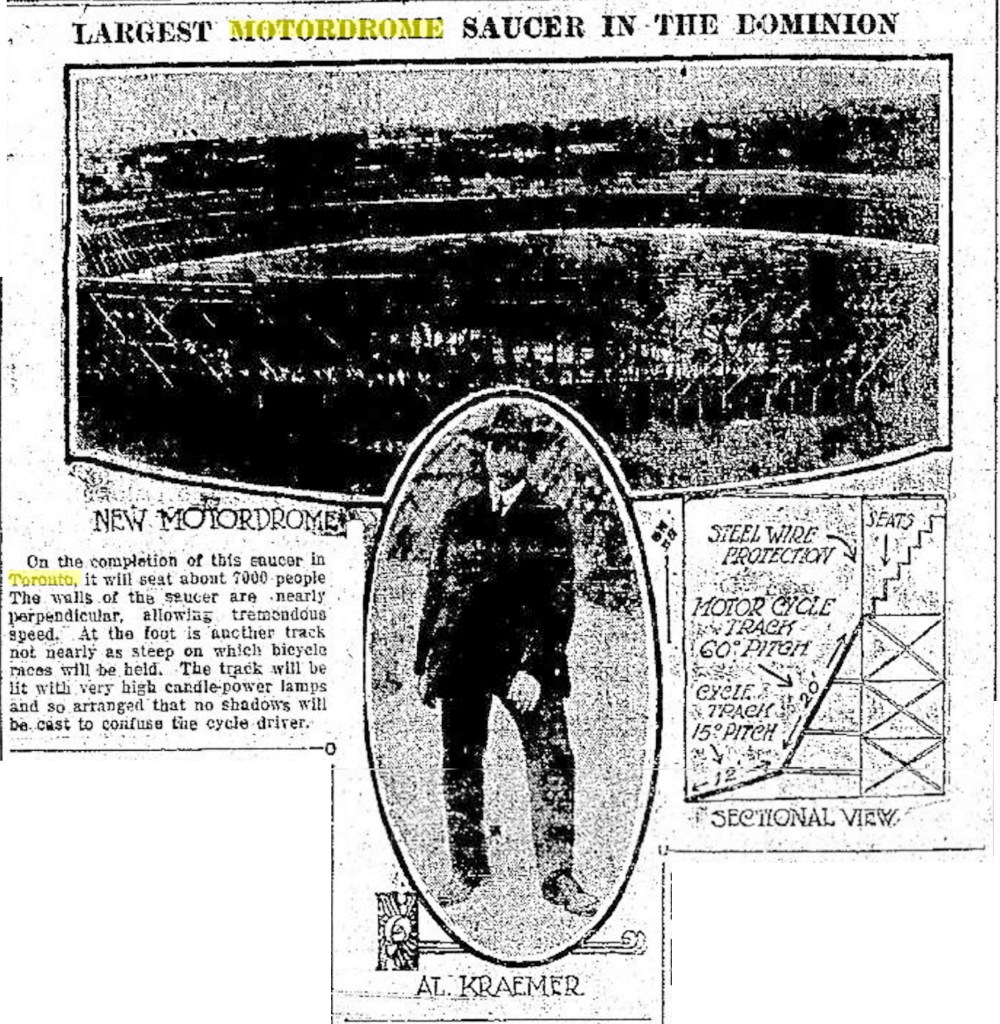
Here both bicycles & motorcycles raced. The bicycle track had a 15 degree pitch, 12’ wide. The motorcycle track was pitched at 60 degrees & was 20’ wide. It was often described as a “wall“, These early tracks were built without any engineers involved & were very dangerous, so that they were nicknamed “murderdromes”. At the top of the track only a wire fence separated the racers from the spectators who sat there on bleachers. High cornering speeds & high g-forces spun men & equipment off the track into the crowd, with lethal flying splinters & debris. Riders had little safety equipment only leather jackets & sometimes leather pants. A number of men were killed on board tracks like this.
On Victoria Day, 1914, the Motordrome’s quarter-mile track opened with seating for 7,000. 1,000 candlepower nitrogen lights were used to illuminate races that roared until the early hours. Floyd MacFarlane, a wheelerdealer and ladies’ man, was the promoter until a jealous husband stabbed a screwdriver into MacFarlane’s ear, killing him instantly.
Races were held two and three nights a week throughout the summer. Speeds of 80 mph averaged over long distances . One thirty minute race went nearly 160 laps.
The First World War put an end to most racing activity as the primary audience, young people stopped coming. The men left to fight overseas and the women had other priorities from new babies to jobs in munitions plants.
After World War Two ended the government offered low-interest mortgages to returning servicemen as well as other housing. From 1945 to1946 the Canada Mortgage and Housing Corporation built 1328-1338 Queen Street, Greenwood Court, as veterans’ housing. It was built on the site of one of the Price brickyards, part of the Motordrome site as well. (In the 1920s the Dunlop Field, a soccer field, south of Jones and Queen Street East, also became housing.)
For more about the Motordrome see:
https://leslievillehistory.com/devil-wagons-and-the-murderdrome-torontos-motordrome/
 Leslieville Historical Society