

AT LEAST FIVE OF TEN GAS VICTIMS DIED IN ATTEMPT TO RESCUE COMRADES
SURVIVORS KNOW LITTLE OF HOW THE BLOW FELL
Louis Peters Was at Work – Then He Awoke in Hospital.
JUST OVER THE FLU
Thomas Wilson Had Just Returned From Three Week’s Illness.
Gas which filled the valve house of the Consumers Gas plant at McGee street and Eastern avenue yesterday afternoon, taking ten lives, either seemed to kill within an hour those who inhaled it or leave them little affected beyond sore chests, splitting headaches and painful eyes.
Most of the men who were brought into the fresh air, as soon as they keeled over, were able to go home last evening, but four are in the hospital, suffering considerable pain from their experience.

Peter’s Miraculous Escape.
Of the three survivors who were rescued in an unconscious state from the valve room, Louis Peters, 66 Carlaw avenue, sustained the least injury, and will be able to leave the General hospital in a few days.
Peter had a miraculous escape from certain death. He was employed by the gas company as a machinist’s helper, and when the rush of gas struck the valve room, Peters does not recall what he was doing. He does not even know what happened to him, but merely remembers regaining consciousness in bed in the hospital.
Last evening but for a pair of badly swollen eyes, a pair of sore lungs, a terrific headache, and a slightly dazed condition, he was none the worse for his experience. He was more concerned about getting out of bed and away home, than remaining quiet and recuperating from the effects of the gas. He was able to talk in a cherry manner and inquired hopefully of a fellow workman who was visiting him as to how the others who were in the valve room fared. He did not know how many men had been killed, nor how many had sustained severe gas[s]ing, neither did he know how many men were in the valve room when the gas filled the room.

Is Former Boxer.
Peters is a former boxer, who did considerable boxing in the city some years back. He believes boxing gave him sufficient physical power to withstand the terrible attack of gas, and by outward appearance, Peters owes his life to his former sport. Though he is not tall, he is powerfully built.
“This is all that’s wrong with me,” he said as he tapped his chest. “A little sore here, but I’ll be out tomorrow. If they would give me my trousers now, I’d get out go-night.”
“Do you know what happened?” The Star asked. “I can’t tell you anything for I don’t know. It was just like being back again at the old boxing game, getting a punch on the jaw, and getting knocked out. I don’t know who was in the valve room, how many, nor do I remember what I was doing at the time. All I know is that I’m here.”
Did you hear any noise before you were knocked out?” “Never heard anything as far as I know.”
Peters was more anxious to ask questions of his fellow workman who was in another part of the building when gas broke on the room.
Questioned as to whether he thought a pipe had burst, Peters declared he could not say as he remembers nothing. He does not know whether there was an explosion.

Clear of Effects of Gas.
Peters was pulled out of the valve house by the rescue squad, and rushed to the General hospital in an ambulance. When he arrived there, he was unconscious and remained in that state for about a half hour, when resuscitation proved successful. Doctors in charge of Peters say he is practically clear of effects from the gas, but that will require treatment for a day or two in order to offset any possibility of bronchitis setting in.
A peculiar feature of the Peters case is that Mrs. Peters, who lives about half a mile away from the scene of the catastrophe, ran all the way from her home to the plant when she heard of the accident. She did not then learn that her husband had been rendered unconscious.

Wife Describes Scene.
Mrs. Peters related that a section of the works appeared to be a mass of flames. This was merely the enlarged flames from the ovens. “Men were staggering around the yard as though intoxicated,” said Mrs. Peters. “They were reeling all over the place. The flames were bursting out the doors, and the firemen did wonderful work in rescuing the victims. I saw a fireman come out from one of the doors, pulling a man behind him and the fireman collapsed just as he got outside. It was a fearful sight,” declared Mrs. Peters. Mr. Peters has been employed by the gas company for about five years. He was well known as a 143 pound boxer some years ago, and has been quite a pigeon fancier and has won several prizes for pigeon racing. He was rejected for the army on account of a broken ankle.

Risked Life For Comrades.
Thomas Wilson, 60 years of age, who is one of the heroes of yesterday’s disaster, and who is now lying in St. Michael’s hospital poisoned by the deadly fumes which overcame him as he risked his life to save his comrades, lives at 310 Logan avenue. The Star at his home last night found Mrs. Wilson a sweet faced old lady anxiously awaiting news of his condition.
“I saw him at the hospital,” she said, “his face was all blackened by the gas, but he knew me. The first words he spoke were about the others. “Are they saved mother?” he asked me, and I did not dare to tell him the truth. I just nodded, and then he smiled and seemed quite happy about it, he was not worrying about himself at all.”
Just Over the Flu.
Mrs. Wilson told The Star that she had only yesterday got her man back to work. “For three weeks we have had him down with the flue,” she exclaimed, “but today he ate a good dinner, and away he went back to work again. If I had only thought this would happen I would never have let him go from the house.”
“My husband comes of Scottish parents, but he was born in Belfast, Ireland,” said Mrs. Wilson. “I am afraid, as he has bronchial trouble, I can only pray that he will live.”
So dazed was Mrs. Wilson at the magnitude of the misfortune that had overwhelmed her, that she was quite unacquainted with the names of those who had already passed. She was overcome with grief when a neighbor told her that both J. Martin and Archie Murdock were amongst those who had passed away.
“Martin was my husband’s mate,” she said, “and Mr. Murdock was a friend of ours as well, this is indeed terrible.”

A Horrible Scene.
To The Star Mr. Wilson said the story of the catastrophe as he experienced it.
“It was about two o’clock,” he said, “as near as I can remember. We were working in the machine shop when Mr. Ellis, assistant manager, rushed in and called us. The four of us all ran down to the valve house. All I could see was a horrible sight of men lying around everywhere as if they were dead. It was horrifying. The valve house was full of escaping gas fumes. I held my mouth with my and helped to pull two of the men out but I guess it got me then. I can’t remember any more.”
Wilson, who is a machinist’s helper, has been in the employ of the gas company for over seven years. As the recollection of the scenes came back to him he paused for an interval. Eventually he managed to add
Of the other men who were in the machine shop at the time of the accident Wilson could only recollect two, Archie Murdock and John Bruce.
“How did the accident happen?” Wilson was asked.
“I don’t know but I do know that it happened in the valve house where the pressure for the entire city was regulated.”
Formed Human Chain.
Walter Taylor, 5 McGee street, a close friend of Hugh Thompson, came to visit him at St. Michael’s Hospital.
“The first we knew of the accident,” he said, “was when John Clarke, foreman of the purifying plant, ran into our room and called to us and said, “Run over and do what you can in the valve room. There’s been an accident.” Fourteen of us left in a body. We got some of them out of the pit, and we worked on them in the open in an attempt to bring them back to life.”
How did you get them out?” was the question.
“Well,” replied Taylor, “we formed a chain, one man passing a body to the other and so on till the body was removed to the open. We could not stay there more than a minute ourselves. But as soon as one man dropped out he was relieved by another.”
George Alvy’s Heroism.
Interviewed last night by The Star teamster, George Alvy, of Harrison Avenue, Mimico Heights, stated that he was one of the first men to go down into the pit in the rescue party. Mr. Alvy, who is Scotch, and has been farming until recently, when he began working for the Consumers’ Gas Company, said with the characteristic simplicity of the British workman, “My foreman told me to go down, and I went.” Then the intensity of the tragic experience through which he had passed coming upon him in full force, he lapsed into his native Scotch accent. “I wisna doon there two minutes, when I felt masel going”. Alvy managed by a mighty effort to pull himself by means of a rope and tackle to the top of the pit outside the window. Just as he felt himself going under his and was grasped by someone and he was pulled to safety. The strength of the fumes may be realized to some extent when it is taken into consideration that even after this brief experience Alvy was unable to walk properly at four o’clock. Notwithstanding the fact that he was still suffering from a nauseated stomach and a throbbing head, Alvy stated that he had been obliged to walk nearly two miles from the end of the King street car line to his home at Mimico Heights.
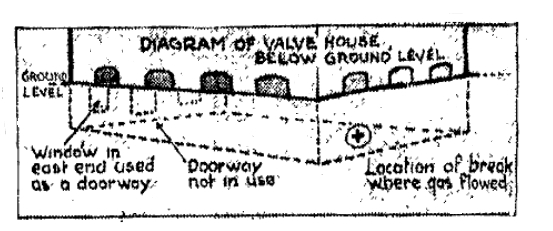
One point of interest which was elicited from Alvy’s version of the accident was that the victims had all apparently attempted to escape from the window, although after getting through the window it would have been necessary for them to raise themselves one at a time out of the pit in front of the window. The reason for this choice of exit is easily understood by those who saw the scene of the accident. In order to leave by the door of the building, which is right beside the window, it would have been necessary for the men to go up a plank incline, along a gas main, up a precarious step where they must proceed single file, along a short platform, down a flight of steps, up another flight of iron steps and so out the door. When the men evidently chose the much shorter and more direct route up the plank incline, across the mains, down another incline and out the window, they failed to reach the exit in time. According to Alvy’s statement “the men were all lying right at the bottom of the window.”
First on the Scene.
Aerial No. 1 from Lombard street fire hall was first on the scene. “We received the alarm at 1.39 p.m.,” Lieut. George Ellis, who was in charge told the Star. “part of the men were already out on another alarm but I took six men and went over with the aerial.
“We were the first firemen to arrive. A number of bodies had already been carried out and men from the Gas Company were working on them trying artificial respiration. Four of our men took charge of this for the time being.
“We were told that one man was still in the building. Fireman Bowering and entered from the east. We were not wearing gas masks. Grealis entered through a window in the west end and dragged a body up till we were able to reach it. The three of us then carried it out. The man was dead. Who he was I cannot say.”
Lieut. Ellis had just returned to work after a serious attack of flu and yesterday was the first day that he had been on duty. Though still far from strong and suffering as a result of his illness, he did not spare himself in the least.
Fireman William Grealis sketched his part in the rescue work briefly and graphically.
“As soon as we arrived, I grabbed my mask and went to the west end of the building,” he said. “I climbed in through a window there and dropped twenty feet into the basement. I had first put on my mask.”
“A body was lying on the gangway about six feet from the valve where the cap had been taken off. The man had evidently been trying to climb out the gangway but had collapsed after a feeble attempt. Lieutenant Ellis and Fireman Bowering had entered by the east end in the meantime. I dragged the body up the gangway till they were able to reach it. Between the three of us we carried it out. The men from the Gas Company had rescued everyone else.”
Fireman Bowering’s story of the rescue coincided with the one told by the other two men. “After we got the body out, we searched to see if any men were still in the place but all had been taken out,” he said. “Then we went out to help in the attempts at resuscitation till those injured had been taken to the hospital.”
This is Fireman Bowering’s second rescue within a week. He is the man who rescued Miss Cummings from a burning house on Shuter street a few days ago. Toronto Star, February 9, 1923
Gave His Life for Others In Rescuing Gas Victims
Frank Rose, Among First to Enter Fatal Valve House, Among Fatalities – Several Great War Veterans Perish.
The silver lining, if such it may be called, to yesterday’s catastrophe when ten workmen lost their lives by being trapped in the valve house of the gas plant at the corner of McGee street and Eastern avenue, following the breaking of a valve in the valve house, is the story of the heroic rescue work carried out by one of the victims, Frank Rose, who was doing repair work outside the valve house.
Members of sorrowing families found consolation through their gratefulness towards one whom it is now beyond their power to repay except through the tribute they may offer to his cherished memory.
“He gave his life for others,” said William Searle, friend and neighbor of the late Francis Rose, of 46 Munro street.
“We did all that was humanly possible,” added Mr. Searle, “but my old friend was gone.”
Mr. Rose was not one of those making the fatal repairs at the valve house. He was one of the rescuers; and laid down his life for his friends.
Mr. Searle, foreman painter at the gas works, was visibly affected as he told of the futile efforts to revive Mr. Rose. They had been personal friends; they were employed by the same company; and each had two sons in the great war. One of Mr. Searle’s sons had not come back, dying at Vimy.
“We did all we could for your poor father, my lad,” said Mr. Searle to Clarence Francis Rose, who had enlisted at sixteen and had won the military medal. “W did our best.”
“I know that you did,” replied the boy. “Well, one thing remains for me to do; and that is to ‘carry on.’”
Across the street, at 46 Munro, the house of mourning, Mrs. Searle was the comforter, assisting Mrs. Rose’s daughter, Mabel, and the daughter-in-law, Mrs. Jesse Rose. The elder soldier-son, Jesse, was also there. The latter had seen an account of the fatality in the afternoon papers, and hastened to his parents’ home. The mother was told the sad tidings ultimately; and, whether she had had a premonition, there had come upon her a foreboding of trouble.
“I almost felt that something had happened,” she said after learning the truth.

Re-united After War.
Francis Rose was born at Belhaven, Ontario, and was 56 years old when tragic death claimed him. He came to Toronto twenty-three years ago, and for nineteen years worked for the Dominion Brewery Company.. At his death he had been with the Gas Company for only a year. He was a member of the Queen street east Methodist Church, the Canadian Foresters and the Orange order. he had held the high offices fraternally. Mr. and Mrs. Rose had celebrated the twenty-fifth anniversary of their wedding. The world conflict had ended; and there was a family reunion.
Mr. Rose leaves his wife, his son, Jesse, his son, Clarence Francis, and his daughter, Mabel, aged eighteen. Jesse is married, Clarence and Mabel are at home, the latter a student at a business college.
The two boys went to war together, and came home together, after an absence of about four years. They were in the field artillery and formed part of the army of occupation in Germany. If the father gave his life for others; the sons had imperilled theirs for their country.
“Father was brave,” said a son last night. “His death showed that. And he would have been with us in Europe if he could have gone.”
It was Clarence Rose’s melancholy duty to identify his father at the morgue. The boy met an intimate friend of his father’s there; but while the friend had not recognized his lodge-brother, the son knew the loved face at once.
Wife Collapses.
At the news of her husband’s death, Mrs. John Bruce, 35 Winston avenue, collapsed completely, and was placed under a doctor’s care.
He had gone through the war without a scratch only to fall a victim to the dangers of peace. The children wandered about the house unable to realize what had happened, knowing only that their father had been injured and hoping that he would be home again in a short time. Neighbors flocked in to offer sympathy. One of the children was worrying over her homework, fearful of what the teacher might say if she arrived at the school in the morning with her tasks undone.
Bruce came here from Scotland several years before the war. he served overseas with the 2nd Railway Battalion, going back to his pre-war job at the gas works on his return. He was a Free Mason and a member of Emmanuel Presbyterian church. Surviving him are his wife and three children, Alma, 11; Florence, 9, and John the baby.
Unconscious of Tragedy.
Unconscious of the tragedy that had befallen them, the four little sons of Alex. Murdock, 188 South Bonnington avenue, were playing together in a neighbor’s house in the care of a motherly bit of a girl not yet in her teens. They prattled away about their father.
“He’s late to-night,” said Archie, the oldest. “Generally he hurries home to work on the house.”
“He was hurt down town at the works,” the child who was looking after them whispered. She was trying so desperately to hide all knowledge of it from the little ones in her charge.
The children told how their father was spending all his spare moments doing odd bits of carpentering to finish the home which he was building himself.
“We’ll have it all done next summer,” said one little tot confidently. “I can help now. I hold the tools for daddy.”
There were four of them altogether, Archie, age 8; Robert, age 6; Alex., age 4, and baby John, age 2. A quartet of chubby little Scotch-Canadians, waiting for their father to come home so that they could lend him a hand in the job of building a house.
“Murdoch was one of the finest men in the district,” said a neighbor. “He came here nearly eight years ago, and he took an active interest in nearly everything that went on. Everyone in Birch Cliff knew him and liked him.”
Murdoch was a member of Camp Sinclair, Sons of Scotland, and attended Union Church, Birch Cliff. He was 45 years of age and had been working for the Gas Company since before the war.
Dependent on World.
Through the death of Geo. Stephens, 84 Guestholm avenue, his family, an invalid wife and three dependent children are thrown on the world to provide for themselves.
Mrs. Stephens is suffering from a stroke which afflicted her two years ago. He was born in Scotland 44 years ago, and had been in Canada 12 years, securing employment with the gas works upon his arrival in Toronto. When the tragedy occurred, he was one of the men working in the yard and ran to the assistance of his fellows. His record with the company was a splendid one. The late Mr. Stephens spent three years overseas where he was gassed. Ten years ago he bought a house, but there is still a mortgage on it of $1,000. He was connected with the Knights of the Maccabees.
Sad indeed is the case of John Martin, 93 ½ Cornell avenue, Birch Cliff, who is among the dead. His wife is lying seriously ill with pneumonia in the little house which she had labored with him so faithfully to build. The late Mr. Martin had been in this country but a short time, coming to Toronto from Glasgow, Scotland, three years ago. He went to work for the Gas Company immediately after his arrival and has been employed there ever since. He was 48 years of age, a member of the Free Masons and of Birch Cliff Congregational Church.
Two From One Family.
John Cotterell, 5 Heyworth crescent, was a foreman at the gas works for the last 17 years, and was in charge of the gang which was at work in the valve house. He never before had met with an accident. He entered the employ of the Gas Company as soon as he arrived from Birmingham, England, where he was born 53 years ago. He had a record of four years’ service overseas, where he was gassed. He was a Mason, Orangeman, and belonged to the Sons of England. His widow survives.
There is no more pitiful episode in the story of yesterday’s tragedy than that of the Leadbeater brothers, Reuben and Arthur. Both were young men, Reuben, the eldest, being 28 years old, and Arthur only 20. They had been in this country only a short while. Their aged parents live in the Channel Islands, unaware of their terrible loss.
Mrs. Albert L. Towner, a sister, with whom the boys were living at 148 Curzon street, is their only relative in this country.
“The first I knew of any accident was when a Star reporter, seeking information about R. Leadbeater, said that he had been gassed,” she stated in a later interview. Shortly after he came back to inquire after Arthur Leadbeater.
“Can it possibly be true,” she exclaimed, that both have suffered in one accident?”
But no light as to the appalling truth dawned upon her, until a neighbor came with the newspaper report.
It seemed almost inconceivable, past realization, that both should have been carried off together.
Nor did Mr. Towner hear any word of the catastrophe until reading his paper.
Was Gassed Before.
To be gassed fatally only two weeks after returning to work after a previous accident, made the death of Arthur Leadbeater even more lamentable. He was the victim of an accident due to a defective valve two months ago from which he had just recovered and returned to work.
Every possible note of tragedy seems to have entered the death of these two brothers. While both were unmarried, Reuben was engage, and was to have been married in the very near future.
Both men were on active service. Reuben was a company sergeant-major in the Royal Engineers, seeing service in India. Arthur, only a lad yet, joined the mercantile marine in the days of the war and toward the last engaged in the dangerous occupation of mine sweeping.
The tragic news came in almost an identical manner to Mrs. Fed Carey, 1 Mallon avenue, of her husband’s death.
“They have told me he was gassed, but hopes were held out that it was not serious,” she said when The Star called.
Later Mrs. Carey said: “They tell me he is dead, but I can’t believe it.”
Edward Carey said he had feared such an accident and had often urged his brother to seek some different work.
Brothers Missed Accident.
Almost 38 years of age, a married man, but with no children, Fred Carey has been working at the gas works
for the past ten years.
Henry Carey, living at 227 Cedarvale avenue, and Ernest Carey of 1 Mallon avenue, both brothers of Fred Carey, were both at the hospital yesterday afternoon. They came to identify their brother, who had already been removed to the morgue.
Both of them are employed at the same plant, but neither of them had been at work yesterday. Henry because he was ill, and had not worked all week, and Ernest because he was on the night shift and was asleep at the time of the accident.
Harry Lonsdale, another of the dead, 309 Greenwood avenue, came to Canada in 1910. Two brothers, Abraham and Alfred Cheesman of 151 and 76 Greenwood ave. respectively, friends of Lonsdale, were with him shortly before the accident. According to Mr. A Cheesman, he had been working at the gas works for only three months, previous to which he was unemployed for some time. Toronto Star, Feb. 9, 1923
AT THE SCENE OF THE TRAGEDY.
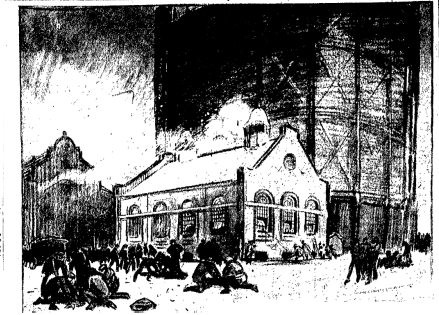
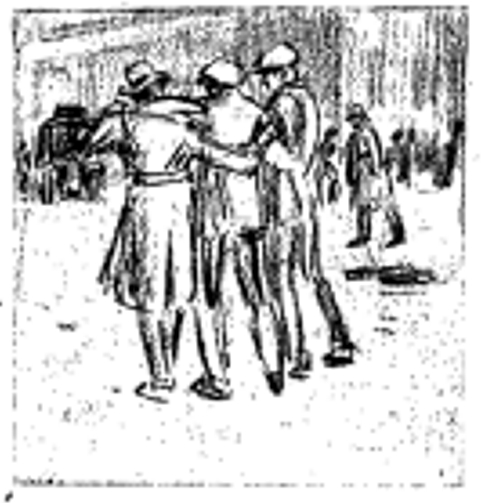
Sketches made by a Star Artist at the plant of the Consumer’s Gas Company yesterday afternoon, where ten men lost their lives in an accident in the valve house. The UPPER drawing shows the outside of the building after the first bodies had been carried out. Parties of rescuers are working on the victims in an attempt to bring them around by artificial respiration. The small diagram is a plan of the valve house itself below the ground level. The two LOWER drawings shoe RIGHT, two of the workers helping a comrade overcome by fumes. LEFT, fireman bringing out the last man trapped in the basement. Toronto Star, Feb. 9, 1923
 Leslieville Historical Society